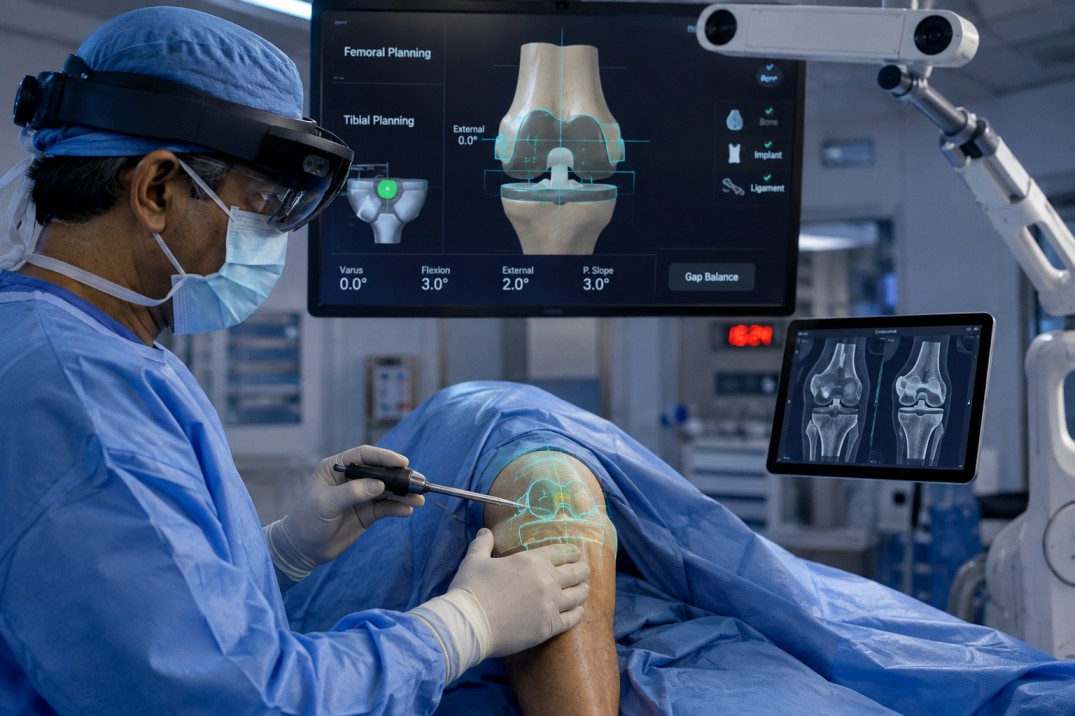
Knee replacement surgery has evolved significantly with advances in medical technology. Traditional surgical techniques remain effective for many patients, but modern innovations are giving orthopaedic specialists new tools to improve surgical planning, precision, and personalized treatment. One such innovation is augmented reality (AR), which is increasingly being explored as a technology-assisted approach in modern joint replacement procedures.
For people living with severe arthritis, chronic knee pain, stiffness, or reduced mobility, understanding these developments can help when discussing treatment options. Augmented reality knee replacement uses digital information and visual guidance to support surgeons during important stages of surgery while keeping clinical expertise and decision-making at the center of the procedure.
What Is Augmented Reality in Knee Replacement?
Augmented reality is a technology that combines digital information with the surgeon’s view of the real surgical environment. In knee replacement procedures, AR systems may provide information related to the patient’s anatomy, alignment, bone preparation, and implant positioning.
Unlike a fully automated surgical system, AR does not independently perform the operation. Instead, it is designed to assist the surgeon by displaying relevant information that may help during critical steps.
The surgeon remains responsible for evaluating the patient’s condition, making clinical decisions, and performing the procedure. The technology acts as an additional tool that may support precision and personalized surgical planning.
Why Is Technology Important in Modern Knee Surgery?
Every patient’s knee is different. Differences in bone anatomy, natural alignment, arthritis severity, ligament condition, and soft-tissue balance can influence the surgical approach.
A standardized procedure may not always provide the same level of personalization for every patient. Technology-assisted systems can provide additional information that helps surgeons understand individual anatomy and make informed decisions during surgery.
The main objective is to achieve appropriate implant positioning, alignment, and knee stability while supporting a functional range of motion.
How Does AR-Assisted Knee Replacement Work?
The process generally starts with a detailed preoperative assessment. The surgeon reviews the patient’s symptoms, medical history, physical examination, and diagnostic imaging.
Based on this information, an individualized surgical plan can be developed.
During the procedure, the AR system may provide digital information within the surgeon’s field of view. Depending on the technology being used, this information may help with:
- Understanding the patient’s anatomy
- Assessing knee alignment
- Guiding bone preparation
- Supporting implant positioning
- Evaluating soft-tissue balance
- Assessing joint movement
The surgeon uses this information along with clinical judgment and surgical experience.
Improving Surgical Planning
Preoperative planning is an important part of knee replacement surgery. Every patient may have different levels of bone loss, deformity, and joint damage.
Digital tools can help the surgical team assess the patient’s anatomy and develop a customized surgical strategy. This planning process may allow potential challenges to be identified before the operation.
Better preparation can help the surgical team understand the steps required during the procedure and establish goals for alignment and implant placement.
Supporting Surgical Precision
Accurate bone preparation and implant positioning are important aspects of knee replacement surgery. The position of an implant can influence knee movement, stability, and overall function.
AR technology may provide real-time information that helps surgeons assess the position of surgical instruments, bone cuts, and implants.
This additional guidance may support more precise execution of the surgical plan. However, surgical accuracy depends on several factors, including the surgeon’s experience, patient anatomy, implant design, and the specific technology being used.
Personalized Knee Replacement Treatment
Personalization is becoming increasingly important in modern orthopaedic care.
Patients have different lifestyles, activity levels, anatomical characteristics, and expectations. AR-assisted technology may help surgeons tailor certain aspects of knee replacement to the individual’s needs.
For example, information about natural alignment, joint movement, and ligament balance may be considered when developing the treatment strategy.
The aim is to create a stable and functional knee that supports everyday activities and appropriate physical movement.
Potential Benefits of AR-Assisted Knee Replacement
AR technology may offer several potential benefits for appropriately selected patients.
1. Enhanced Visualization
Digital information displayed during surgery may help the surgeon better understand the patient’s anatomy and alignment.
2. Real-Time Guidance
AR systems may provide information during important surgical steps, allowing the surgeon to assess and adjust the procedure when necessary.
3. Personalized Planning
Technology-assisted planning can help account for individual anatomical differences and surgical requirements.
4. Support for Implant Positioning
Additional guidance may help surgeons assess implant placement and alignment during the procedure.
5. Assistance With Joint Balancing
The balance between implants, ligaments, and surrounding soft tissues is important for knee stability. AR technology may provide information that supports the assessment of joint balance.
While these potential benefits are promising, patients should understand that technology does not guarantee a particular surgical outcome. Recovery and long-term results depend on multiple factors.
Who May Be a Candidate?
AR-assisted knee replacement may be considered for patients who require knee replacement because of advanced arthritis or significant joint damage.
However, not everyone needs technology-assisted surgery. Patient selection depends on factors such as:
- Severity of arthritis
- Knee deformity
- Bone quality
- Overall health
- Previous surgeries
- Activity requirements
- Individual treatment goals
A consultation with a qualified specialist can help determine the most suitable approach.
Patients looking for a top orthopaedician in Panchkula should consider the surgeon’s experience, treatment philosophy, available technology, and ability to provide personalized care.
Recovery After AR-Assisted Knee Replacement
Recovery after AR-assisted knee replacement generally involves many of the same principles as conventional knee replacement surgery.
Patients may need pain management, wound care, swelling control, and gradual movement after surgery.
Physiotherapy is an important part of rehabilitation. Exercises may focus on:
- Improving knee flexibility
- Strengthening leg muscles
- Restoring balance
- Improving walking ability
- Reducing stiffness
- Gradually increasing physical activity
The recovery timeline varies between individuals. Age, general health, muscle strength, body weight, preoperative mobility, and commitment to rehabilitation can all affect recovery.
Patients should follow their surgeon’s and physiotherapist’s recommendations and avoid progressing too quickly.
The Future of Augmented Reality in Knee Replacement
As medical technology continues to advance, AR may become an increasingly valuable tool in orthopaedic surgery. Future systems could offer more detailed anatomical visualization, improved surgical planning, and increasingly personalized guidance.
The combination of advanced technology and experienced surgical care may help further refine knee replacement procedures.
However, technology should complement—not replace—the surgeon’s expertise. Accurate diagnosis, careful planning, appropriate patient selection, skilled surgery, and dedicated rehabilitation remain essential components of successful knee replacement care.
Conclusion
Augmented reality represents an exciting development in modern knee replacement surgery. By combining digital information with the real surgical environment, AR-assisted systems may support surgical planning, visualization, implant positioning, alignment assessment, and personalized treatment.
For patients considering knee replacement, the most important step is to receive a thorough evaluation and discuss all available treatment options with a qualified orthopaedic specialist. Understanding the potential advantages and limitations of AR technology can help patients make informed decisions about their surgical care and recovery journey.