Nobody tells you this early enough: most failures in a Hydraulic Radial Piston Pump setup don’t start with the pump itself. They begin with awful demands, make promises on delivery that they know they can’t keep, and rely on suppliers who make the cheapest bid, then cut corners by weakening material quality.
Due to the rise in the demand for Piston Pump systems, Indian factories looking to improve efficiency by creating higher pressures with reduced operational downtimes will benefit most from the growth seen in the steel, marine, mining, and heavy automation industries in the period up to 2025.
In a forging plant running three shifts, one hour of hydraulic stoppage can cost anywhere between ₹1.8 lakh and ₹4 lakh depending on production schedules. That changes how procurement teams evaluate suppliers.
And yet, many buyers still compare quotations only on unit pricing.
That mistake gets expensive fast.
Why Reliable Hydromotor Suppliers in India Matter More in 2026
Pressure Stability Is Replacing Peak Pressure Marketing
For years, industrial buyers focused only on maximum pressure ratings. That approach is fading.
Modern Hydraulic Radial Piston Pump Manufacturers in India are now redesigning piston geometry to improve pressure stability during continuous-duty operations rather than chasing inflated peak numbers for catalogs. Plants running 24/7 production lines increasingly reject systems showing pressure fluctuation above 2.5% under sustained load. Five years ago, nearly 5% was still considered acceptable in many factories.
Which means vibration reduction has become a procurement priority, not just an engineering discussion.
A supplier who keeps talking only about “maximum pressure capacity” without discussing load consistency usually hasn’t worked closely with real production environments.
Compact Hydraulic Assemblies Are Becoming Standard
Industrial floor space is no longer cheap. Particularly around Pune, Faridabad, Rajkot, and Chennai where retrofit projects often happen inside crowded production layouts.
New-generation Piston Pump Manufacturers now produce compact radial piston systems delivering operating pressures above 700 bar while reducing installation footprint by nearly 18% compared to older assemblies. That matters during modernization work where every inch of clearance becomes a problem.
Retrofitting hydraulic systems is harder than most buyers expect because old piping layouts rarely match new mounting geometries perfectly.
Smart Monitoring Is Moving Into Mid-Sized Factories
Condition monitoring used to belong mostly to large OEM operations.
Not anymore.
Now even factories that are not that big expect hydromotor manufacturers to help predictive maintenance systems to monitor temperature spikes, oil contamination, and abnormal trends in vibrations.
Procurement teams increasingly want early-warning systems before maintenance shutdowns become emergency shutdowns.
A supplier who cannot explain predictive monitoring compatibility in 2026 is already behind the market.
Seal Material Selection Gets Ignored Too Often
This still causes avoidable failures across Indian industrial plants.
Many imported hydraulic systems struggle under Indian operating conditions not because the piston design is poor, but because seal compounds degrade faster under higher ambient temperatures and inconsistent oil cleanliness. We’ve seen imported systems lose efficiency within 14 months simply because the seal material wasn’t suited for local operating conditions.
That’s not only a manufacturing issue.
That’s a buyer evaluation failure too.
The Specification Detail Most Buyers Skip
Flow Rate Consistency Under Heat Load
Most datasheets present ideal-condition flow rates. Real factories don’t operate in laboratory conditions.
During peak summer months, hydraulic oil temperatures inside Indian plants regularly cross 58°C. Lower-grade pumps often develop internal leakage at those temperatures, reducing actual output efficiency and creating unstable system performance.
Reliable Hydraulic Radial Piston Pump Suppliers provide temperature-based performance curves rather than polished brochure numbers alone.
If a supplier avoids that discussion entirely, assume the data won’t survive real operating conditions.
Surface Finish Inside the Piston Bore
Very few procurement teams ask about internal bore finish quality.
And yet, bore finish directly affects oil film stability, wear resistance, friction losses, and long-term efficiency. Higher machining precision improves performance but increases manufacturing cost. That’s why suspiciously cheap quotations should immediately raise concerns.
Nobody manufactures precision hydraulic assemblies at rock-bottom pricing without compromising somewhere.
Integrated Hydromotor Compatibility
Modern hydraulic systems increasingly combine pumps and motors into integrated assemblies. Experienced Hydromotor Suppliers in India now focus heavily on compatibility between pump pressure behavior and motor torque delivery characteristics.
Poor matching creates excess heat generation.
Heat destroys seals. Then downtime follows.
Usually during peak production demand.
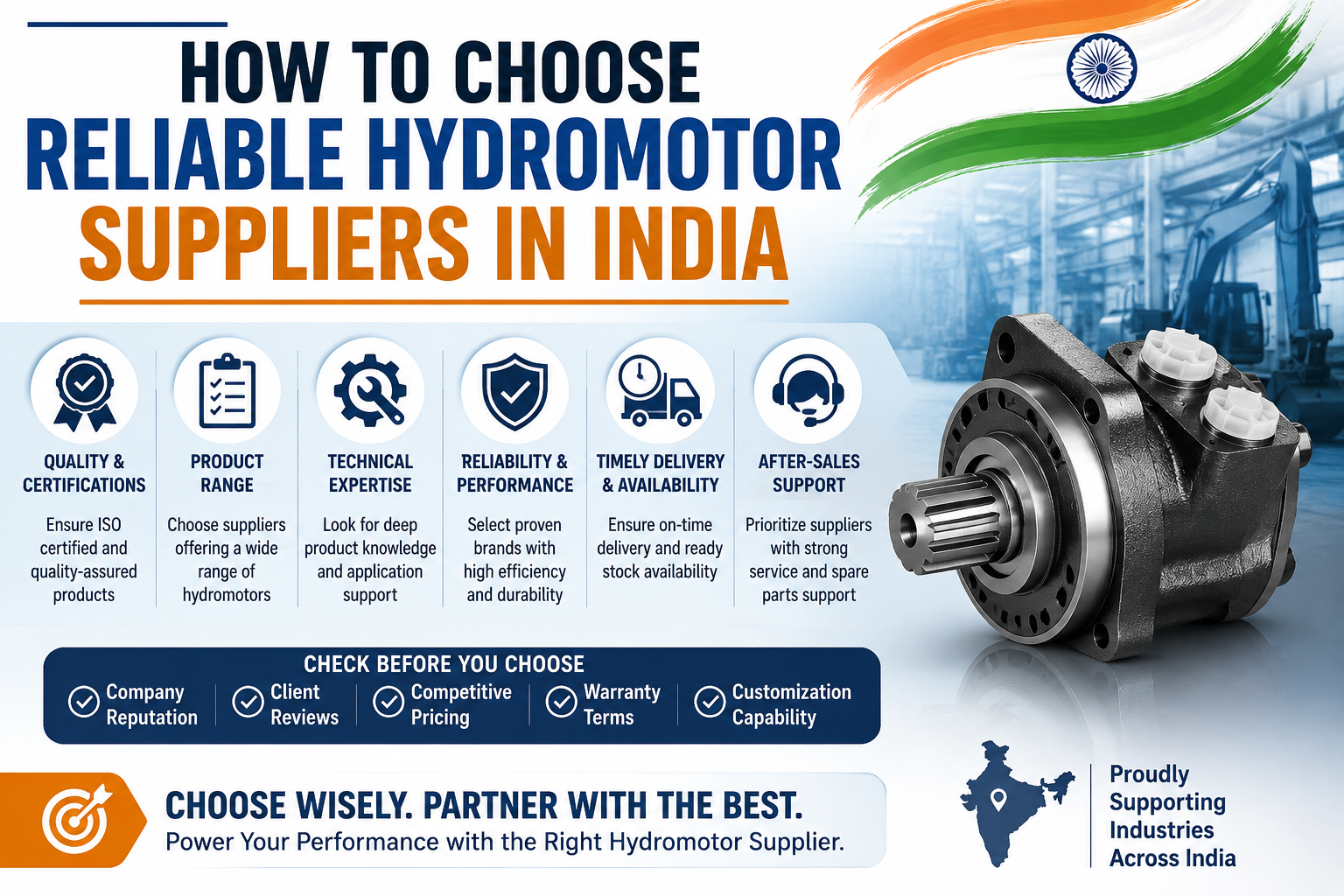
Five Supplier Evaluation Criteria That Actually Matter
1. Ask for Batch-Wise Pressure Testing Records
A serious supplier documents testing consistently.
A bad answer sounds like:
“We do random testing before dispatch.”
That usually means inconsistent quality control.
2. Verify Delivery Stability, Not Just Capacity Claims
Some Piston Pump Manufacturers in India quote unrealistic lead times simply to secure purchase orders before delaying shipments after advance payments clear.
Most procurement teams learn this lesson once.
And usually during a shutdown situation they cannot afford.
3. Check Export Handling Experience
Export packaging for hydraulic systems is more difficult than buyers expect. Moisture protection failures during sea shipment still damage expensive hydraulic assemblies every year.
Suppliers exporting to 31 countries generally understand corrosion prevention and long-distance packaging standards far better than businesses shipping domestically alone.
4. Evaluate Technical Response Quality
Ask direct technical questions about contamination tolerance or viscosity range behavior.
If the reply sounds copied from a catalog, you’re probably dealing with a trading intermediary rather than an actual manufacturer.
5. Inspect Spare Parts Availability Before Ordering
A hydraulic system without spare support becomes a liability quickly.
And yet, buyers still ignore spare kit availability because the initial quotation looks attractive during negotiation.
How Modern Piston Pump Systems Protect Industrial Margins
Reduced Downtime Losses
Stable pressure delivery reduces production interruptions. The profitability of an entire quarter can be influenced by even a 3% increase of uptime in sectors using continuous manufacturing.
Reduced Heat Production
When manufacturing with Hydraulic Radial Piston Pumps, less excess heat is produced as a byproduct resulting in oil degradation and extending seal life.
Better Energy Efficiency
Variable displacement systems now help factories reduce hydraulic power consumption by nearly 12–18% during fluctuating load cycles.
Electricity costs matter far more now than they did five years ago.
Longer Component Life
Higher machining precision lowers internal wear rates across hydraulic assemblies, reducing replacement frequency for connected components.
Easier Retrofit Compatibility
Compact modern systems integrate more easily into existing production lines without requiring major redesign work or prolonged shutdown periods.
Stronger Spare Supply Predictability
Skilled Hydromotor Vendors have better informational supply management for shafts, seals, bearings, and repair kits. In emergency breakdown situations, their procurement team can feel the positive difference.
The Reason as to Why India is One of the Largest Hydraulic System Sources
India’s CNC machining advancements and export-oriented industrial units transformed the Hydraulic manufacturing industry across Haryana, Gujarat, Maharashtra, and Tamil Nadu.
Today, the trustworthy suppliers of piston pumps in India have a competitive advantage in the global market for precision machining, pressure consistency, and customization of engineering specifications.
Buyers sourcing from North India also benefit from faster freight movement through NCR logistics corridors compared to inland manufacturing clusters with weaker transport connectivity.
That logistics advantage matters more than many overseas buyers initially realize.
About Us — What Real Hydraulic Supply Work Actually Teaches You
At N.T Associates, we’ve spent years working with industrial buyers who care less about polished presentations and more about whether the hydraulic system survives continuous production pressure.
We’ve seen projects fail because suppliers quietly substituted seal materials without informing buyers. We’ve also watched procurement teams underestimate contamination control requirements and then blame the pump after premature wear. That’s why we discuss operating conditions before recommending specifications.
Back in 2021, we stopped sourcing one imported seal variant after repeated complaints from high-temperature industrial users in western India. Failure rates dropped noticeably after the change. Real supply experience teaches you faster than catalog claims ever will.
Send Us the Right Technical Details — You’ll Get Faster Quotations
If you’re sourcing a Hydraulic Radial Piston Pump or looking for experienced Hydromotor Suppliers in India, send us:
- Operating pressure range
- Required flow rate
- Application type
- Oil specification
- Existing system details
- Quantity requirement
We usually respond within one business day for standard inquiries.
For OEM and bulk industrial orders, MOQ discussions depend on configuration type and customization requirements. We can also help evaluate compatibility with existing Hydromotor systems before dispatch.
For product specifications and hydraulic system details, visit N.T Associates
Conclusion
The 2026 market for Piston Pump systems is shifting toward tighter machining tolerances, predictive monitoring compatibility, and better thermal efficiency. Buyers still choosing suppliers only on base pricing will continue facing avoidable downtime and replacement costs. Indian manufacturers are now competing on engineering reliability as much as production scale. Over the next few years, verified operating performance will matter far more than catalog claims.
Here is another blog you might be interested in.
Piston Pump vs Gear Pump: Which Is Better for Industry?
FAQs
1.What industries use hydraulic radial piston pump systems the most?
These systems are preferred by steel plants, marine equipment manufacturers, mining companies, die-casting facilities, manufacturers of hydraulic presses, and high-volume, highly automated production lines. They are ideal for high-pressure, long-duration service.
2. How should customers assess reliable piston pump manufacturers?
Customers should look at results from pressure tests, machining consistency, spares on-hand, and lead-time records. If the vendor does not want to engage in technical discussions, the customer can be assured that there will be several issues later.
3. How do India’s piston pump manufacturers fares against other countries?
Yes, several manufacturers from India have had to expand to international markets due to significant improvements in the quality of their CNC machining over the past decade. However, quality still varies from factory to factory, so verification of their suppliers is imperative and cannot be replaced by marketing brochures.
4. What questions should buyers ask potential hydraulic radial piston pump suppliers?
Buyers should ask for data on contamination tolerance, seal data, curves for performance at limit temperatures, and pressure stability data. Availability of replacement parts should be asked about earlier, as breakdowns will guarantee the need for spare parts.
5. How are hydromotor manufacturers changing the way industry works?
Those manufacturers that are really serious about staying in the game will be looking at the integration of their systems with other systems at the component level of their systems, rather than at the component level.
6. Are hydraulic systems brought in from abroad always better than what India has to offer?
No, while some of these systems are extremely well-designed, many of these systems are in the poor performing category due to poor Indian operating temperatures and unsatisfactory standards of maintenance. After installation, a significant level of support will be required for interchangeable parts that will become expensive.
7. Why do industrial buyers prefer Hydromotor Suppliers from India?
Indian Suppliers provide industrial buyers convenience due to reduced delivery times, low transportation costs, easy technical coordination, and local availability of spare parts. This is especially valuable to buyers in need of urgent replacements.