The modern factory floor never sleeps. Thousands of sensors capture data points every second. Yet, many plant managers still struggle to understand their operations. Raw data often sits in silos. It remains trapped within individual machines or isolated databases. To achieve true resiliency, leaders need a unified view. Custom dashboards provide this clarity. They transform raw numbers into actionable intelligence. This explores how Manufacturing Software Development creates these vital tools. We will examine the technical architecture, key metrics, and the strategic value of real-time monitoring.
The Need for Real-Time Visibility
Traditional manufacturing relied on end-of-shift reports. Managers looked at what happened eight hours ago. This reactive approach creates waste. It leads to unexpected downtime and quality defects. Today, global markets demand speed and precision. A Manufacturing Software Development Company helps firms transition to a proactive model.
Real-time monitoring identifies problems before they escalate. It tracks the pulse of every motor, belt, and valve. If a bearing overheats, the system flags it instantly. This immediate feedback loop builds resiliency. Resiliency is the ability to absorb shocks and maintain output. Without custom software, manufacturers fly blind through turbulent markets.
Core Architecture of Custom Dashboards
Building a high-performance dashboard requires a robust technical stack. It is not just about a pretty interface. The backend must handle massive data throughput.
1. Data Acquisition Layer
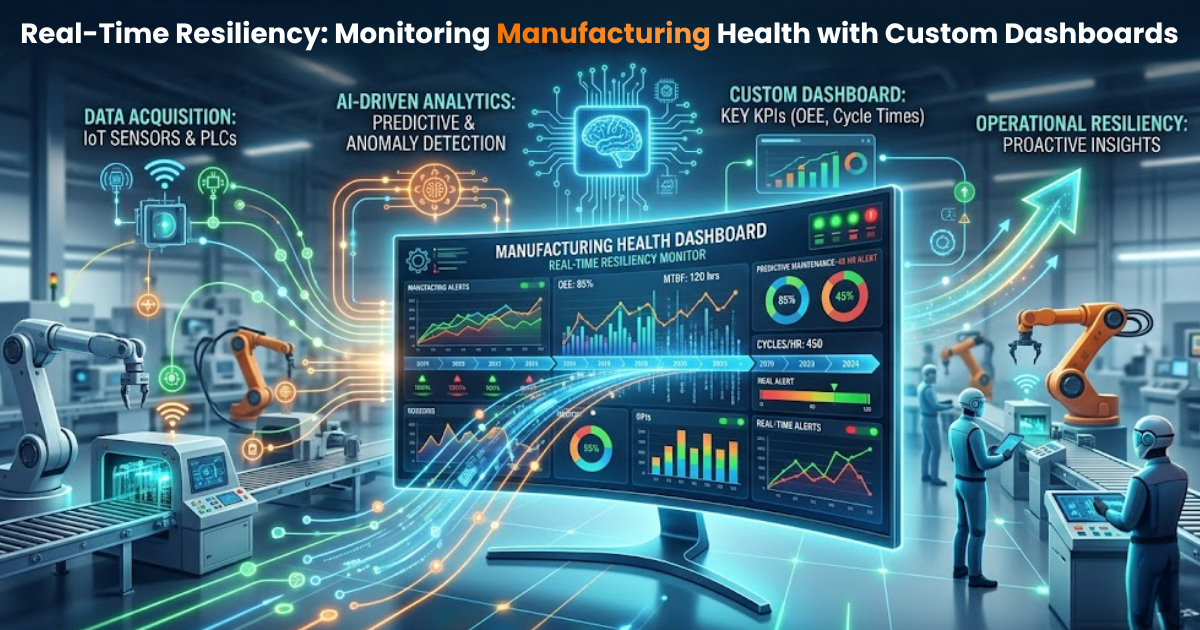
First, developers must connect to the hardware. Most plants use Programmable Logic Controllers (PLCs). Software engineers use protocols like OPC-UA or MQTT to bridge the gap. These protocols allow the software to “talk” to the machines. This layer ensures data flows without interruption.
2. Processing and Storage
Raw data is often “noisy.” It contains spikes or irrelevant values. The system must clean this data in real-time. Streaming platforms like Apache Kafka or AWS Kinesis often handle this task. Once cleaned, the data moves to a time-series database. Databases like InfluxDB or TimescaleDB excel here. They store sequential data points efficiently.
3. The Visualization Layer
This is the dashboard itself. Developers use frameworks like React or Vue.js for the frontend. These tools allow for dynamic updates. The screen refreshes without reloading. This ensures the data on the screen matches the physical reality on the floor.
Key Metrics for Manufacturing Health
A dashboard is only as good as the metrics it tracks. Overloading a screen with data causes “alarm fatigue.” Expert Manufacturing Software Development focuses on high-impact KPIs.
1. Overall Equipment Effectiveness (OEE)
OEE is the gold standard for production health. It combines three factors:
- Availability: Is the machine running during scheduled time?
- Performance: Is it running at its maximum rated speed?
- Quality: How many units meet the required specifications?
A world-class OEE score is typically 85% or higher. Many factories operate at 60% without realizing it. A custom dashboard brings this gap to light.
2. Mean Time Between Failures (MTBF)
This metric tracks reliability. It measures the average time a machine operates before breaking down. Increasing MTBF directly improves factory resiliency.
3. Cycle Time Variation
Consistent speed is vital for lean production. If one machine fluctuates, it creates bottlenecks. Dashboards visualize these variations using control charts. This helps engineers stabilize the flow.
The Role of Artificial Intelligence
Modern dashboards do more than show current status. They predict the future. A Manufacturing Software Development Company often integrates Machine Learning (ML) models.
1. Predictive Maintenance
ML algorithms analyze historical vibration and temperature data. They learn the “signature” of a failing part. The dashboard then displays a “Health Score.” This score tells technicians when a part will likely fail. According to Deloitte, predictive maintenance can reduce maintenance costs by 25%. It also cuts breakdowns by 70%.
2. Anomaly Detection
Sometimes, a machine behaves strangely without a clear cause. AI detects these outliers instantly. It alerts the team to investigate. This prevents small glitches from becoming catastrophic failures.
Why Custom Solutions Outperform Off-the-Shelf Tools
Many vendors sell generic manufacturing software. However, every factory has unique workflows. Custom solutions offer several advantages:
- Integration: Custom software connects to your specific legacy machines.
- Scalability: You can add features as your business grows.
- User Experience: Dashboards match the specific language of your operators.
- Data Ownership: You keep full control over your operational data.
Generic tools often force you to change your processes. Custom Manufacturing Software Development fits the software to your process.
Case Study: Reducing Downtime in Automotive Parts
Consider a mid-sized automotive supplier. They faced frequent unplanned downtime on their stamping presses. They hired a Manufacturing Software Development Company to build a custom dashboard.
The developers installed vibration sensors on the main drive shafts. They linked these sensors to a central dashboard. Within three months, the system identified a pattern. Increased vibration always preceded a gearbox failure by 48 hours.
The company shifted to “planned interventions.” They replaced parts during scheduled breaks. This change reduced unplanned downtime by 40%. Their annual production increased by 12%. This is the power of real-time resiliency.
Technical Challenges in Implementation
Building these systems is complex. Developers must overcome several hurdles:
1. Latency Issues
In a high-speed environment, a five-second delay is too long. Engineers must optimize the entire data pipeline. They use “edge computing” to process data near the machine. This reduces the load on the central server.
2. Data Security
Connected factories are targets for cyberattacks. Developers must implement end-to-end encryption. They also use strict identity management. This ensures only authorized personnel can change machine settings.
3. User Adoption
If workers find the dashboard confusing, they won’t use it. Great software requires intuitive design. High-contrast colors help in dimly lit factory environments. Large buttons make it easy to use with gloves.
Impact on the Workforce
Real-time monitoring changes the role of the factory worker. They shift from manual laborers to data-driven problem solvers.
Dashboards provide “democratized data.” Everyone from the floor operator to the CEO sees the same facts. This transparency builds trust. It encourages teams to collaborate on improvements. When a dashboard shows a red status, the team knows why. They can act without waiting for a supervisor’s command.
Financial Facts and Industry Stats
The shift toward digital manufacturing is accelerating. Look at these industry figures:
- The global smart manufacturing market will reach $500 billion by 2028.
- Companies using real-time data see a 20% increase in labor productivity.
- Energy costs drop by 10% through better machine monitoring.
- Scrap rates often decrease by 15% after dashboard implementation.
These numbers show that software is a profit center, not a cost.
Building a Resilient Future
The manufacturing landscape is changing fast. Supply chain disruptions are common. Labor shortages persist. In this environment, efficiency is not enough. You need resiliency.
Manufacturing Software Development provides the tools to survive and thrive. Custom dashboards offer a “single version of the truth.” they allow you to see the invisible. You can spot a failing motor from a mile away. You can find a bottleneck before it stops production.
Working with a specialized Manufacturing Software Development Company is a strategic move. They understand the nuances of the shop floor. They know how to translate hardware signals into business value.
Stop guessing about your factory’s health. Start measuring it in real-time. The data is already there. You just need the right software to see it. Building a resilient factory starts with a single dashboard. From there, the possibilities for growth are endless. Turn your data into your greatest competitive advantage today.
Conclusion
Real-time resiliency is no longer a luxury for modern plants. It is a fundamental requirement for survival. Custom dashboards serve as the central nervous system of the digital factory. They bridge the gap between physical machinery and strategic decision-making. Through expert Manufacturing Software Development, companies transform chaotic data into a clear roadmap for success.
Investing in these tools offers immediate and long-term benefits. You reduce waste, prevent costly repairs, and maximize your existing assets. A dedicated Manufacturing Software Development Company ensures that your technology grows alongside your production needs. This partnership allows you to stay ahead of competitors who still rely on manual tracking.