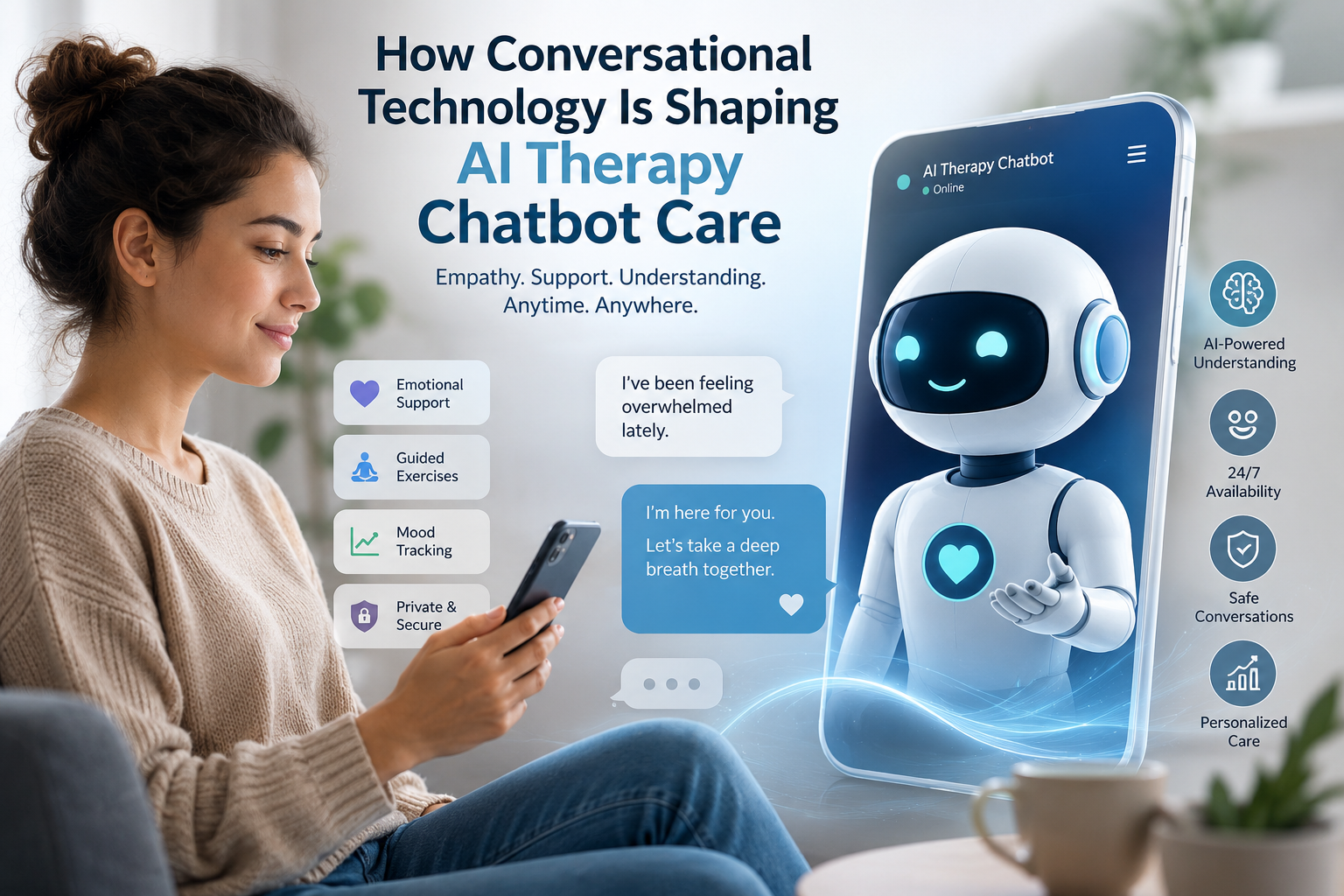
The growing demand for accessible mental health support has accelerated the adoption of conversational technologies across healthcare environments. Digital assistants capable of understanding language, identifying emotional cues, and responding with empathy are increasingly becoming part of modern wellness strategies. Rather than replacing therapists or clinical interventions, these systems are designed to extend support, improve accessibility, and provide assistance between professional sessions.
Modern conversational platforms can engage users in meaningful discussions, guide emotional reflection, encourage healthy coping strategies, and help individuals monitor changes in mood patterns over time. Their ability to remain available at any hour addresses one of the largest barriers in mental healthcare, namely the availability of timely support.
The rapid progress in natural language processing and machine learning has transformed simple scripted chat interfaces into highly adaptive communication tools. These systems can recognize context, interpret sentiment, and maintain coherent conversations that feel increasingly natural to users.
As organizations explore new approaches to digital wellness, AI therapy chatbot development has emerged as a specialized field focused on creating systems that prioritize empathy, safety, and responsible interaction. The emphasis is not merely on generating responses but on designing experiences that support emotional wellbeing through thoughtful conversation design.
Exploring the Core Technologies Behind Therapeutic Conversations
The effectiveness of conversational care solutions depends heavily on the technologies operating behind the interface. Several advanced capabilities work together to create interactions that feel supportive, relevant, and responsive to individual needs.
Key technologies include:
- Natural language processing for understanding user intent.
- Sentiment analysis for detecting emotional tone.
- Machine learning models for identifying conversation patterns.
- Context retention mechanisms for maintaining continuity.
- Speech recognition for voice-based interaction experiences.
- Predictive analytics for identifying behavioral trends.
Natural language processing allows systems to interpret user messages beyond simple keywords. Instead of responding to isolated phrases, advanced models analyze sentence structure, emotional indicators, and conversational context.
Sentiment analysis plays an equally important role. By identifying frustration, anxiety, sadness, or optimism within messages, systems can adapt their responses to match the user’s emotional state. This helps create interactions that feel more supportive and less mechanical.
Memory and contextual understanding further improve conversational quality. When a system remembers previous discussions, user preferences, or recurring concerns, it can offer continuity that contributes to a stronger sense of engagement.
For teams involved in AI therapy chatbot development, balancing technical sophistication with emotional sensitivity remains one of the most important design considerations. Accuracy alone is insufficient if the interaction lacks warmth, empathy, or relevance to the user’s experience.
Examining Personalization Methods in Digital Emotional Support
Personalization has become one of the defining characteristics of successful conversational healthcare tools. Individuals experiencing stress, loneliness, burnout, or emotional distress rarely benefit from generic responses. Effective systems adapt communication styles, recommendations, and interventions to suit the specific needs of each user.
Personalization can occur across several dimensions:
- Communication preferences and language style.
- Emotional history and mood patterns.
- Preferred wellness exercises and coping techniques.
- Frequency and timing of interactions.
- Cultural and linguistic considerations.
Adaptive personalization creates a more engaging experience by making conversations feel relevant rather than repetitive. A user experiencing workplace stress may receive productivity and relaxation guidance, while another dealing with social anxiety may receive support centered on confidence-building exercises.
Behavioral learning models contribute significantly to this process. By observing user engagement patterns, the system can identify which interventions are most effective and adjust future conversations accordingly.
Personalization also contributes to trust. When users feel understood, they are more likely to engage consistently and openly with the platform. However, personalization must always be balanced with privacy protections and transparent data practices to maintain user confidence.
The future of digital mental wellness will likely depend heavily on this ability to provide tailored experiences while respecting ethical and regulatory boundaries.
Assessing the Role of Context Awareness in Sensitive Interactions
Human conversations rely heavily on context. The meaning of a sentence often depends on previous exchanges, emotional circumstances, and situational factors. Conversational healthcare technologies must therefore develop sophisticated methods for maintaining contextual awareness throughout interactions.
Context awareness enables systems to:
- Recognize ongoing emotional themes.
- Avoid repetitive or contradictory responses.
- Track changes in mood over time.
- Understand references to previous discussions.
- Escalate concerns when risk indicators appear.
For example, a statement such as “I am feeling the same as yesterday” requires knowledge of earlier conversations to produce an appropriate response. Without context retention, the interaction may become fragmented and ineffective.
Long-term context management is particularly important for users who engage with support tools regularly. Consistency in communication contributes to emotional comfort and strengthens user engagement.
However, contextual awareness introduces technical challenges related to data storage, privacy management, and information accuracy. Developers must determine how much historical information should be retained and how it should be protected.
Advanced memory architectures and secure data frameworks are helping address these concerns. The result is a generation of systems capable of delivering more coherent, meaningful, and emotionally aware interactions than earlier conversational technologies.
Reviewing Ethical Safeguards for Responsible Virtual Care Design
Ethics occupies a central role in conversational healthcare systems because interactions often involve vulnerable individuals discussing sensitive topics. Responsible design practices are therefore essential to ensure safety and trustworthiness.
Several ethical priorities guide development efforts:
- Protection of personal and health-related information.
- Transparency regarding system capabilities and limitations.
- Clear escalation pathways for crisis situations.
- Bias reduction across demographic groups.
- Human oversight for high-risk scenarios.
Privacy remains one of the most important considerations. Users must understand what information is collected, how it is stored, and how it is used. Transparent communication regarding these practices strengthens trust and supports informed participation.
Bias management presents another significant challenge. Training datasets that lack diversity may result in responses that are less effective for certain populations or cultural groups. Inclusive datasets and regular evaluation procedures help improve fairness and consistency.
Another important principle involves avoiding unrealistic expectations regarding system capabilities. Conversational technologies can provide support and guidance, but they are not substitutes for emergency intervention or professional diagnosis.
Responsible implementation therefore depends on clear boundaries between supportive interaction and clinical treatment. Establishing those boundaries protects users while enhancing the credibility of digital wellness solutions.
Analyzing Development Frameworks for Compassionate Assistants
Building emotionally intelligent conversational systems requires collaboration across multiple disciplines, including psychology, linguistics, artificial intelligence, and user experience design. Successful projects often involve mental health professionals working alongside engineers and researchers.
The development process typically includes several stages:
- Defining therapeutic goals and interaction boundaries.
- Designing conversation structures and response strategies.
- Training language models using relevant datasets.
- Testing emotional accuracy and contextual understanding.
- Validating safety protocols and escalation procedures.
- Monitoring performance after deployment.
The growing specialization of AI therapy chatbot development reflects the complexity of creating systems capable of delivering meaningful emotional support while maintaining reliability and safety standards.
Organizations entering this space frequently explore broader AI chatbot development services to access expertise in machine learning infrastructure, conversational architecture, and compliance frameworks. These resources can help streamline implementation while ensuring technical quality.
Another frequently discussed topic among developers involves how to develop an AI therapy app that balances usability with clinical responsibility. Achieving this balance requires careful planning, interdisciplinary collaboration, and extensive testing under real-world conditions.
Continuous improvement remains essential after deployment. User feedback, conversation analysis, and behavioral insights all contribute to refining interactions and improving long-term effectiveness.
Considering Integration Pathways Across Healthcare Ecosystems
Conversational support technologies are increasingly being integrated into broader healthcare environments rather than operating as isolated applications. This integration allows digital tools to contribute to coordinated care strategies and more comprehensive patient experiences.
Potential integration areas include:
- Patient engagement platforms.
- Remote monitoring systems.
- Wellness and prevention programs.
- Employee assistance initiatives.
- Telehealth ecosystems.
Integration can improve continuity of care by connecting conversational interactions with broader support frameworks. For example, users may receive reminders related to therapy appointments, wellness exercises, or medication schedules through a single interface.
Healthcare professionals can also benefit from summarized insights that highlight engagement patterns or changes in emotional wellbeing, provided that privacy regulations and user consent requirements are fully respected.
As AI therapy chatbot development continues to evolve, interoperability standards will become increasingly important. Systems that communicate effectively with healthcare infrastructure can contribute to more coordinated and efficient care delivery.
The rise of emotional AI companion chatbot development also reflects a broader shift toward long-term supportive relationships between users and digital systems. These solutions focus on companionship, routine interaction, and emotional engagement rather than task completion alone.
Such developments suggest that conversational care technologies will continue expanding their role within preventive and supportive healthcare models.
Evaluating Future Directions for Human Centered Support Tools
The future of conversational wellness technology will likely be shaped by advances in emotional intelligence, multimodal interaction, and adaptive learning capabilities. Systems are expected to move beyond text-based communication and incorporate voice, facial expression analysis, and behavioral signals to better understand user experiences.
Several emerging trends are already influencing development priorities:
- Real-time emotional recognition capabilities.
- Multilingual conversational support.
- Improved personalization through adaptive learning.
- Enhanced accessibility for underserved populations.
- Stronger collaboration between human professionals and digital tools.
Voice interaction represents one particularly important area of growth. Spoken conversations often capture emotional nuance more effectively than written messages, enabling richer and more responsive communication experiences.
Advances in emotional modeling may also improve the ability of systems to recognize subtle shifts in mood and respond more appropriately. While these technologies remain under active development, they have the potential to significantly enhance the quality of digital support.
Another important direction involves greater emphasis on explainability and transparency. Users increasingly expect to understand how recommendations are generated and how decisions are made within intelligent systems.
Ultimately, the success of future conversational healthcare technologies will depend not only on technical innovation but also on ethical responsibility, inclusivity, and thoughtful human-centered design.
Building Sustainable Models for Digital Emotional Assistance Systems
The long-term sustainability of conversational care technologies depends on maintaining user trust, ensuring consistent performance, and adapting to changing healthcare expectations. Sustainable systems are those that evolve alongside clinical knowledge, technological advances, and societal needs.
Several factors contribute to long-term viability:
- Ongoing model evaluation and retraining.
- Continuous security improvements.
- Regulatory compliance updates.
- Accessibility enhancements for diverse populations.
- Collaboration with healthcare professionals.
Sustainability also involves measuring outcomes rather than simply tracking engagement metrics. Understanding whether interactions contribute positively to wellbeing is essential for guiding future improvements.
Research institutions, healthcare providers, and technology developers are increasingly collaborating to establish standards for evaluation and quality assurance. These efforts are expected to improve consistency across the industry and support broader adoption.
Conclusion
Conversational technologies are reshaping the way digital mental wellness support is delivered by combining accessibility, personalization, and continuous availability. Their ability to understand language, recognize emotional signals, and maintain meaningful interactions has opened new possibilities for supportive care experiences. As technological capabilities continue to advance, thoughtful design, ethical responsibility, and collaboration with healthcare professionals will remain essential to ensuring these systems provide meaningful value while supporting the wellbeing of those who rely on them.