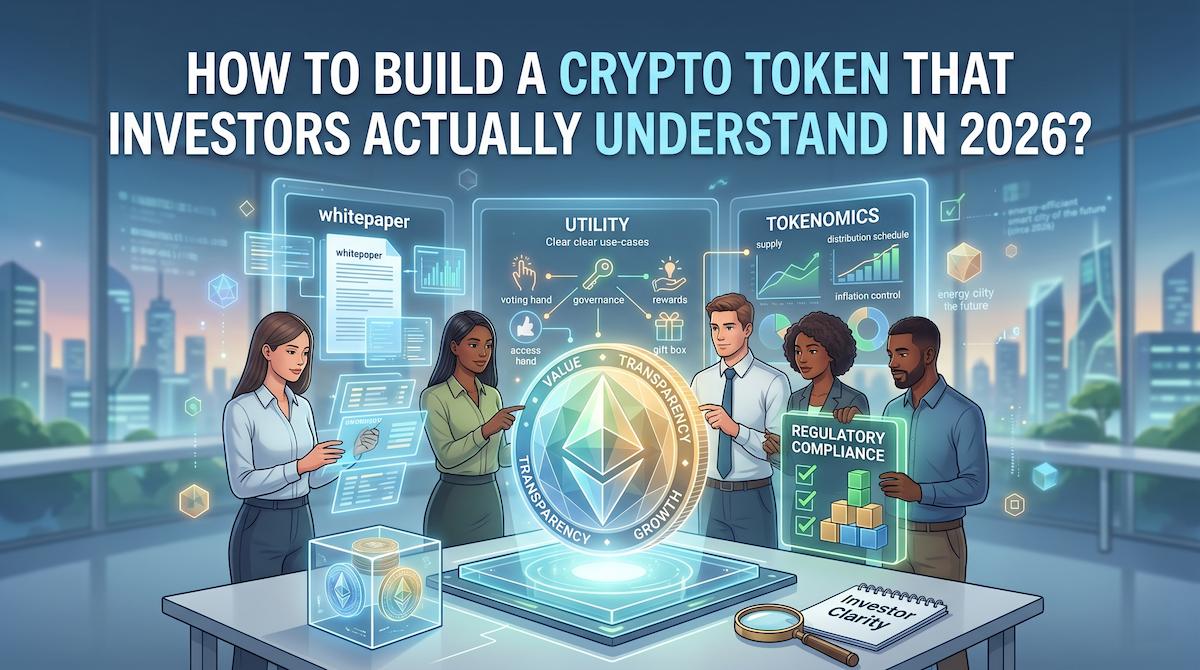
Crypto investors in 2026 are not impressed by vague promises, inflated roadmaps, or white papers packed with technical jargon.
They want clarity.
A token that investors understand is not just well-coded. It is well-positioned, economically coherent, legally aware, and easy to explain in one sentence. The market has matured. Institutional players are entering. Regulations such as MiCA in Europe have pushed projects toward better disclosures. Retail investors, meanwhile, have become more skeptical after years of failed launches, meme coin cycles, and unsustainable token incentives.
The winning token is no longer the loudest one.
It is the one that makes sense.
Start With a Token Thesis Investors Can Repeat
Every strong token begins with a simple investment thesis. Not a slogan. Not a vision statement. A thesis.
This is the clearest answer to one question: why should this token exist?
Define the economic problem
A token should solve a coordination, access, payment, ownership, governance, or incentive problem. If the product can work perfectly with a normal database and fiat payments, investors will question why a token is needed.
Good token theses usually sound practical:
- A gaming token rewards players for in-game contribution.
- A DePIN token incentivizes people to supply real-world infrastructure.
- A stablecoin improves settlement speed and cross-border liquidity.
- A governance token gives users influence over protocol decisions.
- An RWA token represents fractional exposure to income-generating assets.
The more specific the problem, the easier the token is to understand.
Avoid “utility” without usage
Many failed tokens claimed utility but had no real demand. Discounts, staking badges, and vague access rights are not enough.
Investors want to see who uses the token, why they need it, and what happens if they do not have it.
Make the one-line explanation sharp
A clear token can be explained without a deck.
For example:
“This token rewards independent GPU providers for supplying verified compute to AI developers.”
That is stronger than:
“We are building a decentralized AI ecosystem powered by community-driven tokenomics.”
One sentence can expose whether the token is real or decorative.
Design Tokenomics Around Behavior, Not Hype
Tokenomics is where most projects lose investor trust. A fancy supply chart means little if the incentives do not create sustainable demand.
In 2026, investors are looking for behavior-based tokenomics.
Map every stakeholder
A token economy has several participants:
- Users
- Validators or node operators
- Liquidity providers
- Developers
- Treasury managers
- Investors
- The founding team
Each group must have a clear reason to hold, earn, spend, or stake the token.
If one group benefits while another carries the risk, the economy will eventually break.
Separate demand from speculation
Speculation can create early liquidity, but it cannot carry a token forever. Real demand comes from usage.
Ask:
- Is the token required to access the network?
- Is it burned, locked, staked, or spent during usage?
- Does higher product adoption increase token demand?
- Are incentives temporary or structurally necessary?
- Can users bypass the token entirely?
A token with no usage-linked demand becomes dependent on marketing cycles.
Build supply discipline
Investors pay close attention to unlock schedules. Large insider allocations, short cliffs, and aggressive emissions create sell-pressure fears.
A healthier structure usually includes:
- Long team vesting
- Transparent investor unlocks
- Ecosystem incentives tied to milestones
- Treasury reporting
- Emission reductions as adoption grows
The goal is not to make supply look scarce on day one. The goal is to make supply credible over years.
Make the White Paper Read Like an Investor Document
The old white paper format was often too technical for investors and too promotional for regulators.
That no longer works.
In 2026, a strong token white paper must explain the project like a business, a network, and a financial mechanism at the same time.
Lead with the market context
Start by explaining the market problem. Use numbers where possible.
For example, a tokenized real estate project should explain liquidity issues in property markets, minimum investment barriers, settlement delays, and investor access gaps.
Do not start with blockchain philosophy.
Start with the pain.
Explain the token role clearly
A good white paper should answer:
- What does the token do?
- Who needs it?
- How does it enter circulation?
- Why does demand increase?
- What are the risks?
- What rights does the token not provide?
The last point is important. Investors appreciate honest boundaries.
Use diagrams and examples
A token flow diagram can explain in 30 seconds what five pages of text cannot.
Show how value moves between users, validators, the treasury, and token holders. Include a sample transaction. Explain what happens when the network grows.
Clarity reduces perceived risk.
Treat Compliance as a Product Feature
Regulation is no longer an afterthought. It shapes how investors evaluate tokens.
Projects that ignore compliance may attract short-term speculation, but serious investors increasingly prefer tokens with clear legal positioning.
Know your token category
A token may function as:
- Utility token
- Governance token
- Payment token
- Security token
- Asset-referenced token
- E-money token
- NFT or semi-fungible asset
- Real-world asset token
Each category comes with different disclosure, licensing, marketing, and investor protection concerns.
Mislabeling the token can damage trust before launch.
Avoid misleading investor language
Words matter.
Promises such as “guaranteed returns,” “passive income,” or “risk-free yield” can create legal and reputational problems.
A professional token document should explain potential value drivers without promising price appreciation.
Build jurisdiction-specific plans
A global token launch needs regional thinking. The EU, U.S., UAE, Singapore, Hong Kong, and India do not treat crypto assets the same way.
A serious launch strategy should define:
- Where the token will be offered
- Who can participate
- Whether KYC is required
- What disclosures are needed
- Which exchanges or launchpads are suitable
- How marketing claims will be reviewed
Compliance does not kill growth.
Uncertainty does.
Show Real Utility Before the Token Launch
One of the strongest investor signals is product traction before token generation.
A token should accelerate a working system, not compensate for the absence of one.
Launch the product first when possible
Investors are more confident when they can see:
- Active users
- Transaction volume
- Developer activity
- Community participation
- Revenue or protocol fees
- Partnerships
- Testnet data
A token tied to visible usage is easier to value than a token tied only to a future roadmap.
Use testnets as proof
For infrastructure, DePIN, AI, gaming, and DeFi projects, a testnet can show whether people actually participate.
Useful testnet metrics include:
- Number of wallets
- Retention rate
- Transactions per user
- Active nodes
- Uptime
- Developer integrations
- Cost per transaction
- Failed transaction rate
Do not inflate vanity numbers. Investors know the difference between airdrop farmers and real users.
Connect token utility to traction
If the product has 100,000 users but none of them need the token, that is a problem.
The launch narrative should show how tokenization improves the system.
Build a Treasury Investors Can Trust
Treasury design is often overlooked, but it can decide whether a token survives difficult market cycles.
A treasury is not a marketing wallet.
It is the project’s operating reserve.
Define treasury purpose
A credible treasury supports:
- Development
- Security audits
- Liquidity
- Ecosystem grants
- Market expansion
- Partnerships
- Emergency reserves
Investors should know what treasury funds can and cannot be used for.
Publish allocation logic
A transparent allocation table should explain:
- Team allocation
- Investor allocation
- Community rewards
- Ecosystem fund
- Liquidity provision
- Advisors
- Treasury reserve
Percentages alone are not enough. Explain why each bucket exists.
Add governance controls
For mature projects, treasury spending should include controls such as multisig approvals, spending limits, proposal voting, or third-party reporting.
The message is simple: funds are not controlled casually.
Communicate Risk Like a Serious Project
Investors do not expect zero risk. They expect honest risk disclosure.
Projects that hide risk look inexperienced.
Cover technical risk
Smart contract bugs, oracle failures, bridge vulnerabilities, validator attacks, and key management issues can destroy token value.
Strong projects discuss audits, bug bounties, monitoring, and upgrade procedures.
Cover market risk
Token price volatility, liquidity shortages, user churn, and exchange dependency should be addressed directly.
A serious document explains what happens in weak market conditions.
Cover regulatory risk
Regulatory treatment can change. Exchange listings can be delayed. Jurisdictions can restrict participation.
Investors appreciate projects that show awareness rather than pretending regulation does not exist.
Use Real-World Examples to Sharpen the Model
The best token designs are easy to understand because they mirror real economic systems.
DePIN tokens
DePIN projects use tokens to reward people who supply infrastructure such as wireless coverage, storage, sensors, or compute.
The investor logic is straightforward: if real-world supply grows and customers pay for access, the token may become part of a useful incentive loop.
Stablecoins
Stablecoins show that crypto adoption often grows fastest when the token has a clear job: move value, store value, or settle transactions.
The simplicity is the strength.
RWA tokens
Real-world asset tokens appeal to investors because they connect blockchain rails to familiar assets such as treasuries, real estate, invoices, or commodities.
But they also require stronger legal structure, custody, valuation, and redemption mechanics.
A tokenized asset is only as credible as the asset behind it.
Prepare an Investor-Ready Token Launch Stack
A professional token launch requires more than smart contract deployment. It needs architecture, documentation, security, liquidity, compliance support, and post-launch operations.
This is where execution quality matters.
Blockchain App Factory provides token development services for businesses that want to design, build, and launch crypto tokens with clear utility, structured tokenomics, smart contract development, wallet and exchange integration, and launch support tailored to project goals.
The core launch stack includes
- Token architecture and blockchain selection
- Smart contract development and audits
- Tokenomics design
- Vesting and allocation contracts
- White paper and litepaper support
- KYC and compliance workflows
- Liquidity and exchange readiness
- Dashboard and analytics setup
A good launch partner does not just create a token. It helps make the token understandable, usable, and scalable.
Build the Investor Narrative Around Evidence
Investors understand tokens faster when every claim is backed by evidence.
Replace claims with proof
Instead of saying “massive market opportunity,” show market size, user pain, and adoption trends.
Instead of saying “strong community,” show active contributors, retention, governance participation, or developer growth.
Instead of saying “sustainable tokenomics,” show emissions, utility loops, and unlock controls.
Use dashboards
Live dashboards build trust. They allow investors to track:
- Circulating supply
- Treasury balances
- Token unlocks
- Protocol revenue
- Active wallets
- Transaction volume
- Staking participation
- Governance activity
Visibility turns belief into monitoring.
Keep the narrative consistent
The website, white paper, pitch deck, exchange materials, community posts, and founder interviews should all explain the token the same way.
Mixed messaging creates doubt.
What Investors Actually Want to Understand
Most investors are not asking for perfection. They are asking for legibility.
They want to know:
- Why the token exists
- Why users need it
- How supply is controlled
- What drives demand
- Who receives tokens
- When unlocks happen
- What legal risks exist
- Whether the team can execute
- How the project survives after launch
A token that answers these questions clearly has a major advantage.
Final Thoughts
Building a crypto token in 2026 is not about launching faster than everyone else. It is about launching with more clarity than everyone else.
The market has seen too many tokens with vague utility, weak economics, unclear compliance, and short-lived hype. Investors now look for projects that can explain their token like a system: what it does, who it serves, how it grows, and why it deserves to exist.
A token investors understand is easier to trust.
A token investors trust is easier to fund, list, use, and scale.
That is the real advantage in 2026.