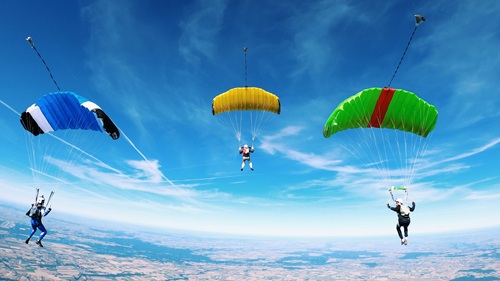
Before packing our bags for a hot dive, the most common urban legend that comes to mind is that there’s no active drop zone just inside the city limits of Merida. A brochure that says the high drop directly over the Paseo de Montejo’s mansions in pastel colors is a little imaginative marketing. Otherwise, there might be civilian parachute landings without heaviness on the historical architecture and narrow colonial grid.
The geographical “ Skydiving Merida Mexico experience”, however, is much grander. At a higher altitude (10,000 to 13,000 feet), the level topography of the Yucatan Peninsula appears like a giant map in colors.
Here, high above the limits of the present-day Mérida, the Gulf of Mexico and the prehistoric jungle merge into one spectacularly impressive landscape. This is a collection of 7 BACKWARD views of the greater area of Mérida and Yucatan – views that should be experienced from underneath a parachute canopy!
- The Endless Emerald Blanket of the Mayan Jungle
The forest in the Yucatan appears from the ground level as a solid wall of side-of-the-road trees. But from 10,000 ft up, you see just how immense and wild this ancient landscape is.
To the south and west of this altitude, your jump originates toward Merida, and the ground turns into one seamless deep-green jungle with a low canopy all the way to the horizon. A humbling visual reminder of the terrain on which the ancient Maya walked, undisturbed by hills or mountains.
- The Mysterious “Ring of Cenotes”
Famous on the Yucatan Peninsula, especially in Mexico and the Caribbean. The design is geometric and was formed 66 million years ago when the edge of the famous Chicxulub asteroid impact crater just north of Mérida created the layout.
A raft ride under a parachute provides the best bird’s-eye view of the caverns, while a ground tour only gives you one! They are apparent even in the midst of the jungle, like a small, perfectly made round sapphire and turquoise gem cutting through the jungle floor. From an aerial view, you can witness these water portals as an alignment; this is something you can’t do from a hiking trail.
- Brilliant Salt Flats and Pink Waters of Celestún
To the West of Mérida is the Biosphere Reserve of Celestún. A clear day with an open parachute and decreasing velocity as you fall allows you to see a very nice contrast of colors toward the Gulf coast line.
Within shallow hyper-saline lagoons and salt flats are sunshine yellow to crimson-pink hues due to a special algae microflora. Pink hues can be seen against the white sandy shoreline and the deep blue of the Gulf of Mexico, painting a huge work of art for a giant painter on the coast of the peninsula.
- The Colossal Size of the Alacranes Reef (On Ultra-Clear Days)
The nearby coral reef to the north of the town of Mérida in the far reaches of the Gulf of Mexico is called Arrecife Alacranes.
The ascent to the highest point possible with a clear view of the sea before jumping on the boat at the port of Progreso is only a ride of a few hours; hence, a rare opportunity to witness this vast marine sanctuary on a bright morning. At the edge of the deep blue Gulf, suddenly the vast, light turquoise crescent of shallow-water reefs is revealed. It’s only fit for pilots, frigatebirds, and skydivers.
- The Bold Transition of the Emerald Coast.
To the north of the town of Mérida in the extreme area of the Gulf of Mexico lies the nearby coral reef, known as Arrecife Alacranes.
Looking north towards the port of Progreso (the nearshore beach in Mérida), you see the most dramatic sunset you can see of ‘the Emerald Coast ‘.
Stretching almost four miles out into the sea green, you can see the long, thin pine-lined pier of the Progreso Pier, one of the world’s longest cruise ship piers.
- The Patio Garden of Residences, Mexico City
In the late 1800s, the land area around Mérida was the uncontested world henequen ‘capital ‘, featuring expansive plantations of henequen and grand haciendas.
The historic geometry of this golden era can also be seen from the air. The agave plants grow in clean rows of tiles on the ground, with the green incorporating shimmering highlights while ancient 19th-century chimneys and red-tiled roofing are all that remain of the old hacienda factories. These pedestrian footprints, unseen by roadside plants at ground level, are clearly visible from a bird’s-eye view.
- Two Worlds (The Yucatan and Caribbean Horizons),
The greatest observation from a tandem skydive in this area is the immense geologic splendor of the peninsula’s own landscape.
At 13,000 feet, one is able to catch a good glimpse of the dramatic encounter between two totally distinct coastal worlds. On the left, however, lie the wild and flat, jungle-covered plains of the Yucatan, extending as far as you can see to the historic cradle of Mérida. The waters of the Gulf of Mexico, close to the city of Mérida, are quite colorful, a watery-blue emerald tone due to the shallow limestone shelf and the currents in the coastal waters.
Here on the right side are the Caribbean waters, so incredibly blue, and the white sand beaches of Cozumel. It’s a full-blown outburst of untamed jungle history and beachside paradise — a place you’ll never depart till you land on the sandy shores.
In the end
If you’re going to be in Mérida, be sure to book a short day trip to the coast if you are interested in including this bucket-list item on your trip. Skydiving Mérida, Mexico
Work best with Spur collaborates with premier, highly screened, and background-checked area operators that use USPA-certified instructors to ensure a highly safe environment.