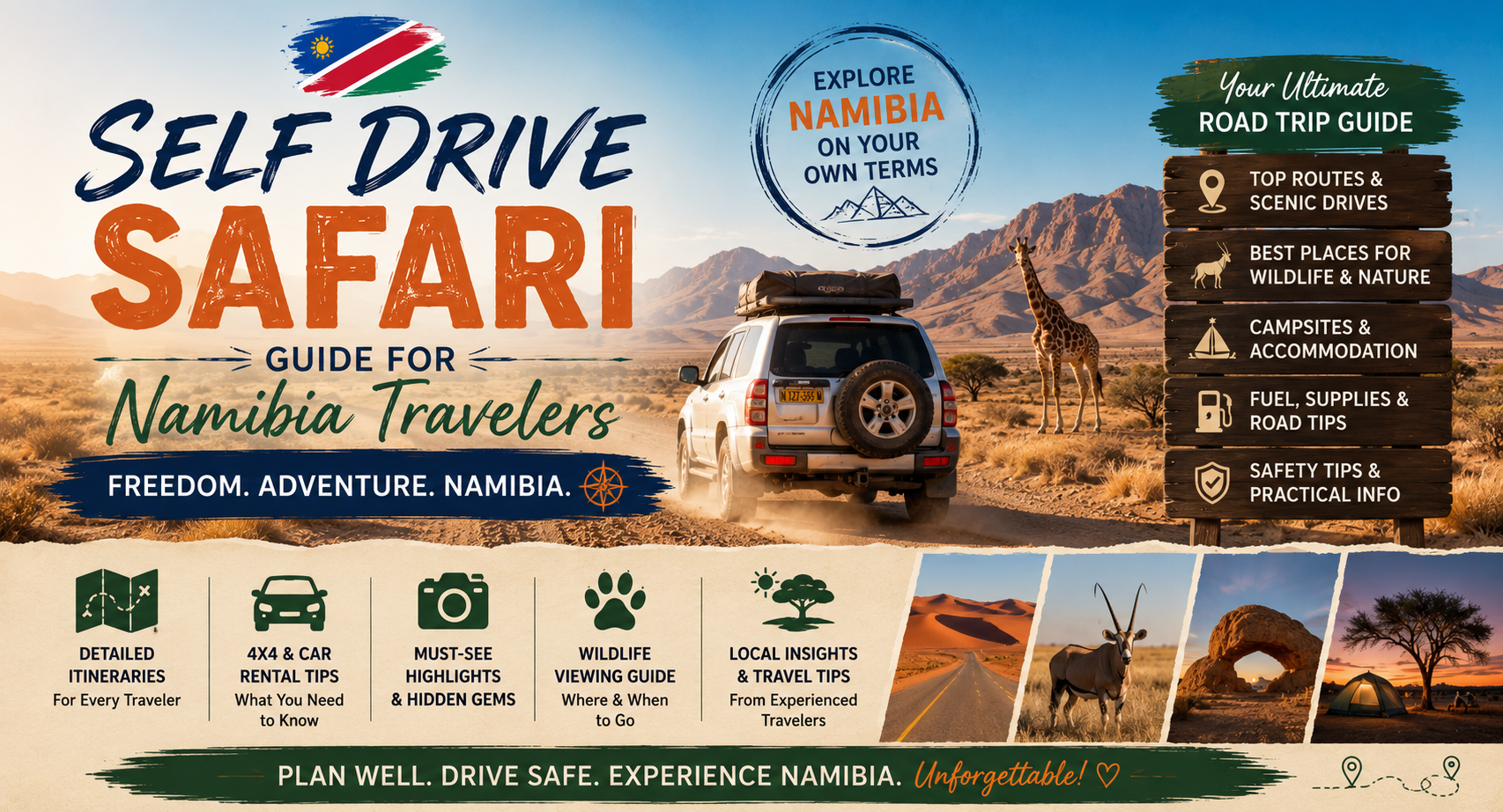
Namibia is one of the most beautiful and wild countries on earth. With its giant red sand dunes, rugged coastlines, and abundant wildlife, it is the perfect destination for an independent road trip.
Driving yourself through this vast desert nation gives you the ultimate freedom to explore at your own pace. However, driving in a country dominated by gravel roads and remote landscapes requires some preparation.
This comprehensive guide answers the most common questions travelers ask when planning a self-drive adventure in Namibia.
1. Is it safe to go on a self-drive safari in Namibia?
Yes, Namibia is considered one of the safest countries in Africa for self-drive travelers, including solo adventurers. Violent crime against tourists is very rare, especially once you leave the major urban areas.
The real safety risks in Namibia are environmental. The country is vast, dry, and sparsely populated. Getting stuck without water, driving too fast on gravel roads, or encountering wild animals are the actual challenges you need to prepare for. As long as you respect the speed limits, plan your routes carefully, and keep a cool head, a self-drive trip is incredibly safe and rewarding.
2. Do I really need a 4×4 vehicle for a Namibian road trip?
You do not strictly need a $4 \times 4$ for the entire country if you only stick to the main highways. However, renting a vehicle with high ground clearance is highly recommended.
While a regular sedan can handle the tarred roads, it will offer a very bumpy and uncomfortable ride on Namibia’s extensive gravel road network. Furthermore, if you plan to visit places like the deep sands of Sossusvlei, the muddy tracks of the Caprivi Strip, or the rugged terrains of Damaraland, a $4 \times 4$ is absolutely essential. A larger vehicle also sits higher, giving you a much better vantage point for spotting wildlife in Etosha National Park.
3. What are the speed limits and driving rules in Namibia?
In Namibia, you drive on the left side of the road. It is a legal requirement to keep your headlights turned on at all times, even in broad daylight.
Speed limits are strictly enforced by local police and speed cameras:
- Tarred/National highways: Max speed of $120\text{ km/h}$ ($75\text{ mph}$).
- Gravel roads: Max speed of $80\text{ km/h}$ ($50\text{ mph}$), though you should often drive slower depending on road conditions.
- Urban areas: $50\text{ km/h}$ to $60\text{ km/h}$ ($31\text{ mph}$ to $37\text{ mph}$).
Always wear your seatbelt, and never drink and drive. If you are caught speeding in a rental car, the tracking device in your vehicle will alert the rental agency, which can void your insurance entirely.
4. Why should you never drive at night in Namibia?
The golden rule of driving in Namibia is simple: do not drive after dark.
Once the sun sets, the risk of hitting a wild animal or domestic livestock increases dramatically. Kudus, desert elephants, zebras, and cows frequently wander onto the unlit highways. Because there are no streetlights outside of major towns, you will not see them until it is too late. Furthermore, gravel roads become much harder to read in the dark, making it easy to lose control on sudden sandy patches or deep potholes.
5. How do I handle tire pressure and flat tires on gravel roads?
Tire management is the most important skill for a Namibian road trip. Sharp volcanic rocks and extreme desert heat can easily cause punctures.
You must check your tire pressure every morning before you start driving. When traveling on hot tarmac, your tire pressure will naturally rise due to the heat, which can exceed $40^{\circ}\text{C}$ ($104^{\circ}\text{F}$).
- On gravel roads, keep your tire pressure slightly lower—around $1.8\text{ bar}$ to $2.0\text{ bar}$ ($26\text{ psi}$ to $29\text{ psi}$)—to absorb the bumps and give you more traction.
- If you drive through deep sand, you may need to deflate them further to about $1.2\text{ bar}$ ($17\text{ psi}$).
Always ensure your rental car comes with at least one, preferably two, high-quality spare tires and all the necessary tools to change them.
6. What should I do if my car breaks down in the middle of nowhere?
If your car breaks down or you get a flat tire in a remote area, the most important rule is to stay with your vehicle. A car is much easier to spot from the air or by passing travelers than a single person walking through the desert.
Cell phone signal is very poor or non-existent in remote regions. It is smart to buy a local SIM card (MTC is the main provider) at the Windhoek airport, but do not rely on it completely. Download offline maps (like Google Maps or Maps.me) before you set off. Many reputable rental companies equip their cars with GPS tracking and an emergency panic button. Keep plenty of drinking water (at least $5\text{ liters}$ per person per day) in the car in case you have to wait a few hours for help.
7. How long does it actually take to drive between destinations?
Do not trust the driving times provided by digital maps. A journey that looks short on paper can take twice as long due to the road conditions.
As a general rule, add an extra $50\%$ to whatever time Google Maps suggests. For example, if a route is listed as $4\text{ hours}$, plan for it to take $6\text{ hours}$. This extra buffer allows you to slow down for corrugated gravel, take photos of the mind-blowing scenery, take rest breaks, and arrive at your next lodge or campsite well before the sun goes down.
8. What is the best time of year to visit Namibia?
The best time for a self-drive safari is during the dry winter months, from June to October.
During this time, the temperatures are cooler and pleasant, and wildlife viewing is at its peak. Because water is scarce, animals gather in huge numbers around the remaining waterholes in Etosha National Park, making them incredibly easy to spot. The low season runs from December to April, which is the rainy summer. While the desert turns beautifully green and prices are lower, some gravel roads can wash away, making river crossings dangerous for inexperienced drivers.
9. Should I choose rooftop tent camping or stay in lodges?
This depends entirely on your budget and travel style, but both options are fantastic in Namibia.
- Rooftop camping: Renting a $4 \times 4$ equipped with a rooftop tent is the ultimate way to experience the wild. Namibian campsites are world-class, often featuring private bathrooms, braai (BBQ) areas, and stunning desert views.
- Lodges: If you prefer comfort, Namibia has some of the most luxurious and architecturally stunning eco-lodges in the world.
Whichever you choose, you must book your accommodations months in advance if you plan to travel during the peak season (July to October), as spaces fill up quickly.
10. Where can I buy food and find fuel along the way?
As soon as you land at Hosea Kutako International Airport in Windhoek, head to a major supermarket to stock up on food, snacks, and water. You will go days without seeing a large grocery store once you head into the desert.
When it comes to fuel, follow this simple rule: never pass a fuel station without topping up your tank. Even if your tank is half full, stop and fill it. Fuel stations are few and far between, and sometimes remote stations run out of fuel before the next delivery truck arrives.
- Bonus Tip: Stop at McGregor’s Bakery in the tiny desert outpost of Solitaire. They are famous for serving the best apple pie in the middle of the desert!
11. How much cash do I need to carry in Namibia?
The official currency is the Namibian Dollar (NAD), which is pegged $1:1$ with the South African Rand (ZAR). Both currencies are accepted interchangeably throughout the country.
While major lodges, supermarkets, and national parks accept international credit cards (Visa and Mastercard), you still need to carry cash. Many remote fuel stations only accept cash or local cards. You will also need cash to tip fuel station attendants (who pump your gas and wash your windshield) and car guards in the cities. It is best to withdraw around $3000$ to $5000\text{ NAD}$ at the Windhoek airport before starting your trip.
12. What are the visa requirements for entering Namibia?
Before you pack your bags and hit the open road, you need to make sure your travel documents are in order. Most international travelers require a valid passport with at least 6 months of validity remaining and a few blank pages.
Depending on your nationality, you may need to apply for a Namibia tourist visa or family visit visabefore your arrival. Fortunately, Namibia now offers a simplified electronic visa (e-Visa) system that lets you complete your application online without having to mail your passport to an embassy. Getting your visa approved early ensures a smooth entry so you can focus entirely on your upcoming road trip.
Why Choose Us?
Planning a self-drive safari is exciting, but securing the right travel documents can sometimes feel overwhelming. That is where we come in to make your trip preparation stress-free.
- Reliable Travel Visa Services: Our global approach has assisted numerous travelers in obtaining their visas successfully.
- Round-the-Clock Assistance: Reach out to us 24/7, and our dedicated visa experts will respond within 72 hours to answer all your questions.
- Experienced Visa Consultants: Receive professional, expert guidance to ensure the accuracy and acceptance of your application.
- Efficient Visa Application Process: Apply for your visa in just a few minutes using our highly simplified online form.
Are you ready to start planning your dream desert road trip? Apply today for your Namibia Family Visit and Tourist e-Visa to get your travel documentation sorted quickly and securely!