
The scale of mobilization during the First World War was entirely unprecedented. Between 1914 and 1918, global powers had to suddenly clothe tens of millions of men heading into industrialized trench warfare. This massive shift transformed the textile industry, forcing the humble WW1 army uniform manufacturer to evolve from a small-scale, local garment shop into a mass-production powerhouse capable of turning out millions of rugged, weather-resistant wool garments.
Today, the legacy of those original factories lives on through the dedication of living historians, collectors, and filmmakers. Thanks to modern production techniques, finding a museum-grade ww1 army uniform online has never been easier, allowing us to preserve the tactile history of the Great War.
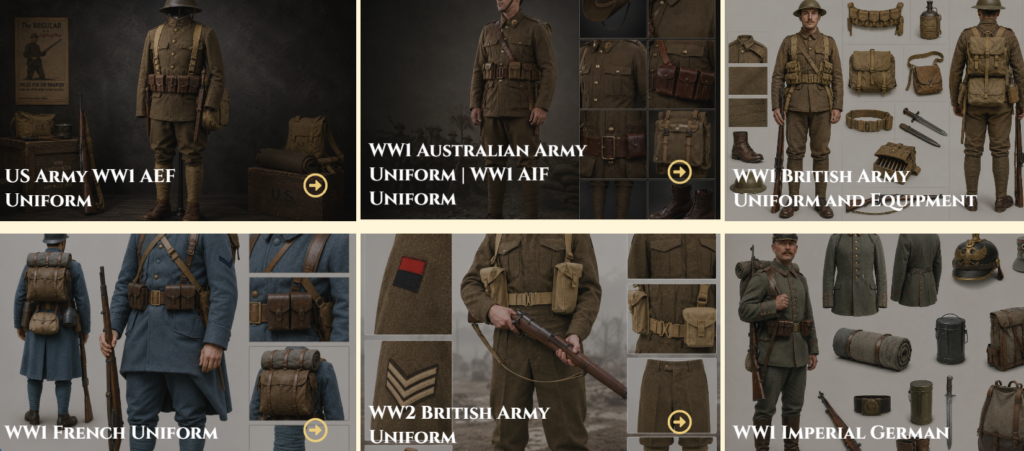
The Industrial Challenge of Clothing Millions
Before the outbreak of the war, most European armies relied on small contracts with regional tailors and localized supply depots. When millions of men volunteered or were conscripted, the supply chain nearly collapsed under the pressure.
Every major combatant nation faced its own unique manufacturing hurdle:
- Great Britain: The War Office had to rapidly standardize the 1902 Pattern Service Dress. British mills in Yorkshire worked around the clock to weave millions of yards of heavy, scratchy khaki serge wool.
- Imperial Germany: German factories had to transition from peacetime Prussian blues to the famous field grey (Feldgrau). As the Allied naval blockade tightened, manufacturers had to get creative, utilizing substitute materials (Ersatz) like paper yarn and recycled wool blends to keep up with frontline demand.
- The United States: Entering the war late in 1917, the US military had to rapidly scale up production of its olive drab (OD) wool tunics, relying on dozens of civilian garment factories converted overnight into military supply lines.
The original WW1 army uniform manufacturer wasn’t just making clothes; they were creating a soldier’s primary defense against the harsh, muddy, and freezing conditions of the Western Front. The thickness of the wool, the reinforcing stitching on the seams, and the durability of the buttons were quite literally matters of life and death.
The Hunt for Authenticity Today
For modern reenactors, museum curators, and film productions, stepping into the boots of a Great War soldier requires an extreme level of attention to detail. You cannot simply wear a generic costume; the weight, the cut, and the weave of the fabric must perfectly match historical specifications.
Historically accurate garments can be difficult to replicate due to the unique weave styles of the early 20th century, such as heavy serge, whipcord, and Bedford cord. When searching for a high-quality ww1 army uniform online, buyers often struggle to find reproductions that avoid modern synthetic blends—which look cheap under cameras or fail to hold up during rigorous field reenactments.
+-----------------------------------------------------------------------+
|             WHAT SEPARATES A COSTUME FROM A REPLICA?                  |
+------------------------+----------------------------------------------+
| Feature                | Premium Historical Reproduction              |
+------------------------+----------------------------------------------+
| Fabric Type            | Heavy, high-density 100% wool or wool-blend  |
| Hardware               | Period-correct brass, steel, or bone buttons |
| Stitching              | Authentic patterns, including internal lining|
| Fit                    | High-waisted, period-accurate tailoring      |
+------------------------+----------------------------------------------+
Replicamilitary: Preserving Living History
If you are looking to honor the brave soldiers of the Great War with a premium, historically faithful kit, Replicamilitary bridges the gap between the past and the present. Standing out as a premier modern WW1 army uniform manufacturer, they specialize in bringing archival blueprints back to life.
Whether you need a British Tommy’s khaki service dress, an Imperial German Feldrock, or doughboy olive drabs, Replicamilitary ensures that every garment meets rigorous historical standards. By combining authentic pattern drafts with durable, period-accurate textiles, they supply living history enthusiasts worldwide with gear that looks, feels, and weathers just like the originals.
When you purchase a ww1 army uniform online from their collection, you aren’t just buying a piece of clothing—you are investing in a meticulously researched piece of historical craftsmanship built to withstand the rigors of the field.