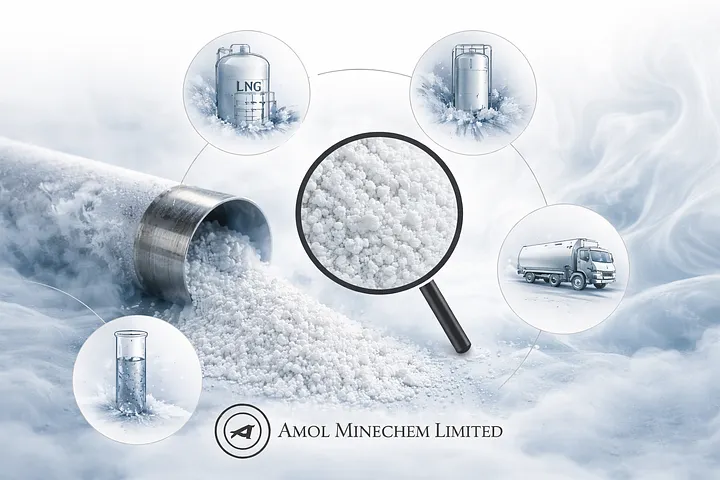
When engineers design storage systems for liquefied gases, the thermal challenge is unlike anything found in conventional construction. Liquid nitrogen sits at minus 196 degrees Celsius. Liquid oxygen is stored at minus 183 degrees. LNG tanks operate at minus 162 degrees. At those temperatures, even a minor insulation gap does not just reduce efficiency. It creates cold spots, structural stress, and in some cases, genuine safety risk. The material chosen to fill the annular space of these double-walled tanks must be reliable across a temperature range that stretches from deep cryogenic lows to ambient and beyond.
Cryogenic perlite has become the industry-accepted answer to that challenge, and for good reason.
What Makes Cryogenic Perlite Different from Other Insulation Materials
Perlite in its raw form is a siliceous volcanic rock carrying two to six percent combined water within its glassy structure. When the ore is crushed and rapidly heated above 871 degrees Celsius, that water vaporises and the softened material expands up to twenty times its original volume. The result is a lightweight, white, cellular material packed with microscopic closed-cell air pockets.
Those air pockets are the source of its thermal performance. Cryogenic perlite maintains a thermal conductivity of approximately 0.044 W/mK at ambient temperature, and that figure holds dependably across a service range from minus 269 degrees Celsius all the way up to plus 1,093 degrees Celsius. Very few insulation materials can make that claim without degrading, shrinking, or absorbing moisture at one end of that range or the other.
The closed-cell structure also means moisture retention stays at 0.5 percent maximum, a specification that matters enormously in cryogenic service. Any moisture trapped inside an insulation annulus will freeze at operating temperatures, form ice, expand, and compromise the structural integrity of the insulation fill over time.
Key Properties That Make It the Right Choice for Cryogenic Applications
Several properties work together to make cryogenic perlite a practical and long-term solution for gas storage insulation. It is non-combustible, which reduces insurance requirements and simplifies compliance with fire safety regulations. It does not shrink, swell, warp, or slump under thermal cycling, meaning the annular fill remains consistent across years of service. It is inorganic, so it resists rot and vermin. Bulk density for cryogenic-grade material typically runs between 35 and 50 kg per cubic metre loose, compacting to between 48 and 66 kg per cubic metre, specifications that influence both fill volume calculations and long-term settlement behaviour in large tanks.
Settlement is actually a critical concern in LNG and industrial gas storage. Over years of operation, even well-packed cryogenic perlite can develop voids as the material settles unevenly, particularly in very large tanks. Those voids create localised warm zones that appear as cold spots on the outer tank surface. Identifying and addressing these before they become structural problems requires both monitoring expertise and access to top-up services using on-site expansion equipment.
On-Site Expansion: Where Expertise Becomes the Differentiator
Not all cryogenic perlite suppliers offer on-site expansion capability. Transporting pre-expanded material over long distances is logistically difficult because of its extremely low bulk density, meaning the economics of cryogenic projects often favour suppliers who can bring portable expansion plants directly to the site and produce the material fresh at point of fill.
Amol Minechem Limited operates seven portable perlite expansion plants, each with a production capacity of 750 kg per hour, designed specifically for site expansion work developed over more than four decades of field experience. These plants deliver hot expanded cryogenic perlite directly into the tank or cold box, eliminating moisture pickup during handling and giving project teams full transparency over density, quality, and particle breakdown at the point of application.
The company has executed cryogenic insulation projects across India, China, Qatar, Egypt, Kuwait, the USA, and Canada, producing approximately 700,000 cubic metres of expanded perlite on-site globally. That includes 11 live top-up jobs on LNG tanks, 29 large LNG tanks completed worldwide, more than 55 LIN, LOX, LAR, and ethylene-propylene tanks, and over 70 cold boxes and ASU plants. Clients have included SAIPEM, LINDE, Air Liquide, Bechtel, Air Products, and Praxair, among others.
Cryogenic Perlite in Cold Boxes and ASU Plants
Beyond LNG storage, cryogenic perlite plays an equally important role in air separation units (ASUs) and cold boxes used in industrial gas production. These systems operate continuously at deep cryogenic temperatures, and the insulation performance of the perlite fill directly affects the energy efficiency of the separation process. Here, particle size distribution matters as much as bulk density. The standard cryogenic-grade specification calls for 90 to 100 percent passing a 1.18mm sieve, with particle sizing graduated down through 0.85mm, 0.6mm, 0.3mm, and 0.15mm fractions, each with defined minimum and maximum pass percentages, ensuring the fill packs efficiently without excessive void space or compaction resistance.
Why Sourcing from a Process-Controlled Manufacturer Matters
For procurement teams specifying insulation materials for cryogenic projects, the technical sheet is only part of the decision. Consistency batch to batch, reliable delivery to site, and access to a team capable of executing the fill work are equally important factors.
With over 45 years in perlite production, ISO certification, and a field team experienced in executing cryogenic projects across four continents, Amol Minechem Limited brings both the material and the execution capability under one roof. For project teams working on LNG storage, ASU construction, or maintenance top-ups of existing cryogenic tanks, that combination is what turns a material specification into a reliable project outcome.