
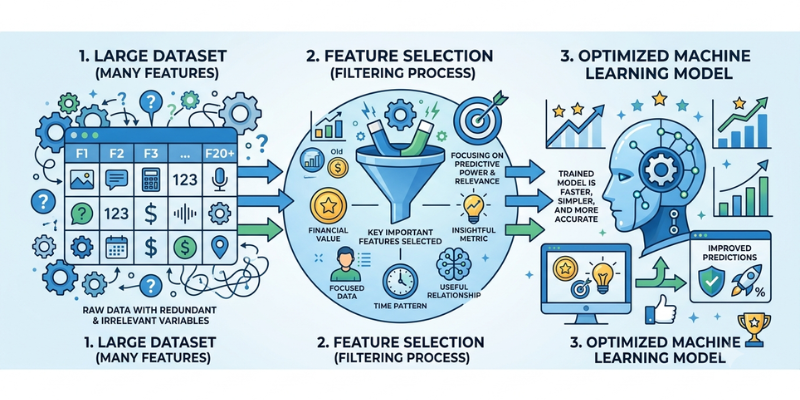
Machine learning models perform better when they learn from useful and relevant data. However, not every piece of information in a dataset helps improve predictions. Some features may be unnecessary, while others may even reduce the accuracy of a model. This is why feature selection is an important step in the data science process. It helps you identify the most valuable inputs before training a model. If you want to build a strong foundation in these concepts, you can take a Data Science Course in Trivandrum at FITA Academy to gain practical knowledge through guided learning.
What is Feature Selection
Feature selection involves identifying the most pertinent variables from a dataset to construct a machine learning model. These selected features provide useful information while reducing unnecessary or repetitive data. By retaining just the key features, you can build models that are simpler to comprehend and frequently more precise.
For example, if you are predicting house prices, features such as location, property size, and number of bedrooms may be more useful than the color of the front door. Selecting the right features helps the model focus on the information that truly matters.
Why Feature Selection Is Important
Feature selection offers several advantages during model development. It reduces the amount of data that the model needs to process, which can improve training speed. It also reduces the likelihood of overfitting, which occurs when a model excels on training data but has difficulty with unfamiliar data.
Another important benefit is improved interpretability. When a model uses fewer features, it becomes easier to understand how it reaches its predictions. This is especially useful in industries where decision-making must be clear and transparent.
Common Feature Selection Techniques
There are several methods used to select useful features. Each technique has its own strengths and is suitable for different types of datasets.
Filter Methods
Filter methods evaluate each feature independently by using statistical measures. They rank features based on their relationship with the target variable. The highest ranked features are selected before the model is trained. These methods are simple, fast, and work well with large datasets.
Wrapper Methods
Wrapper methods test different combinations of features by repeatedly training and evaluating a machine learning model. The goal is to find the combination that produces the best performance. Although these methods often deliver accurate results, they usually require more processing time because many models need to be tested. If you want to practice these techniques with real datasets, explore a Data Science Course in Kochi and strengthen your practical machine learning skills.
Embedded Methods
Embedded methods perform feature selection while the model is being trained. Some machine learning algorithms automatically identify which features contribute the most to predictions. This approach combines the advantages of good performance and efficient training, making it a popular choice in many real-world applications.
Choosing the Right Technique
The best feature selection technique depends on your dataset, project goals, and available computing resources. Filter methods are suitable when you need quick results on large datasets. Wrapper methods are helpful when prediction accuracy is the highest priority. Embedded methods provide a balanced solution by selecting features during model training.
It is also important to understand your data before applying any method. Analyzing the connections between features, eliminating redundant information, and recognizing unrelated variables can enhance the quality of the ultimate model.
Common Challenges
Feature selection is not always straightforward. Some important features may appear less useful when examined individually but become valuable when combined with other variables. Highly related features can also make the selection process more difficult.
Another challenge is selecting too few features. Removing important information may reduce the model’s ability to make accurate predictions. Careful testing and evaluation help ensure that the selected features provide the best balance between simplicity and performance.
Choosing the right features is a crucial stage in creating dependable machine learning models. It improves model efficiency, reduces unnecessary complexity, and helps create more accurate predictions. By understanding filter, wrapper, and embedded methods, beginners can make better decisions when preparing data for machine learning projects. As you continue developing your skills, regular practice with different datasets will help you understand when each technique is most effective. To deepen your knowledge with structured learning and hands-on projects, join a Data Science Course in Pune and continue building your expertise with confidence.