Operating a commercial airline involves managing complex operational trade-offs across safety, payload limits, and passenger perception. While travelers interact directly with cabin textiles—relaxing against headrest covers, wrapping themselves in fleece blankets, or using dining linens—few appreciate the material science required to produce these everyday soft goods. Cabin fabrics must meet strict international airworthiness standards while contributing to fleet fuel efficiency and enduring rapid commercial turnarounds.
Sourcing certified, engineered soft goods from an experienced airline textile supplier is an operational essential for airline fleet managers and cabin safety procurement teams. Every textile item introduced into a pressurized aircraft cabin must satisfy rigorous safety requirements without adding unnecessary weight to the aircraft.
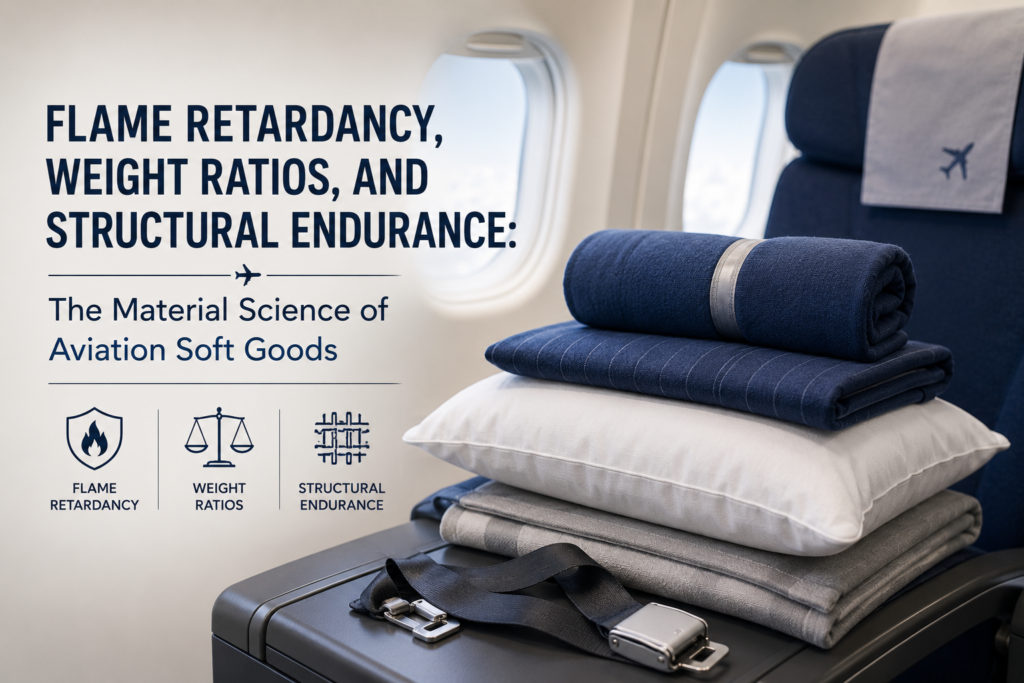
Thermal Barrier Engineering: Flammability and Toxicity Standards
Safety is the baseline requirement for commercial aviation. Because an aircraft cabin is a pressurized, enclosed environment with strict emergency evacuation timelines, cabin materials must act as active flame barriers rather than potential fuel sources.
Regulatory authorities, including the Federal Aviation Administration (FAA) and the European Union Aviation Safety Agency (EASA), mandate strict compliance with FAR 25.853 (Appendix F) flammability standards.
Vertical Flammability Testing
To pass airworthiness certification, cabin fabrics undergo vertical flame tests in certified laboratories. Samples are suspended vertically and exposed directly to a burner flame at 1,550°F (843°C) for up to 60 seconds. To earn certification, the fabric must:
- Self-extinguish within seconds after the flame source is removed.
- Exhibit a total burn length well below regulated thresholds.
- Produce zero flaming drippings that could ignite adjacent seating or carpet materials.
Molecular Inherently Flame-Resistant (IFR) Fibers
Rather than relying on chemical spray treatments that degrade and wash out during industrial laundering, high-performance aviation fabrics are woven from Inherently Flame-Resistant (IFR) polymers, such as modified modacrylics, aramids, or modified polyesters. The flame-retardant properties are built directly into the fiber’s molecular structure, ensuring permanent safety compliance throughout the material’s operational life.
Smoke Density and Toxicity Controls
During thermal decomposition, burning materials release smoke and volatile gases. Aviation textiles are engineered to emit minimal smoke density and extremely low levels of toxic gases (such as hydrogen cyanide, carbon monoxide, and hydrogen chloride), preserving cabin visibility and breathing safety during emergency evacuations.
Static Electricity Dissipation
At cruising altitudes, relative humidity inside pressurized cabins frequently drops below 15%. Dry air promotes static electricity accumulation on synthetic surfaces. Interweaving microscopic carbon or stainless-steel anti-static threads into cabin blankets and upholstery allows static charges to dissipate safely, preventing uncomfortable shocks when passengers move or adjust their bedding.
The Physics of Fuel Efficiency: Fabric Weight and Microfiber Geometry
Weight control is a continuous priority in fleet operations. Every additional kilogram carried onboard increases fuel consumption, operational costs, and carbon emissions over thousands of flight hours. Consequently, fleet procurement teams continually seek opportunities to reduce weight across all cabin components, including soft goods.
Sourcing lightweight inflight blankets and pillowcases constructed with engineered fiber geometries provides immediate operational savings:
- Hollow-Core Fiber Insulation: Utilizing synthetic microfibers designed with hollow inner cores creates microscopic air pockets within each thread. These trapped air pockets insulate effectively by reflecting body heat. This enables low-weight fleece blankets to deliver thermal comfort equal to traditional wool blankets at a fraction of the physical weight.
- Low Grams Per Square Meter (GSM): Advanced spinning techniques allow textile engineers to manufacture high-density fabrics at significantly lower GSM ratings. Reducing fabric weight while maintaining opacity and tensile strength lowers the aircraft’s overall takeoff mass.
- Compact Overhead and Galley Storage: High-density, low-weight fabrics compress efficiently into galley carts and overhead stowage bins, freeing up cabin space and simplifying inventory handling for flight crews.
Material Specifications Across Cabin Classes
Selecting the right textile construction requires matching the performance demands of each cabin zone with weight, safety, and durability targets.
| Cabin Application | Material Construction | Core Engineering Advantage |
| Economy Cabin Blankets | Low-GSM Inherently Flame-Retardant Micro-Fleece | Compact stowage, low weight, permanent fire safety compliance. |
| Premium Economy Duvets | Brushed Combed Poly-Cotton Matrix | High thermal retention, soft tactile hand-feel, wrinkle resistance. |
| First & Business Class Linens | Long-Staple Cotton-Poly Satin Weaves | Silky texture, high breathability, luxury presentation. |
| Headrest & Seat Covers | High-Tenacity Woven Synthetic Blends | Antimicrobial, stain-resistant, durable under heavy abrasion. |
| Inflight Refreshing Towels | 100% Low-Twist Combed Cotton Terry | High moisture absorbency, plush volume, excellent heat retention. |
Premium Cabin Fabrics and Brand Identity
In premium cabin environments, soft goods serve as tactile touchpoints that communicate brand quality and attention to detail. Passengers paying for First and Business Class accommodations expect an inflight environment that mirrors the comfort of a boutique hotel.
Utilizing specialized wholesale airline fabrics enables carriers to create a cohesive, branded cabin environment:
- Custom Jacquard Weaving: Intricately woven blankets featuring custom geometric patterns, corporate brand colors, and subtle logos elevate the visual presentation during passenger boarding.
- Hypoallergenic Pillow Covers: Smooth, breathable pillowcases protect passenger skin from friction and static during long-haul sleep, encouraging restful travel.
- Anti-Slip Dining Linens: Tablecloths and napkins woven with high-friction backing keep meal trays, glassware, and cutlery stable during light cabin turbulence.
- Hot and Cold Refreshing Towels: Absorbent, plush cotton terry towels presented before meals or prior to landing provide a refreshing sensory detail that helps alleviate travel fatigue.
Structural Resilience Under High-Frequency Institutional Laundering
Commercial aircraft operate on demanding turnaround schedules, requiring soft goods inventory to rotate rapidly between flight segments. Inflight textiles are collected, laundered, sanitized, repacked, and reloaded continuously, exposing them to far more wash cycles than typical commercial linens.
To remain service-ready across these high-frequency laundry cycles, aviation soft goods must be built for structural durability:
- High-Tenacity Edge Finishing: Reinforced double-needle stitching and lock-stitched borders prevent frayed edges, warping, or tearing during high-speed industrial extraction.
- Stain-Release Treatments: Synthetic fibers treated with advanced stain-release finishes shed food, wine, and makeup stains easily during standard wash cycles, maintaining a clean appearance.
- High-Temperature Color Fastness: Deep brand dyes are locked into the synthetic fiber matrix, resisting fading even when exposed to heavy sanitizing chemicals and high-heat drying cycles.
- Protective Sanitary Packaging: Once cleaned, blankets and pillows are sealed in protective, recyclable film to preserve cleanliness and ensure hygiene for the next passenger.
Frequently Asked Questions
1. Why do airline blankets require specialized fire safety certifications?
Because aircraft cabins are enclosed environments with strict emergency evacuation timelines, all soft goods must pass vertical flammability tests. This ensures fabrics will not easily ignite, spread flames, or produce dense, toxic smoke in an emergency.
2. What is the operational advantage of inherently flame-resistant (IFR) fabrics over topical chemical treatments?
Topical fire-retardant coatings can wash out or wear off over time through repeated commercial laundering. Inherently flame-resistant fibers are flame-retardant at the molecular level, ensuring the fabric remains safe and compliant throughout its operational lifespan.
3. How do low-GSM hollow-core fibers help airlines save fuel?
Hollow-core fibers contain microscopic air pockets inside each strand that trap body heat efficiently. This allows the fabric to deliver warmth equal to a heavy wool blanket at a fraction of the weight, directly lowering the aircraft’s takeoff mass and fuel burn.
4. Why are synthetic blends preferred for economy cabin textiles?
Synthetic microfibers and modified polyesters offer high tensile strength, dry quickly, resist wrinkling, and weigh significantly less than natural wool or heavy cotton. This combination makes them cost-effective to launder, transport, and store across large fleets.
Final Thoughts
Balancing safety compliance, fuel weight management, and passenger comfort requires a thorough understanding of advanced textile engineering. From flame-retardant blankets that keep long-haul passengers comfortable to durable, stain-resistant dining linens used in premium cabins, every fabric selection directly affects operational performance and brand perception. Sourcing certified, high-performance soft goods from an experienced supplier of commercial airline textiles and linens ensures fleet operators maintain full regulatory compliance, reduce fuel consumption, and deliver a clean, comfortable journey for every passenger.