
Environmental sustainability has become a major priority for organizations across the globe. Businesses are increasingly expected to reduce their environmental impact, comply with regulations, and demonstrate their commitment to sustainable practices. As Saudi Arabia continues to advance its Vision 2030 goals, environmental responsibility has become an essential part of business operations. This is where ISO 14001:2015 Environmental Management System (EMS) Certification plays a crucial role.
Organizations seeking ISO Certification in KSA are implementing ISO 14001 to improve environmental performance, reduce waste, conserve resources, and strengthen their reputation. Whether you operate in manufacturing, construction, logistics, healthcare, oil and gas, or service industries, ISO 14001 can help your organization achieve sustainable growth while meeting environmental obligations.
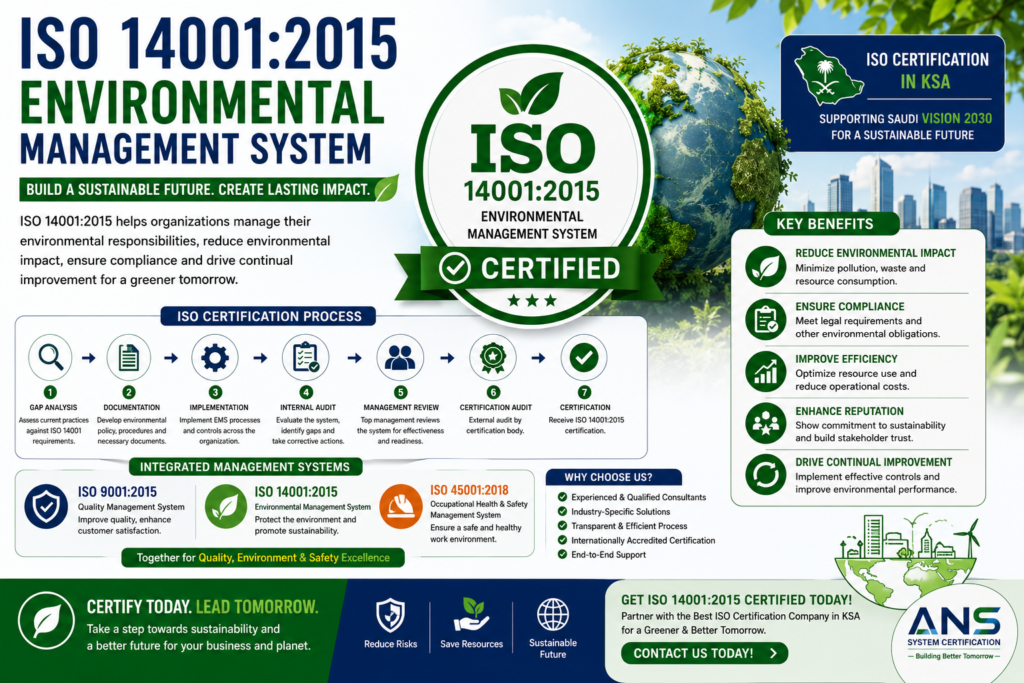
What is ISO 14001:2015?
ISO 14001:2015 is an internationally recognized standard for Environmental Management Systems (EMS). It provides a framework that helps organizations identify, monitor, manage, and continuously improve their environmental performance.
The standard enables businesses to:
- Reduce environmental impact
- Improve resource efficiency
- Manage environmental risks
- Meet legal and regulatory requirements
- Support sustainability initiatives
- Enhance corporate reputation
Organizations obtaining ISO Certification in Saudi Arabia often implement ISO 14001 to demonstrate their commitment to environmental responsibility and sustainable business practices.
Why Environmental Management is Important
Environmental concerns such as pollution, waste generation, energy consumption, and resource depletion are becoming increasingly significant. Governments, customers, and stakeholders expect businesses to operate responsibly and minimize environmental harm.
Effective environmental management helps organizations:
Reduce Waste
Organizations can identify areas where resources are wasted and implement measures to reduce environmental impact.
Improve Compliance
ISO 14001 supports compliance with environmental laws, regulations, and industry requirements.
Enhance Corporate Image
Environmentally responsible businesses gain greater trust from customers, investors, and stakeholders.
Lower Operational Costs
Reducing energy consumption, waste disposal, and resource usage often leads to significant cost savings.
Support Sustainable Growth
Organizations become better positioned for long-term success while contributing positively to the environment.
Benefits of ISO 14001 Certification
Implementing ISO 14001 offers numerous business and environmental advantages.
Improved Environmental Performance
Organizations can monitor and control environmental aspects more effectively.
Better Risk Management
Environmental risks are identified, evaluated, and managed systematically.
Increased Customer Confidence
Customers increasingly prefer businesses committed to sustainability and environmental responsibility.
Enhanced Regulatory Compliance
Organizations can better manage environmental obligations and reduce compliance risks.
Improved Business Opportunities
Many government projects and international contracts prefer suppliers with environmental certifications.
These benefits make ISO Certification in KSA an important strategic investment for organizations seeking sustainable growth.
Industries That Benefit from ISO 14001 Certification
ISO 14001 can be implemented across various sectors, including:
- Manufacturing Industries
- Construction Companies
- Oil and Gas Sector
- Logistics and Transportation
- Healthcare Organizations
- Educational Institutions
- Hospitality Industry
- Information Technology Companies
- Government Organizations
- Service-Based Businesses
Any organization aiming to improve environmental performance can benefit from implementing an Environmental Management System.
Understanding the ISO Certification Process
Achieving certification becomes much easier when organizations follow a structured ISO Certification Process.
Step 1: Gap Analysis
Current environmental management practices are evaluated against ISO 14001 requirements.
Step 2: Documentation Development
Environmental policies, objectives, procedures, and records are created.
Step 3: System Implementation
The organization implements environmental controls and management procedures.
Step 4: Internal Audit
Internal audits assess compliance and identify areas requiring improvement.
Step 5: Management Review
Top management evaluates system effectiveness and readiness for certification.
Step 6: Certification Audit
External auditors review the Environmental Management System for compliance.
Step 7: Certification Approval
Successful organizations receive ISO 14001 certification.
A well-planned ISO Certification Process ensures successful implementation and long-term compliance.
ISO 14001 and Sustainable Business Growth
Modern businesses are increasingly expected to align their operations with sustainability goals. ISO 14001 helps organizations establish a culture of environmental responsibility that supports long-term growth.
Key sustainability benefits include:
- Reduced carbon footprint
- Improved energy efficiency
- Better waste management
- Conservation of natural resources
- Enhanced environmental awareness among employees
These improvements contribute to both environmental protection and business profitability.
Integrated Management Systems: ISO 9001, 14001, 45001 Certification
Many organizations choose to implement multiple ISO standards together to achieve comprehensive operational excellence.
ISO 9001 Certification
Focuses on quality management and customer satisfaction.
ISO 14001 Certification
Addresses environmental management and sustainability.
ISO 45001 Certification
Improves occupational health and safety performance.
Implementing ISO 9001, 14001, 45001 Certification creates an integrated management system that improves efficiency, compliance, and overall business performance.
Choosing the Best ISO Certification Company in KSA
Selecting the right certification provider is essential for successful implementation.
Organizations looking for the Best ISO Certification Company in KSA should evaluate:
- Industry experience
- Qualified auditors
- International recognition
- Customer support
- Transparent certification procedures
Working with the Best ISO Certification Company in Saudi Arabia helps organizations achieve certification efficiently while maintaining compliance with international standards.
Global Expertise and ISO Certification in India
Many organizations operate across Saudi Arabia and India and require internationally recognized certification services.
A Top ISO Certification Company in India can provide expert guidance, implementation support, and certification services for organizations seeking global compliance.
Businesses pursuing ISO Certification in India often work with experienced consultants to streamline implementation and maintain certification success.
Partnering with the Best ISO Certification Company in India ensures access to industry expertise and globally recognized certification practices.
Conclusion
ISO 14001:2015 Environmental Management System Certification helps organizations improve environmental performance, reduce operational risks, and support sustainable business growth. As environmental responsibility becomes increasingly important, obtaining ISO Certification in KSA demonstrates a company’s commitment to sustainability and regulatory compliance.
Whether your organization is pursuing ISO Certification in Saudi Arabia, implementing ISO 9001, 14001, 45001 Certification, or seeking guidance from the Best ISO Certification Company in KSA, ISO 14001 provides a valuable framework for achieving environmental excellence and long-term business success.