
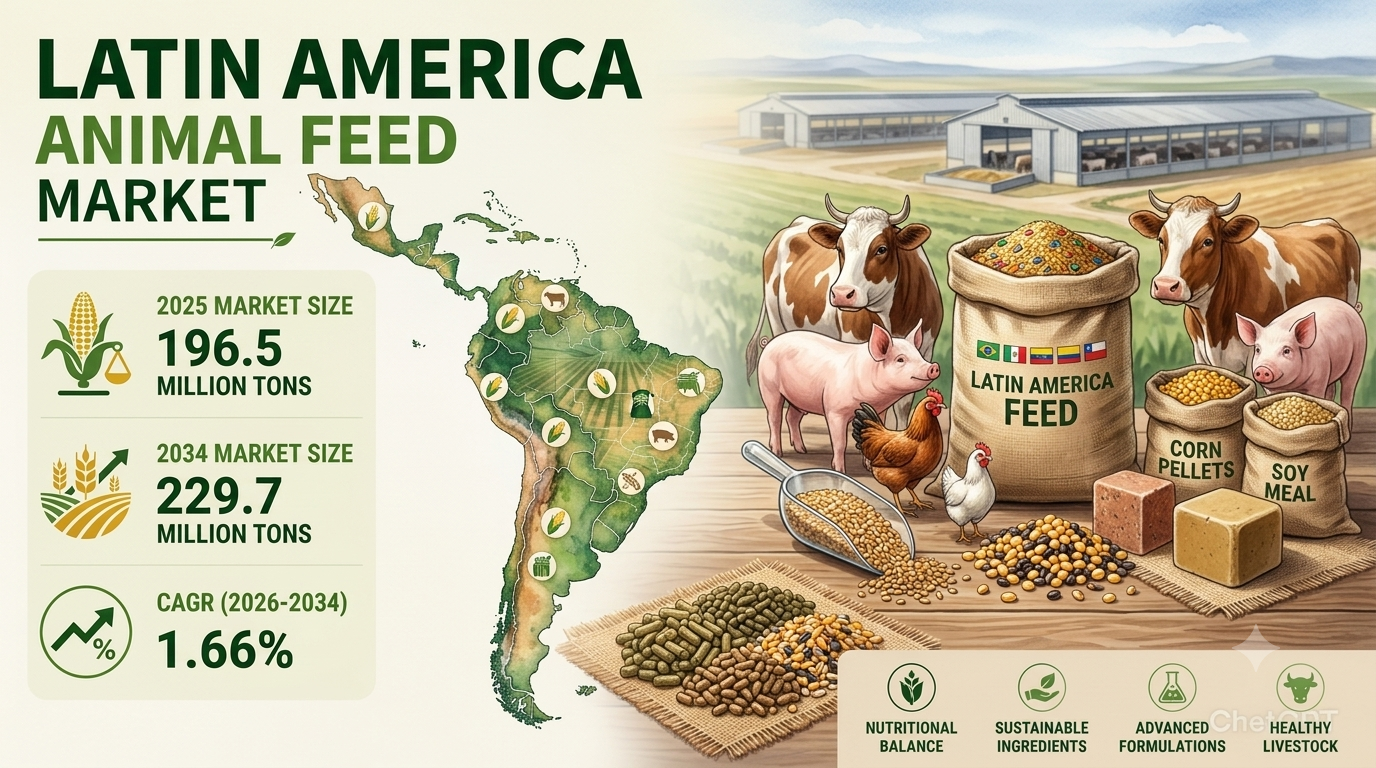
The Latin America animal feed market is witnessing steady growth driven by rising demand for animal protein, expanding livestock production, and increasing urbanization across the region. The market size reached a volume of 196.5 Million Tons in 2025 and is projected to reach 229.7 Million Tons by 2034, exhibiting a compound annual growth rate (CAGR) of 1.66% during 2026-2034. Brazil currently dominates the market, holding a significant market share, driven by its large poultry and beef industries. The region’s extensive agricultural hinterland supplies essential raw materials like corn and soybean meal, supporting sustained feed production. With Latin America being one of the world’s most important production hubs in the global animal protein supply chain, the animal feed market is strategically important to the region’s agricultural economy and export competitiveness.
The Latin America animal feed market is poised for sustained expansion, driven by rising protein consumption, expanding poultry and aquaculture sectors, and increasing investments in feed technology. With a projected CAGR of 1.66% through 2034, the market presents significant opportunities for established feed manufacturers and new entrants focused on nutritional innovation and sustainable formulations.
LATIN AMERICA ANIMAL FEED MARKET SUMMARY
The Latin America animal feed market encompasses a wide range of products designed to provide essential nutrition for livestock, poultry, aquaculture, and other animals, supporting meat, dairy, and egg production across the region. The ecosystem includes raw material suppliers (corn, soybean meal, oilseed meals, fishmeal), feed manufacturers, blenders, distributors, and end-use consumers across the livestock value chain. Major segments identified in the market include type (compound feed, fodder, forage, and feed additives), livestock (poultry, swine, cattle, aquaculture, pet food, equine, and others), raw material (cereals, oilseed meals, proteins, vitamins, minerals, and additives), and production system (integrated farming, commercial, and smallholder). Brazil leads the market, accounting for more than 40% of the regional market share, followed by Mexico and Argentina as key contributors.
PORTER’S FIVE FORCES ANALYSIS — LATIN AMERICA ANIMAL FEED MARKET
The competitive dynamics of the Latin America animal feed market can be analyzed using Porter’s Five Forces framework.
- Competitive Rivalry: The market features multi-tier competition spanning global agribusiness leaders (Cargill, ADM, DSM), regional players, and local feed manufacturers. The industry remains fragmented, with the top five companies generating a relatively modest share of total production value. Competitive differentiation is driven by product quality, nutritional innovation, supply chain efficiency, and customer relationships rather than purely price competition.
- Supplier Power (Raw Materials): Suppliers of key raw materials such as corn, soybean meal, and other feed ingredients have moderate bargaining power due to the region’s abundant agricultural production. However, price volatility in global commodity markets and weather-dependent harvests can temporarily shift power toward suppliers. Large integrated feed producers with backward integration into crop production enjoy greater bargaining leverage.
- Buyer Power: Large-scale livestock producers, poultry integrators, and aquaculture operators have moderate bargaining power due to their volume purchasing and ability to switch between feed suppliers. However, feed quality and nutritional consistency are critical success factors, limiting buyer leverage to some extent.
- Threat of Substitutes: Alternative feeding practices such as on-farm fodder production, grazing, and traditional feeding methods pose substitution threats, particularly for smallholder operations. However, the trend toward commercial livestock farming and intensive production systems favors formulated compound feeds over traditional alternatives.
- Threat of New Entrants: Significant barriers to entry exist in the form of capital requirements for feed manufacturing facilities, supply chain infrastructure, regulatory compliance, and establishing distribution networks. However, the region’s growing market and favorable agricultural conditions continue to attract new domestic and international entrants. Established players benefit from scale economies, raw material sourcing advantages, and long-standing customer relationships.
Request for Sample Report: https://www.imarcgroup.com/latin-america-animal-feed-market/requestsample
MARKET GROWTH DRIVERS:
Several key factors are propelling the expansion of the Latin America animal feed market.
Expanding Livestock Production and Meat Exports
The region’s expanding cattle, poultry, and swine industries serve as powerful demand drivers for animal feed. Brazil and Argentina are major players in global supply chains for animal proteins, being among the world’s leading producers and exporters of cattle, chicken, and pork. This intense production level demands a steady and significant supply of good-quality animal feed for consistency, efficiency, and competitiveness. Brazil produces approximately 30 million tonnes of meat annually, driving feed demand of around 85–90 million tonnes.
Rising Domestic Consumption of Animal Products
Growing local demand for products of animal origin, together with high export prospects, is another main force behind the Latin American animal feed market. With continued urbanization and rising disposable income levels, particularly in Brazil, Mexico, and Colombia, people are adding more animal proteins to their diets, driving demand for meat, dairy, and eggs. This fuels growth in the poultry, dairy, aquaculture, and swine sectors, all of which are feed-intensive industries.
Government Support and Sustainable Agriculture Initiatives
Government incentives toward sustainable agriculture and availability of large-scale feed makers are further impacting the overall Latin America animal feed market share. Trade agreements and international market access are stimulating governments and private players to enhance the feed supply chain, upgrade infrastructure, and enhance research in feed technology, underpinning long-term regional growth. The growing emphasis on sustainable and natural feed ingredients is also shaping market trends.
Advances in Feed Formulation Technology
Growing poultry and aquaculture sectors in nations such as Brazil, Argentina, and Mexico, along with advances in feed formulation technology and growing emphasis on animal productivity and health, are fueling market growth. To remain competitive in export markets, producers are investing in sophisticated feeding systems, nutritional additives, and feed formulations that enhance animal health, growth rates, and production efficiency.
LATIN AMERICA ANIMAL FEED MARKET SEGMENTATION
Segmentation analysis provides a detailed view of the Latin America animal feed market by category:
- Type Insights: Compound Feed, Fodder, Forage, Feed Additives.
- Livestock Insights: Poultry, Swine, Cattle, Aquaculture, Pet Food, Equine, Others.
- Raw Material Insights: Cereal Grains, Oilseed Meals (Soybean Meal), Protein Meals (Fishmeal, Animal By-product Meals), Vitamins, Minerals, Feed Additives.
- Production System Insights: Integrated Farming, Commercial Production, Smallholder Operations.
- Country Insights: Brazil, Mexico, Argentina, Colombia, Chile, Rest of Latin America.
COMPETITIVE LANDSCAPE
The Latin America animal feed market features a fragmented competitive landscape, with multi-tier competition spanning global agribusiness leaders and strong regional players. Key companies operating in the market include:
- Cargill — Leads the Latin American feed market with extensive manufacturing plants in Brazil and Mexico.
- ADM (Archer Daniels Midland) — Intensifying animal nutrition focus in South America, aiming to be among the top five animal nutrition companies in the region within five years.
- DSM Produtos Nutricionais Brasil SA — The largest company in Brazil, generating 3.4% of the industry’s total production value in 2024.
- Other Regional and Global Players — Including various domestic feed manufacturers and international entrants.
Strategic developments are shaping the competitive arena, notably ADM’s expansion of animal nutrition operations in South America, including the opening of a new premix and feed additives production facility in Apucarana, Paraná, Brazil, with an annual capacity of 40,000 tonnes.
REGIONAL ANALYSIS:
Regional dynamics within the Latin America animal feed market are shaped by varying levels of livestock concentration and agricultural activity:
- Brazil emerges as the dominant demand center, holding more than 40% of the regional market share, driven by its large poultry and beef industries. Brazil’s animal meat production of approximately 30 million tonnes annually drives feed demand of around 85–90 million tonnes.
- Mexico is a significant contributor, with layer feed production growing by 4.7% due to robust domestic demand, and poultry serving as the country’s No. 1 choice of protein.
- Argentina benefits from vast cattle ranching operations, with cattle feed being particularly significant. The country is a major player in global animal protein supply chains.
- Colombia and Chile represent growing markets, with rising disposable income levels and increasing animal protein consumption driving feed demand.
RECENT INDUSTRY DEVELOPMENTS
June 2026: ADM opened a new premix and feed additives production plant in Apucarana, Paraná, Brazil, featuring enhanced mixing precision with dosage control, cross-contamination mitigation, and agile traceability capabilities to supply the entire Brazilian market.
March 2026: ADM ramped up animal nutrition operations in Brazil with the new premix plant, targeting a top-five position in South America, with plans for export expansion.
January 2026: ADM entered advanced talks to sell its feed mill in Três Corações, Minas Gerais, to Brazilian agribusiness group Agronorte.
2025: Brazil’s feed industry continued to increase production, with idle capacity in the feed industry indicating potential for further production increases if needed.
2024: The Latin America animal feed additives market was valued at USD 3 billion, projected to expand at over 5.7% CAGR from 2025 to 2034.
Note: If you need any specific information that is not covered currently within the scope of the report, we will provide the same as a part of customization.
Request Customization: https://www.imarcgroup.com/request?type=report&id=4554&flag=E
Write this before about us —
- Report Format, Delivery, and Customization Details
- Report Format Mode: PPT, PDF, and Excel
- Report Delivery Mode: Online Delivery, Physical Delivery
- Report Delivery Time: Report Delivered Over Email within 24 to 48 hours. If requested by the client, a physical copy will be delivered within three to ten days.
- Report Confirmation Mode: Yes via Email
- Report Customization Mode: Yes via Email / Call
- Report Table of Content: Yes
- Report List of Figures: Yes
- Report Methodology Mode: Yes
- Request For Sample Report: Yes