There is a certain kind of silence that exists only above 17,000 feet, the kind you hear when your engine idles at a mountain pass, snow-capped peaks stretching in every direction, and not another soul in sight. This is the silence that draws thousands of riders every year to one destination: Ladakh. And if you’re planning to chase that silence on two wheels, Leh Ladakh Motorcycle Tours are the single most talked-about riding experience in India, if not all of South Asia.
This isn’t a guide written to repeat what you’ve already read elsewhere. This is a deep, practical, occasionally blunt look at what riding through Ladakh actually involves the terrain, the planning, the risks, the joy, and why choosing the right team to ride with, like Royalbike Riders, can be the difference between a trip you survive and a trip you’ll talk about for the rest of your life.
Why Ladakh Isn’t Just Another Motorcycle Trip
Most motorcycle trips are about scenery. Ladakh is about transformation. The region sits in a rain-shadow desert wedged between the Himalayas and the Karakoram range, meaning it barely gets rainfall, yet it’s carved by glacial rivers, dotted with turquoise lakes, and crowned by some of the highest motorable passes on the planet.
Riders come here not just to see Ladakh but to test themselves against it. The altitude alone changes everything: the way your bike breathes, the way your lungs work, the way ordinary tasks like refueling or changing a tire suddenly require more effort. That’s not meant to scare you off. It’s meant to explain why this particular stretch of Himalayan tarmac and gravel, and river crossing, and scree has earned a reputation that draws riders from Germany, Israel, Australia, and everywhere in between, not just domestic travelers on a bucket-list checkbox.
The Real Terrain: What Nobody Tells You Upfront
Glossy brochures show you Pangong Lake at sunset. They rarely show you the forty-kilometer stretch before Pangong where the road disappears into loose gravel and your rear wheel starts fishtailing without warning. They rarely mention the Border Roads Organisation crews working year-round just to keep these passes open, or the fact that a road that was smooth tarmac last season might be a construction zone this season.
Khardung La, often and slightly inaccurately marketed as the highest motorable pass in the world, sits at roughly 17,982 feet. Riding here means dealing with thinner oxygen, colder temperatures even in July, and bikes that lose noticeable power output simply because there’s less air for combustion. Then there’s Chang La, Tanglang La, and the infamous Baralacha La on the Manali route, each with its own personality, its own weather patterns, its own hazards.
River crossings are another element that catches first-timers off guard. The Zanskar route and portions near Nubra Valley require riders to cross glacial meltwater streams that can rise dramatically within hours depending on daytime temperatures upstream. What was a shallow trickle at 7 AM can become a knee-deep rush by 2 PM.
Choosing Your Machine
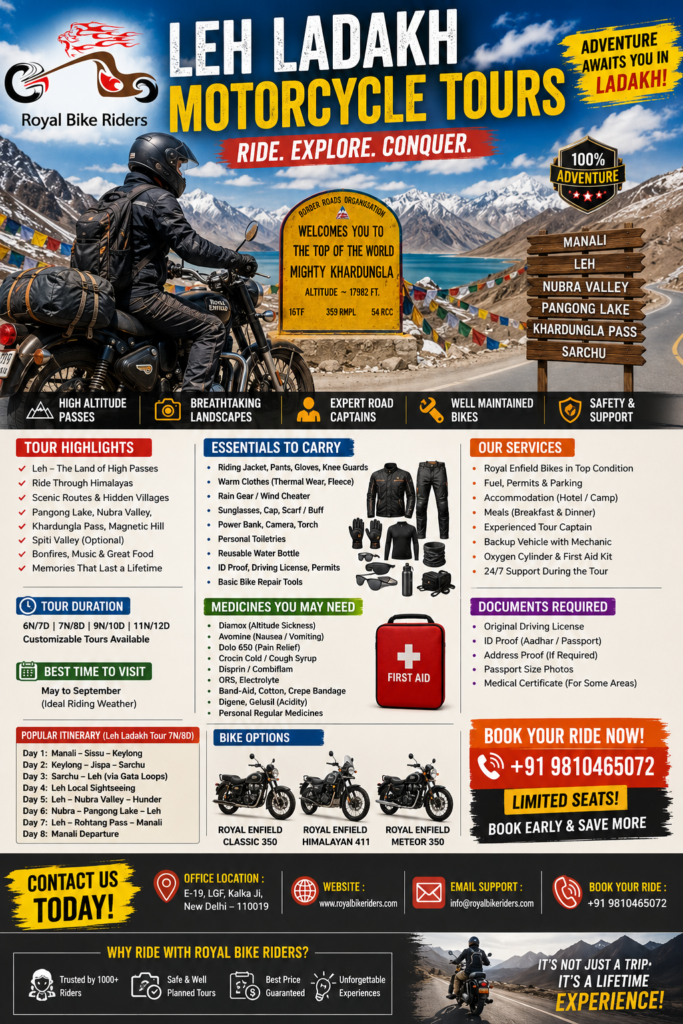
The romantic image of Ladakh riding is almost always a Royal Enfield and for good reason. The torque, the ground clearance, the sheer psychological comfort of that thumping single-cylinder engine has made bikes like the Himalayan, Classic 350, and Bullet the default choice for most tour operators, including Royalbike Riders. But comfort and nostalgia aside, what actually matters mechanically is:
- Ground clearance for the broken sections near Pang and More Plains
- Reliable cooling, since prolonged low-speed climbing generates heat even in cold air
- Simple mechanics that can be fixed roadside without specialized diagnostic tools
- Torque over top seed, since you’ll rarely exceed 60-70 km/h on most passes anyway
Adventure tourers like the KTM 390 Adventure or Himalayan 450 have gained popularity too, offering better suspension travel for the rougher patches. The choice ultimately depends on your riding experience, comfort with weight distribution, and whether you’re chasing nostalgia or performance.
The Route That Defines the Experience
While there are several ways to enter and exit Ladakh, two routes dominate the conversation among serious riders:
The Manali-Leh Highway is roughly 490 km of some of the most dramatic elevation changes in road travel. You start in green, pine-covered Himachal, climb through Rohtang or the Atal Tunnel, cross Baralacha La and Lachulung La, traverse the eerie lunar landscape of the Moore Plains, and descend into Leh through Tanglang La.
The Srinagar-Leh Highway is generally considered gentler in gradient but politically and logistically more sensitive depending on the season and security situation. It passes through Sonamarg, Zoji La, Kargil, and eventually into Leh via the Fotu La and Namika La passes.
Most well-planned itineraries including those run by Royalbike Riders combine both, entering via one and exiting via the other, so you experience the full contrast between Ladakh’s two access corridors rather than backtracking the same road twice.
Beyond Leh: The Valleys That Change the Trip
A common mistake first-time riders make is treating Leh as the destination rather than the gateway. The real magic often lies beyond the town itself.
Nubra Valley, accessed via Khardung La and the newer Wari La route, offers a bizarre and beautiful contrast sand dunes flanked by snow peaks, double-humped Bactrian camels grazing near Hunder, and the confluence of the Shyok and Nubra rivers.
Pangong Tso, the lake made famous by Bollywood, changes color throughout the day from deep blue to green to almost black depending on light angle and cloud cover. Riding along its shoreline at dawn, before tourist convoys arrive, is an entirely different experience than the crowded midday version most photos show.
Zanskar Valley, reached via the recently improved Padum route, remains one of the last genuinely remote stretches of rideable Ladakh. Villages here still follow centuries-old Buddhist traditions largely untouched by the tourism boom affecting Leh and Nubra.
Altitude Sickness: The Part Most Blogs Undersell
Acute Mountain Sickness (AMS) isn’t a minor inconvenience, it’s the single biggest reason trips get cut short. Symptoms include headache, nausea, breathlessness, and in severe cases, confusion or fluid buildup in the lungs (HAPE) or brain (HACE). The mistake most first-timers make is flying directly into Leh (which sits at 11,500 feet) and attempting to ride to Khardung La the very next day.
Proper acclimatization requires at least one full rest day in Leh before any high-altitude riding, adequate hydration more than you think you need, avoiding alcohol for the first 48 hours, and recognizing early symptoms before they escalate. Experienced operators like Royalbike Riders build mandatory acclimatization days into their itineraries specifically because they’ve seen what happens when riders skip this step.
Fuel, Food, and the Logistics Nobody Romanticizes
Between Leh and the last fuel pump before Sarchu, there is a genuinely long stretch with no petrol stations. Riders carry extra fuel in cans, plan refueling stops meticulously, and factor in the fact that engines burn more fuel at altitude due to reduced combustion efficiency.
Food options along the route range from basic dhabas serving Maggi and butter tea to actual home-cooked Ladakhi meals in villages like Sarchu, Pang, and Debring. Don’t expect variety, expect simplicity, and appreciate it for what it is: warm food at 15,000 feet, cooked in conditions most restaurants back home would consider impossible.
Weather Windows: Timing Your Ride
Ladakh’s riding season is short and unforgiving outside its window. Roads typically open around mid-May to early June depending on snowmelt and close by late September or early October when the first heavy snows return.
- June offers the freshest post-winter landscapes but occasional lingering snow on higher passes
- July-August brings warmer temperatures but also monsoon-triggered landslides on the Srinagar route
- September is often considered the sweet spot clearer skies, stable roads, fewer tourist crowds, and dramatically colored autumn valleys
Why Riding With an Experienced Team Matters
There’s a certain type of rider who insists on doing Ladakh solo, and there’s nothing inherently wrong with that ambition if you have the mechanical knowledge, altitude experience, and logistical planning to back it up. But for the vast majority of riders even experienced ones a structured group tour removes variables that can otherwise ruin the trip entirely.
This is where Royalbike Riders built its reputation specifically around Leh Ladakh Motorcycle Tours: well-maintained bikes suited for the terrain, backup vehicles carrying spare parts and oxygen cylinders, riders trained in basic first-response for AMS symptoms, and route knowledge that accounts for real-time weather and road conditions rather than outdated online information.
Group tours also solve a problem few first-timers anticipate: mechanical breakdowns in zones with zero cellular network. A snapped clutch cable or flat tire near Pang isn’t a minor inconvenience when the nearest mechanic is three hours away by vehicle. Having a support system that carries spares and knows basic roadside repair isn’t a luxury here it’s often the difference between continuing your trip and ending it early.
Packing: What Actually Matters
Skip the checklist clichés for a second. The things that genuinely matter for Ladakh riding are layered clothing temperature swings of 20+ degrees Celsius within a single day are common, a good quality riding jacket with removable thermal liner, UV-protective sunglasses or goggles glare off snow and salt lakes is intense), lip balm and moisturizer the dry air cracks skin fast, and a basic personal medical kit including Diamox if prescribed for altitude.
Is It Worth It?
Every rider who’s done Leh Ladakh Motorcycle Tours will tell you some version of the same thing: it’s harder than you expect, colder than you prepared for, and more beautiful than any photo can capture. The passes hurt. The altitude tests you. The isolation, at times, is almost unsettling. And yet, riders return year after year, chasing that specific combination of struggle and reward that only this landscape seems to offer.
If you’re seriously considering this ride, the question isn’t whether Ladakh is worth it, it clearly is, for anyone who values riding as more than just transportation. The real question is whether you’re doing it with the preparation, support, and route knowledge that turns a punishing ride into an unforgettable one.
That’s the exact gap Royalbike Riders was built to close, turning Ladakh from a bucket-list risk into a well-supported, genuinely life-changing motorcycle journey.
OFFICE LOCATION : E-19, LGF, Kalka Ji, New Delhi – 110019
WEBSITE : www.royalbikeriders.com
EMAIL SUPPORT : [email protected]
BOOK YOUR RIDE : +91 9810465072