The Three Pillars of Munich’s Walking Experience
Munich’s walking experience is built most fundamentally on three categories of destination — squares, churches, and markets — that represent the civic, spiritual, and commercial life of the city across eight centuries of urban development. The famous squares of Munich provide the open spaces where the city’s public life has always concentrated. The churches represent the extraordinary artistic investment of Bavarian Catholicism in architectural beauty and devotional experience. The markets connect visitors to the food culture and commercial traditions that have sustained Munich’s daily life from its medieval origins to the present. This guide covers the finest examples of each category in the depth they deserve.
Famous Squares: Marienplatz
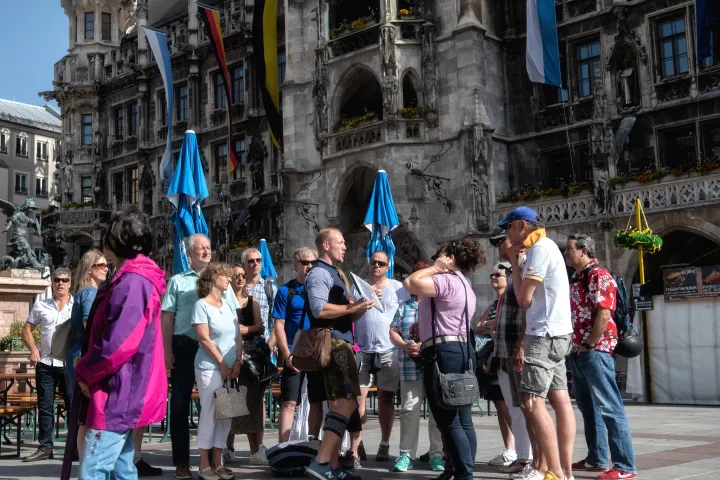
Marienplatz is Munich’s most famous square and its most historically significant public space, having served as the city’s primary civic forum since the city’s foundation in 1158. The square achieved its current name and distinctive column in 1638, and its current dominant architectural element — the New Town Hall — only in the first decade of the twentieth century, but the spatial identity of Marienplatz as Munich’s central gathering point has remained constant across all of these changes. The square’s importance exceeds its architectural qualities: it is the place where Munich celebrates, protests, mourns, and marks the passage of the civic year in the outdoor festivals, markets, and public gatherings that use the square as their stage.
Famous Squares: Odeonsplatz
Odeonsplatz represents a different character of Munich square — monumental rather than intimate, planned rather than organic, and burdened with the specific gravity of twentieth-century historical events that give the space a complex emotional register. Designed by Leo von Klenze as part of the northward expansion of Munich in the 1820s, Odeonsplatz was intended to be the grandest square in the city, creating a ceremonial space commensurate with Bavaria’s new status as a kingdom within the Napoleonic reorganization of German territories. The square’s architectural ensemble is genuinely magnificent, with the Theatinerkirche, the Feldherrnhalle, the Residenz, and the Hofgarten arcade creating an enclosed spatial experience of considerable impact.
Famous Churches: The Frauenkirche
The Cathedral of Our Blessed Lady deserves its position as Munich’s most famous church for reasons that begin with its extraordinary visual impact — the twin towers with their copper onion domes rising above the city’s rooftline to provide the most immediately recognizable element of Munich’s skyline — and extend into its historical significance as the seat of one of Germany’s most important Catholic archdioceses and the setting for major events in Bavarian history from royal coronations to state funerals.
Famous Churches: The Theatinerkirche
The Theatinerkirche on Odeonsplatz is Munich’s most beautiful church interior and one of the finest baroque religious buildings in Germany. The church was commissioned in 1662 by Elector Ferdinand Maria and his wife Henriette Adelaide of Savoy, who summoned Italian architects to create a church worthy of a significant dynastic occasion. The result is a building that brought the full expressive power of Italian high baroque to Bavaria — a white and gold interior of extraordinary spatial and decorative quality that has influenced Bavarian church architecture throughout the century and a half since its completion.
Famous Markets: The Viktualienmarkt
The Viktualienmarkt has operated continuously as Munich’s primary fresh food market since its establishment in 1807, surviving the upheavals of two world wars, the city’s postwar reconstruction, and the transformations of modern retail to remain a genuine functioning daily market alongside its considerable tourist appeal. The market’s permanence reflects the depth of Munich’s commitment to traditional market culture and the city’s ongoing relationship with the agricultural hinterland that has always supplied its urban population with the produce of Bavaria’s fertile countryside. Walking through the Viktualienmarkt is as historically and culturally informative as visiting any monument.
Famous Markets: The Christmas Markets
Munich’s Christmas markets, operating in Marienplatz and surrounding squares from the last weekend of November through Christmas Eve, are among the most celebrated in Europe and the context in which many international visitors form their most enduring impressions of Munich. The handcrafted wooden decorations, the mulled wine in distinctive ceramic mugs, the smell of roasted almonds and cinnamon, and the warm amber light against the winter darkness create a sensory atmosphere of remarkable power. Walking Munich’s Christmas market circuit — including the main Marienplatz market, the medieval market at Wittelsbacherplatz, and the more bohemian Schwabing market at Münchner Freiheit — provides a full picture of the city’s Advent season traditions. Book your tour through Munich Walking Tour and experience these extraordinary spaces with expert guidance.