Key Highlights
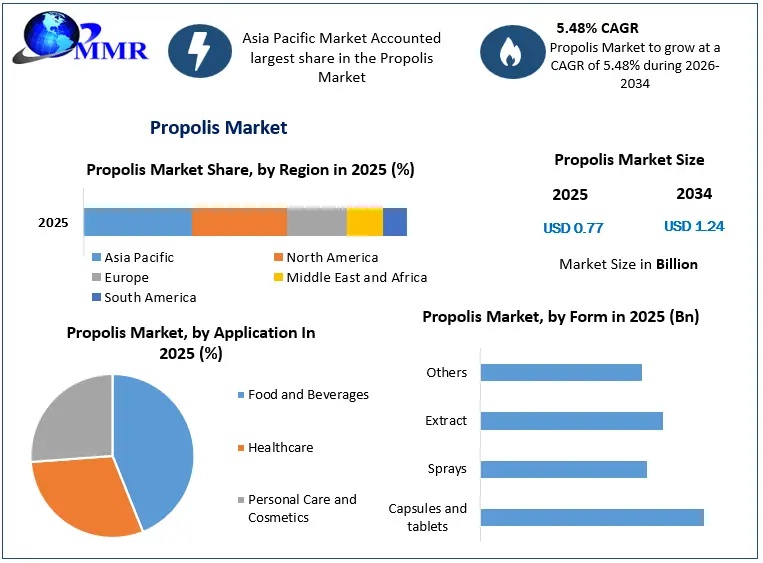
- Market valued at USD 0.77 billion in 2025.
- Expected to reach USD 1.24 billion by 2034.
- Forecast CAGR of 5.48% during 2026–2034.
- Asia Pacific remains the largest regional market.
- Healthcare applications account for the largest market share.
- Growing demand for natural immunity products strengthens global consumption.
- Expanding cosmetics and functional food industries support product diversification.
- Standardization and quality transparency remain key industry challenges.
Why This Matters Now
Consumers are increasingly replacing synthetic ingredients with natural alternatives that provide multiple health benefits. Propolis has emerged as a valuable bioactive ingredient because of its antibacterial, antiviral, antifungal, antioxidant, and anti-inflammatory properties. As preventive healthcare, functional nutrition, and clean-label formulations gain momentum, manufacturers are expanding propolis-based product portfolios across dietary supplements, pharmaceuticals, food, beverages, and personal care.
Market Overview
The Propolis Market comprises bee-derived resin products collected from plant sources and processed into extracts, capsules, tablets, sprays, creams, and functional food ingredients. Rich in flavonoids, aromatic acids, amino acids, and essential oils, propolis is widely recognized for supporting immune health and protecting against microbial activity.
Growing consumer awareness regarding preventive healthcare and natural wellness continues to drive demand worldwide. Pharmaceutical companies increasingly incorporate standardized propolis extracts into respiratory health products, wound care formulations, and immune-support supplements, while cosmetic manufacturers utilize propolis for anti-acne, anti-aging, and scalp care products.
Supply remains concentrated in major producing countries including China and Brazil, supported by expanding commercial beekeeping activities. Rising demand has also created new income opportunities for beekeepers by diversifying revenue beyond honey production.
Despite favorable demand fundamentals, market expansion faces challenges including inconsistent product standardization, quality transparency, allergic reactions among sensitive consumers, and regulatory differences across international markets.
Key Trends Driving Growth
Rising Demand for Natural Immune Support
Consumers increasingly prefer plant-based and bee-derived ingredients that support immunity without synthetic additives. This shift continues to strengthen demand across dietary supplements, throat sprays, lozenges, and functional beverages.
Expansion of Functional Healthcare Products
Healthcare manufacturers are developing standardized propolis formulations targeting respiratory wellness, oral health, wound healing, and immune support. Clinical validation is improving consumer confidence and expanding pharmaceutical adoption.
Growth in Natural Cosmetics
Propolis is gaining wider acceptance in skincare and personal care products because of its antimicrobial and anti-inflammatory properties. Manufacturers continue incorporating propolis into anti-acne products, shampoos, conditioners, soaps, and facial creams.
Commercial Beekeeping Diversification
Propolis production has become an additional revenue stream for beekeepers. Higher commercial demand encourages investment in value-added bee products beyond traditional honey production.
Product Standardization
Manufacturers increasingly focus on standardized bioflavonoid concentrations and quality certifications to improve product consistency and strengthen regulatory acceptance in international markets.
Explore detailed analysis, insights, and growth opportunities : https://www.maximizemarketresearch.com/request-sample/54379/
Segment Insights
Dominant Segment: Healthcare Applications
Healthcare represents the largest application segment due to increasing consumer preference for natural preventive healthcare products.
Propolis demonstrates antibacterial, antiviral, antioxidant, antifungal, and anti-inflammatory properties, making it an attractive ingredient for dietary supplements, respiratory health formulations, wound care products, and immune-support therapies.
For manufacturers, healthcare applications provide higher value-added opportunities through clinically supported formulations and premium positioning within nutraceutical markets.
Fastest-Growing Segment: Online Sales
Online distribution is expected to witness the fastest growth throughout the forecast period as consumers increasingly purchase health supplements through digital retail platforms.
E-commerce enables broader product availability, easier product comparisons, direct-to-consumer marketing, and access to international brands. Digital sales channels also help manufacturers educate consumers regarding ingredient quality and standardized formulations.
Capsules and Tablets
Capsules and tablets continue representing the most widely adopted product format due to dosage convenience, longer shelf life, and growing consumer familiarity with dietary supplements.
Personal Care and Food Applications
Natural cosmetics continue expanding as consumers seek clean-label skincare solutions. Meanwhile, functional food and beverage manufacturers increasingly incorporate propolis into wellness-focused product formulations to address growing preventive health awareness.
Regional Growth Story
Asia Pacific
Asia Pacific remains the largest regional market due to strong production capabilities, established beekeeping industries, and rising consumer demand for traditional natural healthcare products. China continues serving as both a leading producer and major consumer, while Japan and South Korea drive premium supplement demand through growing health-conscious populations.
Europe
European demand continues strengthening as consumers increasingly adopt natural health products supported by stringent product quality standards. Growing pharmacy distribution and clean-label wellness trends further support market expansion.
North America
North America experiences stable growth driven by rising consumption of nutraceuticals, dietary supplements, and functional foods. Consumers increasingly prioritize natural immunity products as preventive healthcare gains wider acceptance.
Emerging Export Markets
Countries including New Zealand continue expanding premium propolis exports to China, Japan, Taiwan, and Southeast Asia. Strong international demand encourages further investment in standardized manufacturing and product innovation.
Competitive Landscape
Competition remains moderately fragmented with manufacturers focusing on product quality, clinical validation, standardized bioactive content, and international distribution capabilities.
Apis Flora, Comvita Limited, Manuka Health New Zealand, and Bee Health Limited continue strengthening their competitive positions through proprietary formulations and scientifically validated propolis extracts targeting premium healthcare applications.
Chinese producers including Zhifengtang, MN Propolis Ltd., and Beehall Group leverage large-scale production capabilities to supply both domestic and export markets, while companies such as NOW Foods, Bio Botanica Inc., Blackmores Limited, and Nature’s Care Manufacture Pty Ltd. expand value-added supplement portfolios targeting health-conscious consumers.
Competitive differentiation increasingly depends on standardized bioflavonoid content, clinical evidence, clean-label formulations, regulatory compliance, and trusted sourcing rather than production volume alone.
Recent Developments
- February 2025: Apis Flora announced new clinical validations for its proprietary EPP-AF green propolis extract targeting respiratory health formulations.
- May 2025: Comvita introduced high-potency propolis immunity capsules standardized for maximum active bioflavonoid content.
- September 2025: Bee Health secured a major European pharmacy supply agreement for liquid propolis extracts, expanding retail distribution across Western Europe.
- January 2026: Nature’s Way launched an alcohol-free organic propolis throat spray designed for sensitive consumers and pediatric wellness.
- April 2026: Organika obtained regulatory approvals for water-soluble propolis tinctures, accelerating exports into key Asian markets including South Korea and Japan.
Future Outlook
Manufacturers that combine scientifically validated formulations, standardized bioactive ingredients, sustainable sourcing, and strong international distribution will capture the greatest long-term opportunities in the rapidly expanding global Propolis Market.
Explore More: Visit our website for Additional reports :
Global 2-Ethylhexanol (2-EH) Market https://www.maximizemarketresearch.com/market-report/global-2-ethylhexanol-2-eh-market/70203/
Solar Glass Market https://www.maximizemarketresearch.com/market-report/global-solar-glass-market/27009/
About Maximize Market Research
Maximize Market Research Pvt. Ltd. (MMR) is a global market research and consulting company that provides reliable, data-focused, and practical business insights. The firm serves a wide range of industries, including healthcare, pharmaceuticals, technology, automotive, electronics, chemicals, personal care, and consumer goods. Through market forecasts, competitive analysis, strategic consulting, and industry impact assessments, MMR helps organizations understand changing market conditions, identify growth opportunities, and make informed business decisions for long-term success.
Contact Us :
2nd Floor, Navale IT Park Phase 3
Pune Banglore Highway, Narhe
Pune, Maharashtra 411041, India
+91 9607365656
[email protected]