AI search has changed one basic thing about online discovery: people are becoming less interested in sorting through a long list of results themselves. They want an answer. If someone needs a dentist, an agency, or a local contractor, they may now ask an AI platform to suggest a few suitable options. For businesses, that creates an obvious concern. If the search experience is changing, does the work done on traditional SEO and directory profiles still have any value?
Putting your business on every directory you come across is not going to make much difference on its own. SEO Directory Listings for small business visibility are more useful when you choose the right sites and keep your information up to date. A listing gives people one more way to find your business, but it also helps keep important details—such as your business name, address, phone number, services, and website—the same wherever they appear online. If someone finds different information on different sites, it can create confusion. Keeping those details accurate makes your business easier to recognize and trust.
Why SEO Directory Listings Still Matter in AI Search
An AI system cannot recommend a business it cannot properly identify. Before a company can become a relevant answer to a search, there has to be enough information available to establish what the business does and where it operates. A local business listing can be one small part of that information. Imagine a plumbing company that appears on its own website, a local business directory, an industry platform, and several reputable business profiles. If the same company name, phone number, location, and services appear across those sources, the business has a much clearer footprint than one that has conflicting information everywhere.
That does not mean a directory profile is a direct ticket into an AI answer. There is no reliable formula that works that way. What matters is the overall picture. A directory profile is useful when it supports information found elsewhere and gives customers another credible place to confirm that the business exists and does what it claims. For a small company without a widely recognized brand, that kind of consistency can be particularly valuable.
From Link Building to Entity Understanding
The old approach to directory submissions was heavily focused on backlinks. Find a site, submit the business, get the link, and move on. That way of thinking has made many businesses chase quantity while paying very little attention to the quality of the profile itself.
A directory can do more than send someone to a website. It can place a business within a particular category, industry, or location. A profile for a law firm on a relevant legal platform carries a different meaning from a profile on a completely unrelated website that happens to accept business submissions. The context matters. If a source has a genuine connection to the company, the listing becomes more useful as part of the company’s wider online presence.
This is also why businesses should not judge every directory by the same set of metrics. A platform with a smaller audience but a strong connection to a particular industry may be more useful than a large generic directory. The question is not simply whether a listing provides a link. The better question is whether the listing helps explain who the business is and why it belongs in that particular place.
Quality Matters More Than Directory Volume
There is an easy trap in directory SEO: counting everything. A business can report 50 submissions, 100 profiles, or 200 new listings, but those numbers say very little about whether the work was worthwhile. If most of those websites are irrelevant, poorly maintained, or never used by real people, the business has gained a long list of profiles without necessarily gaining a stronger presence.
A better approach is to choose directories that have a reason to exist for your audience. A restaurant might look for local food platforms, tourism websites, or city-specific resources. A software company could focus on technology directories, review platforms, and professional associations. A home service company may have more to gain from local resources than from a general directory with businesses from every possible industry. The right number of listings is different for every business. What matters is whether the platforms selected are relevant, trustworthy, and worth maintaining.
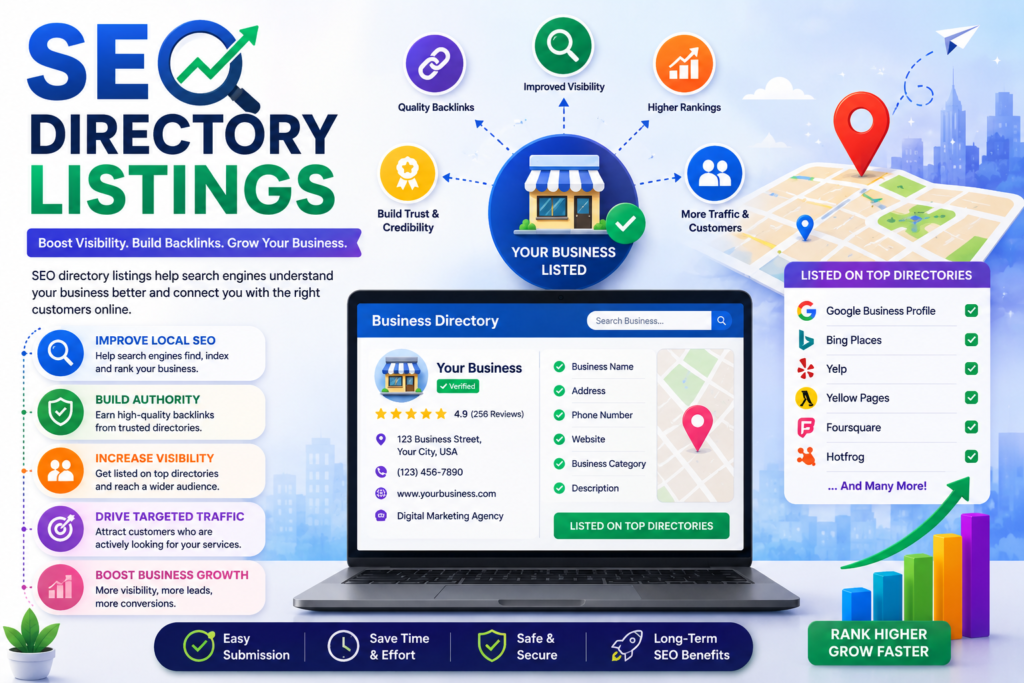
How to Build SEO Directory Listings for AI Visibility
Keep Your Business Information Consistent
When managing SEO Directory Listings, make sure your business name, phone number, website, and address are accurate and up to date. Old or incorrect details can confuse customers, especially when someone is trying to call your business or find your location. Before creating new profiles, take a few minutes to review your existing listings and correct any information that has changed.
Choose Relevance Over Quantity
A directory is worth considering when there is a sensible reason for your business to be there. That might be because it covers your city, serves your industry, or attracts the type of customer you want to reach. If you cannot explain why your company belongs on a particular platform, the listing probably does not need to be a priority.
Take a close look before submitting. Are the businesses listed genuine? Does the site look active? Are the categories relevant? Can people actually use the platform to discover companies? These questions are more useful than simply checking whether the site offers a free submission. A relevant business directory can support your visibility, while a random profile created for the sake of having another listing may simply add maintenance work.
Write Descriptions for Humans First
A business description does not need to sound like an advertisement written by a committee. It needs to tell people what the company does. If you run an accounting firm that works mainly with small businesses, say so. If your plumbing company handles emergency repairs, make that clear. If your agency specializes in ecommerce brands, mention the experience that matters to that audience.
Avoid turning the description into a collection of keywords. That usually makes the profile harder to read and less convincing. Keep the important facts consistent, but do not be afraid to adjust the wording for different platforms. A local directory and an industry-specific site may attract different readers, so the description can emphasize different aspects of the same business.
Connect Listings With Your Wider Digital Presence
A directory profile should make sense alongside the rest of your online presence. If your website says one thing about your services and your directory profiles suggest something completely different, customers may struggle to understand what the business actually specializes in. The wording does not have to be identical everywhere, but the core message should be recognizable.
This is where Tekmag Lisings can fit naturally into a broader directory strategy. Businesses can use relevant platforms to expand their online presence, but the aim should be consistency rather than simply collecting profiles. When a website, local business listing, review profile, and industry directory all point to the same business identity, the overall presence feels much more credible.
Strengthen the Information Behind the Listing
No directory can manufacture expertise. If a company has a weak website and little evidence that it knows its industry, another profile will not change that. Directory listings work better when they support something that already exists. Useful service pages, honest customer reviews, industry mentions, original content, and a professional website all give people stronger reasons to trust the company.
For that reason, directory work should sit inside a larger SEO strategy. The listing may help someone discover the business, but the website and reputation are what help convince them to take the next step. The same principle applies to AI search. Businesses should focus on building a presence that is useful and credible regardless of which search interface a customer happens to use.
Common Mistakes That Can Reduce the Value of Listings
Low-Quality Listings
The easiest mistake is submitting to every directory that accepts your information. A platform with no clear audience and no real connection to your market is unlikely to deserve your attention. Instead of chasing a submission target, spend the time researching platforms that people in your industry or location actually recognize.
Duplicate Content
Copying the same paragraph onto every profile may save a few minutes, but it often produces bland listings. The facts about your company should remain accurate, but the description can be adjusted to suit the platform. A local directory might highlight your service area, while an industry profile can focus on your specialist experience.
Outdated Details
Old information can quietly damage a business’s online presence. A previous phone number, address, or website may still appear on a profile that was created years ago. Review important listings whenever your business details change, and make periodic audits part of your SEO routine.
Keyword Stuffing
Adding unnecessary keywords to a business name is not a smart shortcut. If your official name is “Green Valley Roofing,” use that name. Do not turn it into a string of search terms. Describe your services in the appropriate fields instead. Accurate information will always be a better foundation than forced optimization.
Relying on Directories
A directory profile is not a replacement for a good website or a strong reputation. If customers cannot find useful information, the site is difficult to use, or the business has no evidence of genuine expertise, more listings will not solve the problem. Directories can support visibility, but they are only one part of the picture.
Audit Your Listings
Before creating another profile, search for the ones you already have. Use your business name, phone number, address, and even older versions of the company name. You may find listings that were created years ago and have since been forgotten. Some may contain outdated details, while others may be duplicates.
Sort what you find into three groups: keep accurate and relevant profiles, fix valuable profiles with incorrect information, and remove poor or misleading profiles when possible. This simple exercise can uncover problems that are more important than building another batch of new listings. In many cases, cleaning up the digital footprint you already have is the more sensible first step.
AI Search Ahead
The growth of AI search does not mean businesses should abandon directories. It does mean they should stop thinking about them as a numbers game. Search systems need information to understand businesses, and companies can influence some of the information available about them by keeping their online profiles accurate and consistent.
There is no way to guarantee that an AI platform will recommend your business. However, you can make your company easier to understand. Keep the basic details consistent, explain your services clearly, earn genuine reviews, publish useful information, and build relationships within your industry. Whether someone finds you through Google, a business directory, or an AI-powered search experience, those fundamentals still matter.
Conclusion
SEO Directory Listings still have a place in modern SEO, but their value depends heavily on how they are used. Creating a large number of random profiles is unlikely to be as useful as maintaining a smaller group of relevant, accurate listings. The best profiles reinforce the company’s identity and give customers another trustworthy source of information.
For small businesses, the practical approach is to start with an audit. Find the profiles you already have, correct the information that is wrong, and focus future efforts on platforms that genuinely fit your industry or location. A directory should earn its place in your strategy by being useful, not simply by being available. As AI continues to influence how people discover businesses, companies with a clear and consistent presence across relevant sources will have a much stronger foundation for being found.