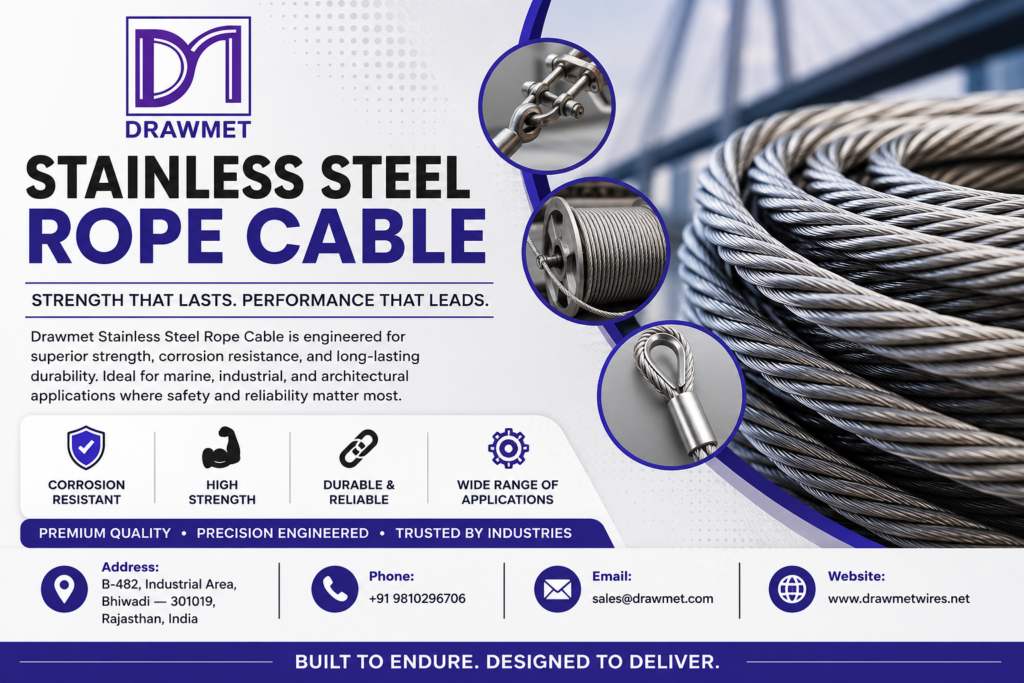
Searching for high-quality stainless steel rope cable that actually lasts? Drawmetwires manufactures corrosion-resistant stainless steel rope cable engineered for marine rigging, architectural railings, construction, and outdoor structural applications. Built using premium-grade stainless steel, each cable resists rust, saltwater exposure, and UV degradation while maintaining excellent flexibility and load-bearing strength. Whether you need cable for balustrades, marine mooring, safety netting, or industrial lifting, Drawmetwires delivers consistent quality backed by proper testing and certification. Businesses and contractors trust Drawmetwires for dependable stainless steel rope cable that reduces maintenance costs and improves long-term safety.
Why Stainless Steel Rope Cable Has Become the Industry Standard
Not long ago, galvanized wire rope was the default choice for almost every industrial and architectural application. Today, that’s changing fast. As buildings get closer to coastlines, as marine industries expand, and as architects push for cleaner, more modern aesthetics in railings and facades, stainless steel rope cable has quietly become the preferred choice across dozens of industries.
The reason is simple: stainless steel resists what regular steel cannot corrosion caused by moisture, salt, and chemical exposure. While galvanized coatings wear down over time and eventually expose the underlying steel to rust, stainless steel rope cable maintains its resistance properties throughout its entire service life, not just for a few years after installation.
Drawmetwires has built a strong reputation manufacturing stainless steel rope cable that holds up to this promise, supplying architectural firms, marine operators, and construction companies with cable that performs consistently even in the harshest environments.
What Exactly Is Stainless Steel Rope Cable?
Stainless steel rope cable is constructed from multiple strands of stainless steel wire twisted together around a core, similar in structure to traditional wire rope but made entirely from stainless steel alloy rather than carbon steel. The most common grades used in manufacturing include:
- 304 Stainless Steel – Offers strong general corrosion resistance and is widely used for indoor or moderately exposed outdoor applications.
- 316 Stainless Steel – Contains added molybdenum, giving it superior resistance to saltwater and chloride exposure, making it the preferred grade for marine environments.
Depending on the intended use, Drawmetwires manufactures stainless steel rope cable in both grades, allowing customers to choose based on their specific environmental exposure rather than settling for a generic solution.
Common Applications of Stainless Steel Rope Cable
Stainless steel rope cable isn’t limited to one industry its corrosion resistance and clean appearance make it valuable across a wide variety of use cases:
1. Architectural Railings and Balustrades
Modern buildings, staircases, and balconies increasingly use stainless steel cable railing systems because they combine safety with a sleek, minimalist look that doesn’t rust or discolor over time.
2. Marine Rigging and Mooring
Boats, yachts, and offshore platforms rely heavily on stainless steel rope cable because it withstands constant saltwater exposure without the rapid degradation seen in standard wire rope.
3. Safety Netting and Fall Protection
Construction sites and industrial facilities use stainless steel cable in safety netting systems, where long-term reliability under tension is critical.
4. Suspension and Tensioning Systems
Green walls, plant trellises, and tensioned facade systems on buildings often use stainless steel rope cable because of its strength-to-weight ratio and weather resistance.
5. Industrial Lifting and Rigging
In environments where hygiene or corrosion resistance matters such as food processing plants or chemical facilities stainless steel rope cable is often chosen over galvanized alternatives.
6. Aviaries and Animal Enclosures
Zoos and outdoor enclosures frequently use stainless steel cable mesh systems because of their durability and resistance to weathering over years of outdoor exposure.
Key Advantages of Stainless Steel Rope Cable Over Standard Wire Rope
Businesses often ask why they should pay a premium for stainless steel rope cable instead of standard galvanized wire rope. The advantages typically justify the investment:
- Superior Corrosion Resistance – Unlike galvanized coatings that wear away over time, stainless steel resists rust throughout its entire lifespan.
- Aesthetic Appeal – The clean, polished look of stainless steel cable is often preferred for visible architectural applications where appearance matters.
- Lower Long-Term Maintenance – Reduced rusting means less frequent inspection, cleaning, and replacement, ultimately lowering total cost of ownership.
- Better Performance in Extreme Environments – Saltwater, humidity, and chemical exposure have far less impact on stainless steel compared to standard steel cable.
- Longer Service Life – Properly manufactured stainless steel rope cable can last significantly longer than galvanized alternatives in harsh conditions, reducing replacement frequency.
How Drawmetwires Manufactures Stainless Steel Rope Cable
Understanding the manufacturing process helps explain why quality varies so much between suppliers in this space. Drawmetwires follows a structured production approach that includes:
- Raw Material Selection – Sourcing high-grade 304 or 316 stainless steel wire depending on intended application.
- Wire Drawing – Reducing wire diameter through precision dies to achieve target tensile strength.
- Stranding – Twisting multiple wires together into strands with consistent tension.
- Closing – Combining strands around a core to form the final cable construction.
- Surface Finishing – Ensuring a smooth, consistent finish that resists snagging and maintains flexibility.
- Testing and Certification – Conducting load testing and breaking strength verification before the cable is approved for sale.
This level of process control is what allows Drawmetwires to guarantee consistent performance across every batch of stainless steel rope cable produced, rather than variable quality that’s common with less rigorous manufacturers.
How to Choose the Right Stainless Steel Rope Cable for Your Project
Selecting the correct cable specification depends on several factors that businesses and contractors should evaluate carefully:
1. Environmental Exposure
For coastal, marine, or high-humidity environments, 316-grade stainless steel rope cable is strongly recommended due to its superior chloride resistance compared to 304-grade.
2. Load Requirements
Every application has a specific safe working load requirement. Undersizing cable to save cost is one of the most common and dangerous mistakes businesses make.
3. Cable Construction
Common constructions like 1×19, 7×7, and 7×19 offer different balances between flexibility and strength. More strands generally mean more flexibility, while fewer strands often provide higher rigidity and strength.
4. Diameter and Length
Precise diameter selection affects both load capacity and compatibility with fittings, terminations, and hardware used in the final installation.
5. Certification Requirements
For safety-critical applications like railings, lifting, or fall protection, always request proper test certification confirming breaking load and compliance with relevant standards.
Drawmetwires works directly with customers to identify the right specification based on these factors, rather than pushing a one-size-fits-all product across every project type.
Common Mistakes to Avoid When Buying Stainless Steel Rope Cable
Even experienced buyers occasionally make costly errors when sourcing stainless steel rope cable:
- Choosing 304 Grade for Marine Use – This grade lacks sufficient chloride resistance for constant saltwater exposure, leading to premature corrosion.
- Ignoring Construction Type – Selecting a rigid construction for an application that requires flexibility (or vice versa) leads to installation difficulties and reduced performance.
- Skipping Load Calculations – Estimating load requirements instead of calculating them properly increases the risk of cable failure under real working conditions.
- Buying Without Certification – Cable without proper test documentation offers no verifiable guarantee of actual breaking strength.
- Overlooking Termination Compatibility – Not all cable diameters and constructions work seamlessly with every type of fitting or termination hardware, leading to installation issues later.
Maintenance Tips for Stainless Steel Rope Cable
While stainless steel rope cable requires significantly less maintenance than standard wire rope, proper care still extends its service life considerably:
- Periodic Cleaning – Removing salt deposits, dirt, and debris helps maintain the protective oxide layer that gives stainless steel its corrosion resistance.
- Visual Inspection – Regularly checking for broken wires, kinks, or unusual wear patterns, especially in high-tension applications.
- Avoiding Chemical Exposure – Certain cleaning chemicals and chlorine-based products can damage the protective layer on stainless steel; using appropriate cleaning agents is important.
- Proper Tensioning – Over-tensioning cable systems, particularly in architectural applications, can lead to premature fatigue even in high-quality stainless steel cable.
Why Businesses and Contractors Choose Drawmetwires
Among the many suppliers offering stainless steel rope cable, Drawmetwires has established itself through consistent focus on manufacturing precision and customer support:
- Multiple Grade Options – Both 304 and 316 stainless steel available depending on application needs.
- Custom Specifications – Diameter, length, and construction tailored to specific project requirements rather than generic standard sizing.
- Rigorous Testing – Every batch tested for breaking strength and quality compliance before dispatch.
- Technical Guidance – Support in selecting the right grade, construction, and diameter for specific environmental and load conditions.
- Proven Industry Trust – Supplying architectural, marine, and construction sectors with dependable stainless steel rope cable solutions.
Final Thoughts
Stainless steel rope cable has become the go-to solution for applications where corrosion resistance, aesthetics, and long-term durability matter more than the lowest upfront price. Whether it’s a coastal marine project, a modern architectural railing system, or industrial rigging in a demanding environment, choosing the right grade and construction makes a measurable difference in performance and safety.
Drawmetwires continues to manufacture stainless steel rope cable engineered specifically for these demanding conditions, backed by proper testing, technical guidance, and a genuine focus on long-term reliability rather than short-term cost savings.
If you’re planning a project that requires dependable stainless steel rope cable.
Quick FAQ Summary
Q: Which stainless steel grade is best for marine applications?
316-grade stainless steel rope cable is recommended for marine use due to its superior resistance to saltwater and chloride exposure compared to 304-grade.
Q: Does stainless steel rope cable require less maintenance than regular wire rope?
Yes, stainless steel rope cable requires significantly less maintenance because its corrosion resistance doesn’t wear off over time like galvanized coatings do.
Q: Can stainless steel rope cable be used for architectural railings? It’s one of the most popular choices for modern railing and balustrade systems due to its clean appearance and long-term durability.
Address:B-482, Industrial Area, Bhiwadi — 301019, Rajasthan, IndiaPhone: +91 9810296706
Email : [email protected]
Website: www.drawmetwires.net