
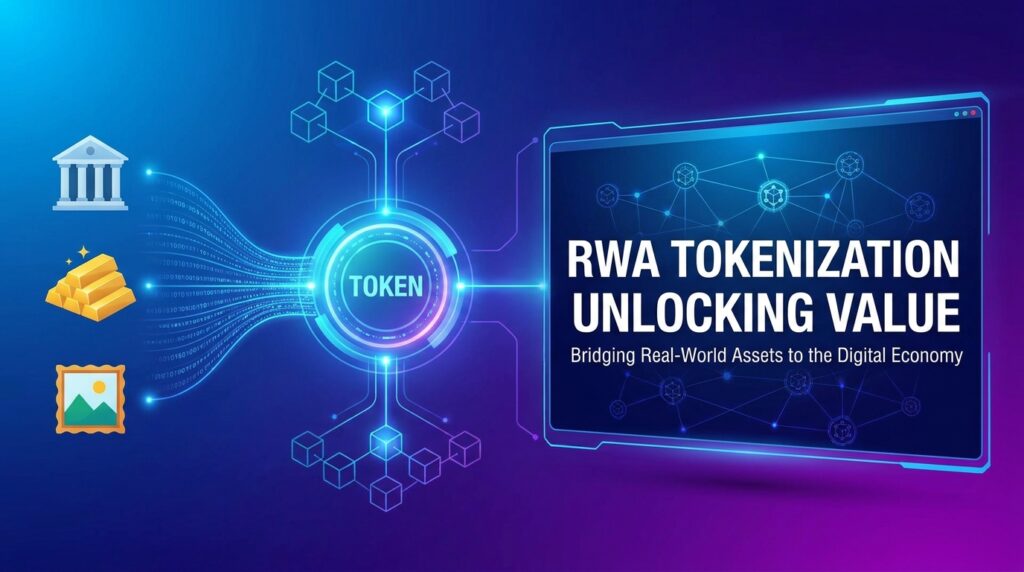
Real-world asset (RWA) tokenization has emerged as one of the most significant applications of blockchain technology beyond cryptocurrencies. The concept is relatively simple: physical or traditional financial assets are represented digitally on a blockchain through tokens that can encode ownership rights, economic interests, or claims against an underlying asset. The implications, however, are much broader. Tokenization can potentially make traditionally illiquid assets more accessible, automate parts of asset administration, improve transparency, and create new ways to structure investment and ownership.
From real estate and private credit to commodities, infrastructure, art, and intellectual property, an expanding range of assets is being explored for tokenization. Major financial institutions have also shown increasing interest in blockchain-based asset infrastructure. According to the World Economic Forum, as much as 10% of global GDP could potentially be stored and transacted through distributed ledger technology by 2027, although the actual adoption trajectory remains dependent on regulation, technology, and institutional acceptance.
For businesses considering entering this market, RWA tokenization is not simply a matter of creating a token and deploying a smart contract. A successful project requires careful asset selection, legal structuring, valuation, custody, token design, compliance, technology development, investor onboarding, and long-term management. This guide explains the complete journey from selecting an asset to creating a functional digital ownership ecosystem.
What Is RWA Tokenization?
RWA tokenization is the process of representing ownership or economic rights associated with a real-world asset through blockchain-based digital tokens. The underlying asset remains connected to the physical or traditional financial world, while the token provides a digital representation of specific rights related to that asset.
For example, imagine a commercial property valued at $10 million. Instead of limiting investment to a small group of investors capable of purchasing the entire property, a properly structured tokenization model could divide economic interests into thousands or millions of digital units. Investors may then acquire tokens representing fractional ownership or another legally defined interest.
The important point is that the token itself does not automatically create legal ownership. Its legal meaning depends on how the project is structured under the applicable jurisdiction. The connection between the blockchain token and the underlying asset must therefore be established through enforceable legal agreements, ownership structures, custodial arrangements, or other mechanisms.
This distinction separates serious RWA projects from purely speculative token launches. The technology is only one part of the ecosystem. Legal enforceability, asset custody, investor rights, and regulatory compliance are equally important.
Why Is RWA Tokenization Gaining Momentum?
Traditional asset markets often operate through layers of intermediaries, paperwork, manual verification, and fragmented databases. Buying, transferring, and settling certain assets can take days or even weeks. Some markets also have high minimum investment requirements, making them inaccessible to smaller investors.
Blockchain technology introduces a shared digital infrastructure where transactions and ownership records can potentially be recorded and verified more efficiently. Smart contracts can automate predefined processes, while tokenization can allow asset interests to be divided into smaller units.
The potential advantages include:
Fractional ownership: High-value assets can potentially be divided into smaller investment units.
Greater accessibility: Subject to securities laws and investor eligibility requirements, tokenized assets may expand access to investment opportunities.
Improved transparency: Blockchain-based records can provide a verifiable history of transactions and token movements.
Operational efficiency: Smart contracts can automate functions such as distributions, transfers, and compliance checks.
Programmable ownership: Tokens can include rules governing transfers, voting, distributions, or other rights.
Potential liquidity: Tokenized markets may eventually create more flexible secondary trading environments, although liquidity is never guaranteed simply because an asset is tokenized.
The last point is particularly important. Tokenization can improve the infrastructure around an asset, but it does not automatically create buyers. A tokenized property may still have limited liquidity if there is no active marketplace or sufficient investor demand.
Step 1: Selecting the Right Asset for Tokenization
Asset selection is the foundation of any RWA tokenization project. Not every asset is suitable for blockchain representation, and choosing an asset simply because it has a high value is not enough.
The ideal asset should have clearly defined ownership, reliable valuation methods, manageable legal requirements, and a strong economic reason for tokenization.
Real estate is one of the most frequently discussed categories because properties have identifiable ownership structures and significant capital requirements. A commercial building, rental property, hotel, or residential development could potentially be represented through a tokenized structure.
Private credit is another promising area. Loans, receivables, and debt instruments can be represented digitally, allowing investors to gain exposure to cash flows under predefined contractual conditions.
Other potential categories include:
- Precious metals and commodities
- Infrastructure projects
- Private equity interests
- Art and collectibles
- Agricultural assets
- Carbon credits
- Intellectual property
- Investment funds
- Treasury and fixed-income instruments
The selection process should evaluate the asset’s legal status, valuation, income generation, custody requirements, investor demand, regulatory classification, and potential market size.
For example, a rental property producing predictable monthly income may have a stronger tokenization case than a highly speculative asset with uncertain valuation. The economic model should be clear enough that investors understand exactly what they are acquiring and how returns are generated.
Step 2: Establishing Legal Ownership and Asset Structure
One of the most critical stages in RWA tokenization is creating a legally enforceable relationship between the physical asset and the digital token.
A common approach is to establish a special purpose vehicle (SPV) or another legal entity that owns the underlying asset. Tokens can then represent shares, beneficial interests, debt claims, or other rights associated with that entity.
For example, suppose a company creates an SPV that legally owns a commercial property. The token may represent an economic interest in the SPV rather than direct ownership of the building itself. Investors need to understand this distinction because their legal rights depend on the structure.
The legal framework should clarify:
- Who owns the underlying asset?
- What rights does each token provide?
- How are income distributions handled?
- What happens if the asset is sold?
- Can tokens be transferred freely?
- What happens if the issuer becomes insolvent?
- Who is responsible for custody and administration?
These questions cannot be solved by blockchain technology alone. They require legal, financial, and regulatory expertise.
Step 3: Conducting Asset Valuation and Due Diligence
Before tokenization, the underlying asset must undergo rigorous due diligence. Investors need confidence that the asset exists, has legitimate ownership, and has been accurately valued.
For real estate, this could involve property title verification, independent appraisal, environmental assessments, tax records, insurance documents, lease agreements, and financial statements.
For private credit, due diligence may include borrower assessments, repayment history, collateral analysis, credit risk, and legal documentation.
The goal is to prevent a disconnect between the digital representation and the underlying asset. A blockchain can prove that a token exists and record its transactions, but it cannot independently verify that the asset represented by the token is genuine or accurately valued.
This is why trusted third-party verification, audits, custodians, and data providers can play an important role in the RWA ecosystem.
Step 4: Designing the Token Economic Model
Once the asset and legal framework are established, the next stage is determining what the token actually represents.
A token may provide:
- Fractional equity ownership
- Revenue-sharing rights
- Debt repayment claims
- Governance rights
- Access to a specific service
- Rights to income generated by an asset
The tokenomics must align with the legal structure. If investors are promised rental income, for example, the project should explain how rent is collected, expenses are deducted, and distributions are calculated.
Consider a hypothetical $5 million rental property generating $400,000 in annual gross rental income. After operating costs, taxes, insurance, management fees, and reserves, the net distributable income might be significantly lower. The token model should reflect the actual economics rather than simply promoting the gross asset value.
Token supply is another important consideration. If 1 million tokens represent an economic interest in an asset, the issuer needs to clearly explain what percentage or claim each token represents.
A well-designed token model prioritizes clarity over complexity.
Step 5: Selecting the Blockchain and Technology Infrastructure
The blockchain selected for an RWA project can influence transaction costs, scalability, security, interoperability, and user experience.
Projects may choose established public blockchain networks, permissioned blockchains, or hybrid architectures depending on their requirements. Public networks can provide transparency and broad accessibility, while permissioned systems may offer stronger control over participant access.
Smart contracts form the technological backbone of many tokenization platforms. They can manage token issuance, transfers, ownership records, distributions, whitelisting, and other programmable functions.
However, RWA smart contracts often require more sophisticated controls than standard cryptocurrency tokens. For regulated assets, the system may need to ensure that only eligible investors can hold or transfer tokens.
This can involve identity verification, wallet whitelisting, transfer restrictions, compliance rules, and automated monitoring.
Security is equally critical. A vulnerability in a smart contract can expose investor funds or disrupt asset operations. Comprehensive testing and independent security audits should therefore be considered essential components of the technology development process.
Step 6: Building Compliance Into the Tokenization Ecosystem
Regulation is one of the most complex aspects of RWA tokenization.
Depending on the asset, jurisdiction, investor base, and token structure, a token may fall under securities, financial services, property, tax, or other regulations. The legal classification cannot be determined simply by calling a token a “utility token.”
Compliance requirements may include Know Your Customer (KYC), Anti-Money Laundering (AML) procedures, investor accreditation rules, securities registration or exemptions, reporting requirements, and restrictions on secondary transfers.
A robust RWA platform should therefore integrate compliance into its architecture from the beginning rather than treating it as an afterthought.
For example, if a tokenized investment is available only to verified investors in specific jurisdictions, the platform may need to prevent unauthorized wallets from purchasing or transferring the tokens. This requires collaboration between legal experts, compliance professionals, and blockchain developers.
Step 7: Token Issuance and Digital Ownership
After legal, financial, and technical structures are finalized, tokens can be issued on the selected blockchain.
At this stage, the platform typically connects the investor onboarding process with the blockchain infrastructure. Users may create accounts, complete identity verification, connect wallets, review offering documents, and purchase eligible tokens.
Digital ownership provides a new way to interact with assets, but the user experience must remain understandable. Investors should be able to see their holdings, transaction history, distributions, and relevant asset information without needing advanced blockchain knowledge.
This is where professional RWA tokenization services can add significant value. A well-designed platform can combine blockchain infrastructure with intuitive dashboards, compliance systems, smart contracts, asset management tools, and investor interfaces.
Step 8: Managing the Asset After Tokenization
Tokenization is not the end of the project. In many ways, it marks the beginning of a long-term digital asset management lifecycle.
The underlying asset must continue to generate value, while token holders need accurate information about performance and distributions.
For a tokenized property, this may involve collecting rent, maintaining the property, paying expenses, managing tenants, and distributing income.
For a tokenized debt instrument, the platform may need to monitor repayments, interest payments, defaults, and credit events.
Blockchain can make ownership records more transparent, but the underlying asset still requires real-world management. This is why successful RWA projects need both digital infrastructure and reliable operational processes.
Real-World Examples of RWA Tokenization
Several companies and financial institutions have explored tokenization in different forms.
BlackRock launched its USD Institutional Digital Liquidity Fund, commonly known as BUIDL, on the Ethereum blockchain in 2024. The fund invests in cash, U.S. Treasury bills, and repurchase agreements, allowing eligible investors to receive blockchain-based representations of fund interests. The initiative demonstrated how established financial products can be integrated with blockchain-based settlement infrastructure.
Securitize has also developed infrastructure for issuing and managing tokenized securities. Its work illustrates the growing convergence between traditional financial products and blockchain technology.
In the real estate sector, platforms such as RealT have explored fractional ownership models that allow investors to gain exposure to individual properties through blockchain-based tokens.
These examples highlight an important trend: RWA tokenization is moving beyond theoretical discussions. Financial institutions, asset managers, fintech companies, and blockchain businesses are experimenting with practical applications involving funds, credit, real estate, and other asset classes.
The Biggest Challenges Facing RWA Tokenization
Despite its potential, RWA tokenization still faces significant challenges.
The first is regulatory fragmentation. Different countries have different rules governing securities, property ownership, digital assets, and investor protection. A model that works in one jurisdiction may not be legally suitable in another.
The second challenge is liquidity. Tokenization can reduce investment barriers, but secondary markets require sufficient participation, regulatory approval, and investor demand.
The third challenge is the “oracle problem.” Blockchain systems cannot automatically know whether a real-world property has been damaged, whether rent has been paid, or whether an asset has been sold. External data sources and trusted entities are required to connect blockchain systems with real-world events.
Finally, investor education remains essential. Tokenized assets may appear technically sophisticated, but investors still need to understand valuation, risk, legal ownership, fees, liquidity restrictions, and potential losses.
The Future of RWA Tokenization
The future of RWA tokenization is likely to be shaped by the convergence of blockchain infrastructure and traditional financial systems.
Rather than completely replacing existing financial markets, tokenization may gradually modernize the way assets are issued, transferred, settled, and managed. Financial institutions may use blockchain networks behind the scenes while investors interact with familiar digital platforms.
The most successful projects are likely to focus less on token creation itself and more on solving real inefficiencies. Faster settlement, improved transparency, automated compliance, fractional access, and better asset administration are more meaningful value propositions than simply putting an asset “on-chain.”
As regulatory frameworks mature and institutional adoption increases, tokenization could become an important component of the broader digital financial infrastructure.
Conclusion
RWA tokenization represents a significant shift in how real-world assets can be structured, owned, managed, and transferred in the digital economy. From selecting the right asset and establishing legal ownership to designing token economics, developing smart contracts, implementing compliance, and managing digital ownership, every stage requires careful planning and specialized expertise. Businesses looking to enter this market should treat tokenization as a complete ecosystem rather than a simple blockchain development project. With the right combination of legal strategy, asset management, technology, security, and investor experience, tokenization can unlock new possibilities for traditionally illiquid markets. For organizations seeking to build secure and scalable blockchain-based asset ecosystems, Blockchain App Factory provides best RWA tokenization development services and RWA tokenization services, helping businesses transform real-world assets into digitally accessible and efficiently managed opportunities.
Frequently Asked Questions
1. What is RWA tokenization?
RWA tokenization is the process of representing real-world assets or the rights associated with them through blockchain-based digital tokens. These assets can include real estate, private credit, commodities, funds, infrastructure, and other traditional assets.
2. Does tokenization mean I directly own the physical asset?
Not necessarily. The legal rights represented by a token depend on the project’s structure. A token may represent direct ownership, shares in an entity that owns the asset, beneficial interests, debt claims, or other contractual rights. Investors should always review the legal documentation before purchasing tokenized assets.
3. Which assets are best suited for tokenization?
Assets with clearly defined ownership, reliable valuation, established legal structures, and measurable economic value are generally strong candidates. Real estate, private credit, investment funds, commodities, and infrastructure are among the asset classes being explored for tokenization.
4. Is RWA tokenization legally regulated?
It can be. The regulatory treatment depends on factors such as the asset type, token structure, jurisdiction, and rights provided to investors. Some tokenized assets may be classified as securities and could be subject to securities laws, KYC, AML, investor eligibility, and transfer restrictions.
5. How can businesses develop an RWA tokenization platform?
Businesses typically need to combine legal structuring, asset due diligence, token economics, blockchain selection, smart contract development, compliance infrastructure, investor onboarding, security auditing, and ongoing asset management. Working with an experienced technology provider can help coordinate these components into a unified tokenization ecosystem.