
If you look at military portraits from the late 19th through the mid-20th century, one specific piece of leatherwork instantly commands authority. It is wide, secured by a distinctive diagonal cross-strap, and sits firmly at the waist of military leadership across the globe. This iconic gear is none other than the British officers sam browne belt.
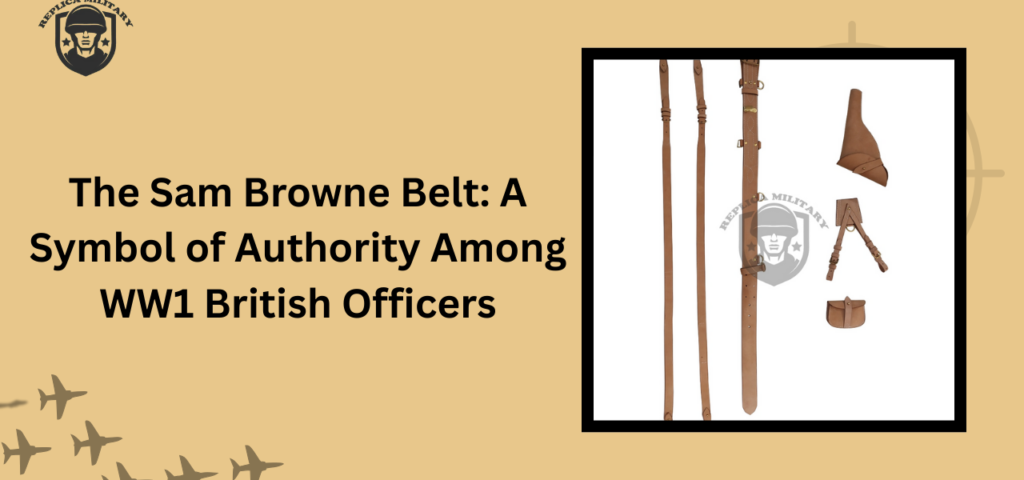
More than a simple uniform accessory, this belt was born out of battlefield necessity, engineered by an officer who needed a practical solution to a life-or-death problem. Today, high-quality reproductions from specialists like Replicamilitary keep this fascinating piece of living history alive for collectors and reenactors worldwide.
Born on the Frontier: The Origin Story
The belt owes its name and design to General Sir Samuel James Browne, a 19th-century British Army officer serving in India. In 1858, during a fierce engagement at Seerporah, Browne was severely wounded, losing his left arm to a sword cut.
For a 19th-century officer, losing an arm was a massive tactical disadvantage. The standard-issue sword belts of the era required two hands to draw a weapon—one hand to steady the scabbard and the other to pull the blade.
Refusing to let his injury end his front-line career, Browne designed a revolutionary modification:
- He added a wide, rigid waist belt backed by a diagonal shoulder strap (running over the right shoulder to the left hip).
- The shoulder strap carried the heavy weight of the sword.
- More importantly, D-rings and steadying straps held the scabbard firmly in place, allowing Browne to draw his sword quickly using only his remaining right hand.
Standard Issue for World War I and Beyond
What started as an ingenious personal hack quickly caught the eye of fellow officers. By the time of the Boer War, the utility of the belt was undeniable, and in 1900, the British officers sam browne belt was officially approved for standard officer dress across the British Army.
During the First World War, the belt became the defining symbol of commission. When a young man earned his commission as an officer, purchasing his Sam Browne was a rite of passage. In the trenches of the Western Front, the belt was modified to carry the changing tools of industrial warfare:
- The Holster: A leather flap holster for the standard Webley .455 revolver.
- The Ammunition Pouch: A sturdy pouch keeping spare rounds readily available.
- The Map Case & Binoculars: Frequently hooked onto the belt’s versatile brass loops.
Interestingly, during WW1, officers often wore two shoulder straps (forming an “X” shape across the chest) to evenly distribute the massive weight of their gear, though the single-strap variant remained the classic dress look.
Crafting History Today
Because original century-old leather dries out, cracks, and loses its structural integrity, relying on authentic antiques for living history or display is risky. This is where modern craftsmanship preserves historical legacy.
At Replicamilitary, the British officers sam browne belt is recreated using premium, heavy-duty bridle leather that mirrors the look, feel, and durability of the originals. Every detail matters—from the distinct double-pronged brass buckle to the hand-stitched D-rings and the rich, period-correct chestnut brown finish.
Whether you are completing a high-fidelity WW1 uniform impression, setting up a historical museum display, or looking for a timeless piece of military leatherwork, investing in a properly crafted Sam Browne honors the innovation of a one-armed general who changed military fashion forever.