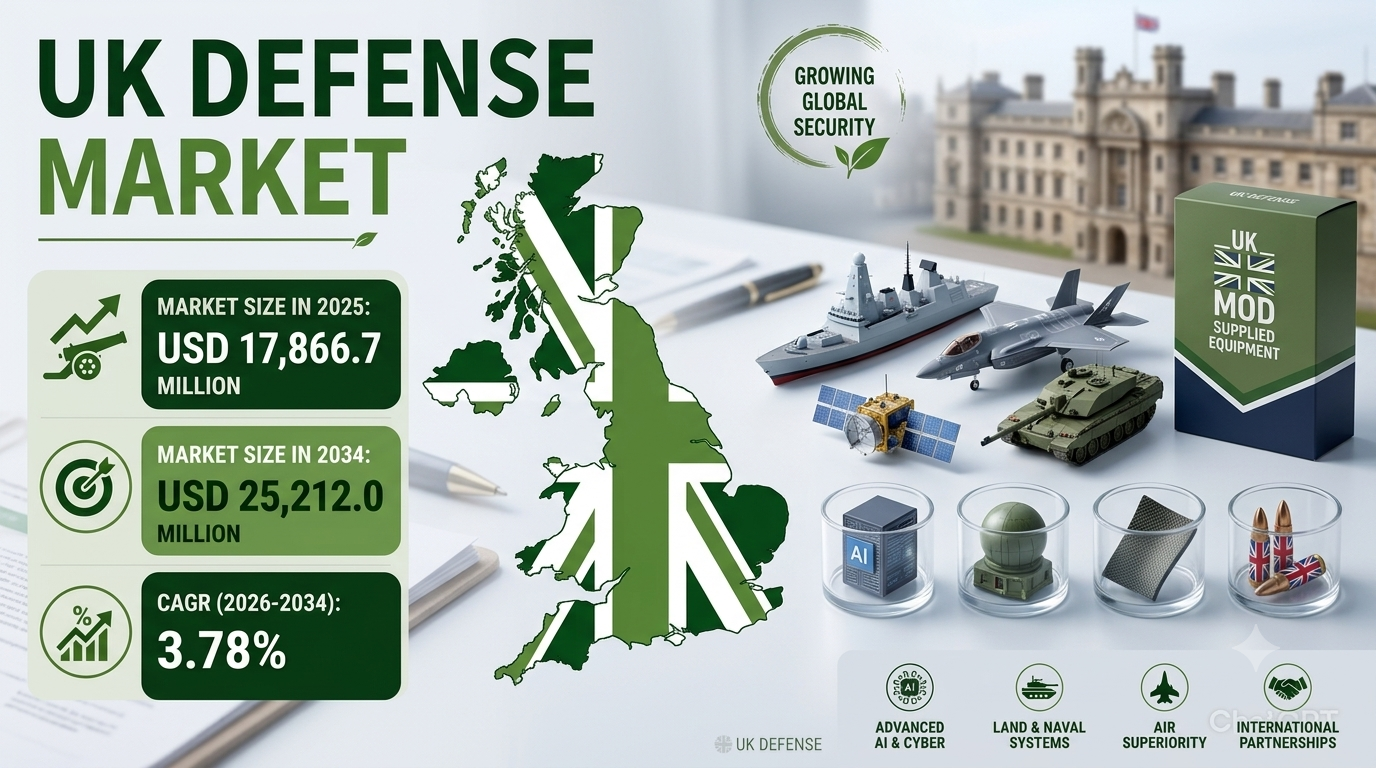
The UK defense market is experiencing robust growth driven by increased defense spending, advancements in military technology, modernization programs, and escalating geopolitical tensions. The market size reached USD 17,866.7 Million in 2025 and is projected to reach USD 25,212.0 Million by 2034, exhibiting a compound annual growth rate (CAGR) of 3.78% during 2026‑2034. Commitments to NATO, international defense collaborations, and the need for robust cybersecurity measures further propel market growth across the country. The UK defense budget increased by 6.8% in 2025 to $76.4 billion, up from $71.5 billion in 2024, following a low in 2021 after financial strain caused by the COVID-19 pandemic, with gradual increases following Russia’s invasion of Ukraine. The government has committed to increasing defense spending to 2.5% of GDP by 2027, reaching £87 billion annually by 2030. This market is strategically important to the UK’s economy as it directly supports national security, technological innovation, and high-value employment across the country.
The UK defense market is poised for sustained expansion, driven by the government’s largest sustained increase in defense spending since the Cold War — to 2.6% of GDP by April 2027 and an ambition to hit 3% in the next Parliament. With a projected CAGR of 3.78% through 2034, the market presents significant opportunities for established primes and new entrants focused on advanced technology, autonomous systems, and sovereign manufacturing capabilities.
UK DEFENSE MARKET SUMMARY
The UK defense market encompasses a wide range of products and services designed for national security, military capability enhancement, and strategic deterrence across the army, navy, and air force sectors. The ecosystem includes global defense primes (BAE Systems, Lockheed Martin, Airbus, Thales, Leonardo), specialist technology providers, and a highly fragmented supply chain with over 12,000 SMEs operating in the ecosystem. Major segments identified in the market include type (fixed-wing aircraft, rotorcraft, ground vehicles, naval vessels, C4ISR, weapons and ammunition, protection and training equipment, unmanned systems), armed forces (army, navy, air force), and region. The communication systems segment accounts for a major market share, driven by the UK’s strategic focus on enhancing secure and efficient military communication networks. The defense industry is estimated to contribute around £10 billion to £15 billion a year to the UK economy, mostly in South East and South West England.
Porter’s Five Forces Analysis — UK Defense Market
The competitive dynamics of the UK defense market can be analyzed using Porter’s Five Forces framework.
- Competitive Rivalry: High, with intense competition between global primes and domestic specialists for major procurement contracts. Rivalry is driven by long-term government contracts, technological advancement requirements, and the need for sovereign capabilities. UK defence leaders such as BAE Systems, Lockheed Martin, and Airbus compete through technological advances, strategic UK alliances, and tailored solutions for military procurement. Business implication: Defense firms must differentiate through technological innovation, program execution reliability, and strong MOD relationships to secure contracts and generate sustainable returns.
- Supplier Power (Prime Contractors): Moderate to High. Major primes with deep MOD ties, integration skills, and critical program positions have significant negotiating power. Companies with sovereign capabilities, test range access, and program criticality command premium positions. Business implication: Defense firms must build defensible positions through sovereign capability, IP ownership, and long-term program integration roles that create high switching costs.
- Buyer Power (MOD): High. The UK Ministry of Defence is the dominant buyer with significant negotiating power, running competitive procurement processes and setting stringent requirements. The MOD has established a target to increase direct spending with SMEs by 50% by May 2028. Business implication: Defense firms must demonstrate value for money, program delivery excellence, and alignment with MOD strategic priorities to win and retain contracts.
- Threat of Substitutes: Low to Moderate. Alternative defense suppliers from allied nations (US, European primes) pose substitution threats, though sovereign capability requirements and security considerations favor domestic suppliers. Emerging technologies (commercial off-the-shelf solutions, dual-use technologies) present substitution risks in certain segments. Business implication: UK defense firms must articulate clear sovereign capability advantages and maintain strong government relationships to mitigate substitution risks.
- Threat of New Entrants: Moderate. High barriers to entry exist for large-scale platform primes (capital requirements, security clearances, proven track record), but lower barriers for technology-focused SMEs and dual-use innovators. The MOD’s focus on increasing SME spending and the Defence Office for Small Business Growth as a “one-stop shop” to simplify entry for smaller firms creates opportunities for new entrants. Business implication: Established players should build defensible positions through sovereign capability, proprietary technology, and strong MOD relationships, while monitoring disruptive technology entrants.
Competitive Rivalry — High (Intense)
- Multi-tier competition spans global primes (BAE Systems, Lockheed Martin, Airbus, Thales, Leonardo), specialized technology providers (QinetiQ, Babcock International), and a fragmented SME supply chain of over 12,000 businesses — driving differentiation through technological innovation, sovereign capability, program execution reliability, and strategic UK alliances.
- The UK aerospace & defense sector recorded revenues of $11.9 billion in 2024, representing a CAGR of 7.6% between 2019 and 2024. The market has witnessed an HHI of 1407 in 2023, which has decreased slightly as compared to 1476 in 2017, indicating modestly increasing competition.
Request for Sample Report: https://www.imarcgroup.com/uk-defense-market/requestsample
MARKET GROWTH DRIVERS:
Several key factors are propelling the expansion of the UK defense market. The increased defense spending and government commitment serve as a powerful demand driver. In February 2025, the government committed to increase defense spending to 2.5% of GDP by 2027, reaching £87 billion annually by 2030. The MoD’s budget for 2025/26 is £62.2 billion — an increase of around 3.2% in cash terms compared to 2024/25. The government’s Industrial Strategy will build on the largest sustained increase in defence spending since the Cold War — to 2.6% of GDP by April 2027. Between January and October 2025, defense buyers published 971 notices valued at a combined £97.93 billion. Additionally, the advancements in military technology and modernization programs are driving market growth. The development and integration of cutting-edge technologies are essential for modern warfare, with UK soldiers testing advanced body-worn technology including laser detection systems, on-person drone control, and integrated sensors. The Defence Science and Technology Laboratory (Dstl) leads trials focusing on integrating various technologies to boost operational effectiveness.
MARKET GROWTH DRIVERS:
The UK defense market is also benefiting from accelerating technology adoption and evolving defense requirements. There is an accelerating shift toward autonomous systems, AI-enabled targeting, drones, and uncrewed maritime platforms, driven by commercial validation of technologies that have proved their battlefield utility in Ukraine. The Ministry of Defence has announced a significant new investment of over £142 million into drone and counter-drone technologies through the UK Defence Innovation (UKDI) unit, launched in July 2025 with a ringfenced annual budget of at least £400 million. Geopolitical tensions and NATO commitments are driving procurement acceleration, with the UK committed to meeting NATO targets and strengthening collective defense capabilities. Furthermore, the defence industrial strategy and export growth are creating new opportunities. British defence exports exceeded £20 billion in 2025, the highest since records began over 40 years ago, with a £10 billion agreement with Norway for the export of at least five Type 26 frigates supporting 4,000 jobs across over 430 businesses.
UK DEFENSE MARKET SEGMENTATION
Segmentation analysis provides a detailed view of the UK defense market by category:
- Type Insights: Fixed-Wing Aircraft, Rotorcraft, Ground Vehicles, Naval Vessels, C4ISR, Weapons and Ammunition, Protection and Training Equipment, Unmanned Systems.
- Armed Forces Insights: Army, Navy, Air Force.
- Regional Insights: South East England, South West England, North West England, Scotland, Wales, Northern Ireland, and other regions.
COMPETITIVE LANDSCAPE
The UK defense market features a competitive landscape with multi-tier competition spanning global primes and strong domestic specialists.
Strategic developments are shaping the competitive arena. BAE Systems received a £708 million contract extension from the UK Ministry of Defence to advance sixth-generation combat air technologies. Thales secured a GBP 1.85 billion Royal Navy support deal tied to AI and virtual tooling. Raytheon UK introduced Red Kite, a sovereign precision weapon fully designed and digitally engineered in the United Kingdom. The MOD awarded a £20 million contract to Lockheed Martin UK to deliver Project Bowline, a hypersonic target programme.
REGIONAL ANALYSIS:
Regional dynamics within the UK defense market are shaped by varying levels of defense industrial concentration and MOD expenditure.
- South East England leads in total MOD regional expenditure at £7.9 billion, accounting for 14% of direct defense manufacturing jobs and is integral to the UK’s nuclear arsenal, with the Atomic Weapons Establishment (AWE) in Aldermaston. The region accounts for 93% of turnover from the defense tech sector and is home to the top five UK defense tech occupiers.
- South West England follows with £6.6 billion in MOD expenditure, with the defense industry’s output predominantly in these two regions, together contributing an estimated £7.1 billion to the economy in 2024.
- North West England recorded £4.8 billion in MOD spend, sustaining critical submarine and combat air programmes.
- Scotland is a key center for shipbuilding, while Barrow-in-Furness is critical for submarine production.
- Other regions including Wales, Northern Ireland, and the Midlands benefit from defence investment through supply chains and Defence Growth Deals.
RECENT INDUSTRY DEVELOPMENTS
July 2026: BAE Systems unveiled an uncrewed combat jet (Brontanax) that has been in development since 2022, as the UK and Europe seek to build sovereign defense capabilities.
July 2026: BAE Systems received a £708 million contract extension from the UK Ministry of Defence to advance sixth-generation combat air technologies for GCAP and future combat air development.
July 2026: The MOD awarded a £20 million contract to Lockheed Martin UK to deliver Project Bowline, a hypersonic target programme.
July 2026: Raytheon UK introduced Red Kite, a sovereign precision weapon fully designed and digitally engineered in the United Kingdom.
July 2026: The first of 150 British-made artillery barrels forged by Sheffield Forgemasters were delivered to Ukraine under a £61 million contract.
June 2026: The government published the Defence Investment Plan, backed by £298 billion of investment over four years, taking UK defence spending to 2.7% of GDP — the highest proportion in three decades.
June 2026: Prime Minister Starmer announced a £15 billion increase to defence spending over the next four years (up to 2029/30).
September 2025: The government published the Defence Industrial Strategy 2025, describing defence as an “engine for growth” and announcing £250 million for new Defence Growth Deals.
October 2025: A £350 million deal with India was announced to supply air defence missiles and launchers, supporting hundreds of jobs in Northern Ireland.
2025: British defence exports exceeded £20 billion, the highest since records began over 40 years ago.
Key Aspects Required for the UK Defense Market
- Market Performance: USD 17,866.7 Million in 2025, with a projected trajectory to USD 25,212.0 Million by 2034.
- Market Outlook: A 3.78% CAGR through 2034 indicates robust growth across fixed-wing aircraft, naval vessels, C4ISR, weapons, unmanned systems, and other defense segments.
- Growth Drivers: Largest sustained increase in defense spending since the Cold War — to 2.6% of GDP by April 2027 and ambition to hit 3% in the next Parliament; £298 billion Defence Investment Plan over four years; over £20 billion in defence exports in 2025; £400 million annual UK Defence Innovation budget; geopolitical tensions and NATO commitments; advancements in AI, autonomy, drones, and hypersonic technologies.
- Competitive Landscape: A multi-tier structure with global primes (BAE Systems, Lockheed Martin, Airbus, Thales, Leonardo) and UK-domiciled specialists (Babcock, QinetiQ), with a highly fragmented SME supply chain of over 12,000 businesses.
- Value Chain Analysis: From MOD procurement and prime contractor integration through tiered supply chains, technology development, manufacturing, and sustainment to export markets.
- Industry Trends: Accelerating shift toward autonomous systems, AI-enabled targeting, and uncrewed platforms; sovereign capability development; MOD target to increase direct SME spending by 50% by May 2028; defence exports reaching record highs; cyber and electromagnetic domain expansion; focus on munitions production and stockpile depth.
- Strategic Recommendations: Focus on autonomous systems and uncrewed platforms, AI-enabled defense technologies, sovereign manufacturing capabilities, and cybersecurity solutions; develop differentiated capabilities in program execution and technology innovation; build strong relationships with MOD and prime contractors; leverage the Defence Office for Small Business Growth to access SME opportunities.
Note: If you need any specific information that is not covered currently within the scope of the report, we will provide the same as a part of customization.
Request Customization:https://www.imarcgroup.com/request?type=report&id=24498&flag=E
Write this before about us —
- Report Format, Delivery, and Customization Details
- Report Format Mode: PPT, PDF, and Excel
- Report Delivery Mode: Online Delivery, Physical Delivery
- Report Delivery Time: Report Delivered Over Email within 24 to 48 hours. If requested by the client, a physical copy will be delivered within three to ten days.
- Report Confirmation Mode: Yes via Email
- Report Customization Mode: Yes via Email / Call
- Report Table of Content: Yes
- Report List of Figures: Yes
- Report Methodology Mode: Yes
- Request For Sample Report: Yes