
Market Overview:
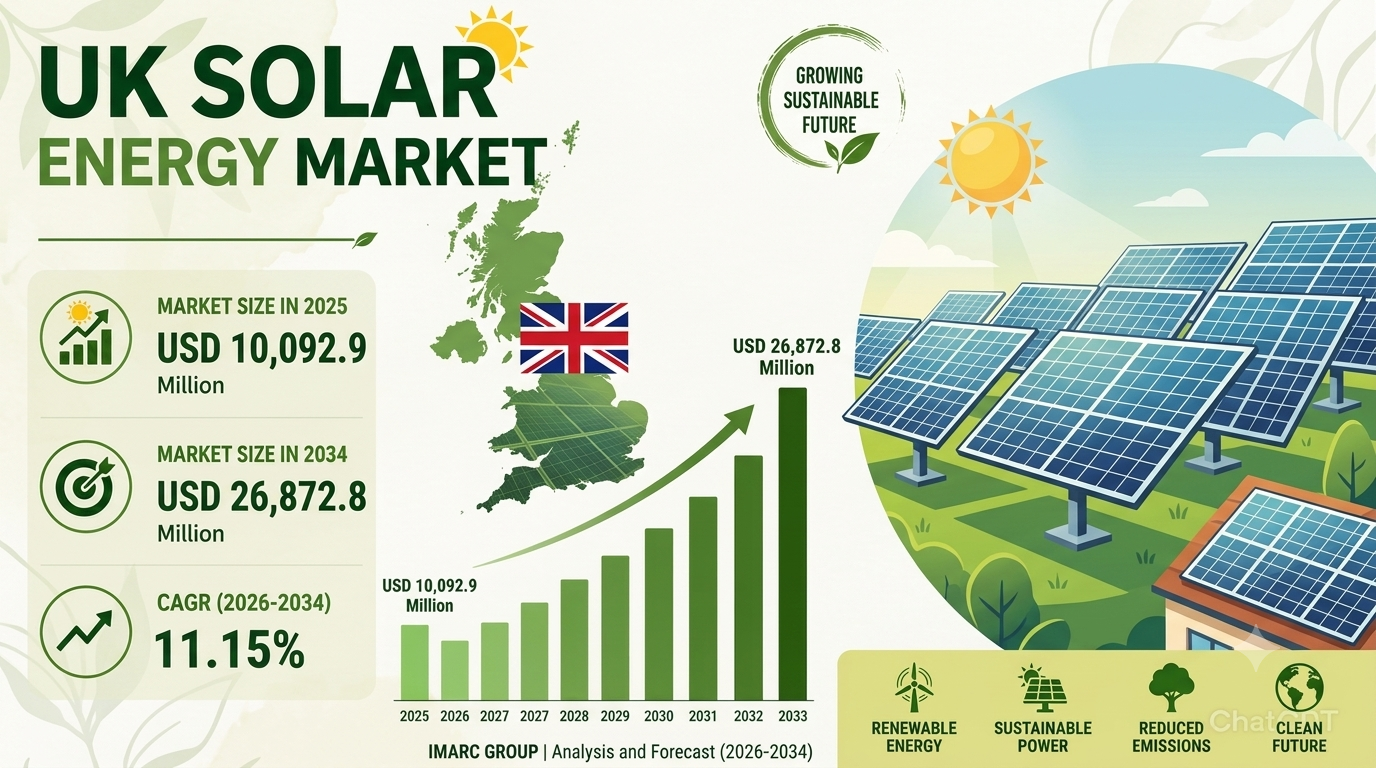
The UK solar energy market is witnessing strong growth driven by favorable government initiatives, increasing solar photovoltaic (PV) installations, a rising focus on environmental sustainability, integration of advanced technologies, and energy independence and security. The market size reached USD 10,092.9 Million in 2025 and is projected to reach USD 26,872.8 Million by 2034, exhibiting a compound annual growth rate (CAGR) of 11.15% during 2026-2034. The UK government’s legally binding target to reduce greenhouse gas emissions by 100% by 2050, alongside its aim to achieve 70 gigawatts (GW) of solar power by 2035, is creating robust consumption patterns for solar energy solutions across the country. This market is strategically important to the UK’s economy as it directly supports the nation’s energy transition, enhances energy security, and contributes to decarbonization targets.
The UK solar energy market is poised for sustained expansion, driven by ambitious government targets, a record 50.8% renewable electricity generation in 2024, and a clear roadmap for 45–47 GW of solar capacity by 2030. With a projected CAGR of 11.15% through 2034, the market presents significant opportunities for established players and new entrants focused on innovative, efficient, and sustainable solar technologies.
UK SOLAR ENERGY MARKET SUMMARY
The UK solar energy market encompasses a wide range of technologies designed for electricity generation, from large-scale utility projects to residential rooftop systems. The ecosystem includes solar panel manufacturers (primarily monocrystalline silicon with emerging technologies like thin-film and TOPCon), system integrators, project developers, distributors, and end-use consumers. Major segments identified in the market include technology (solar photovoltaic (PV) and concentrated solar power (CSP)), application (on-grid and off-grid), and end user (residential, commercial, and industrial). The solar photovoltaic (PV) segment is the dominant technology category, accounting for the vast majority of the market share.
PORTER’S FIVE FORCES ANALYSIS — UK SOLAR ENERGY MARKET
The competitive dynamics of the UK solar energy market can be analyzed using Porter’s Five Forces framework.
- Competitive Rivalry: The market features intense competition between global solar panel manufacturers, large-scale project developers, and specialized UK-based installers. Rivalry is driven by technological innovation, cost reduction, and the pursuit of large-scale projects. Business implication: Companies must differentiate through advanced technology (e.g., TOPCon, bifacial panels), operational efficiency in project development, and strong supply chain management to succeed.
- Supplier Power (Panel Manufacturers): Global manufacturers (primarily in Asia) have significant power, but the UK market also sees increasing supply from European and other international sources. The diversity of suppliers for solar panels, inverters, and mounting systems helps balance this power. Business implication: Solar developers and installers must build diverse and resilient supply chains to mitigate risks and secure competitive pricing.
- Buyer Power: Large utility companies and corporate off-takers have significant negotiating power for large-scale power purchase agreements (PPAs). Similarly, residential and commercial consumers have a wide range of installation options, increasing price sensitivity. Business implication: Companies need to offer compelling value propositions beyond price, such as enhanced efficiency, service guarantees, and financing solutions, to attract buyers.
- Threat of Substitutes: Alternative renewable energy sources like onshore and offshore wind, as well as traditional fossil fuels, pose a substitution threat. However, the declining cost of solar, its scalability, and its suitability for distributed generation make it a strong competitor. Business implication: The solar industry must continue to demonstrate its cost-effectiveness and reliability compared to other energy sources.
- Threat of New Entrants: While significant capital and technical expertise are required for utility-scale projects, barriers to entry are lower for residential and commercial installation, leading to numerous new entrants. The UK’s growing market attracts new domestic and international companies. Business implication: Established players should build defensible positions through vertical integration, strong customer relationships, and proprietary project pipelines.
Request for Sample Report: https://www.imarcgroup.com/uk-solar-energy-market/requestsample
MARKET GROWTH DRIVERS:
Several key factors are propelling the expansion of the UK solar energy market. The favorable government initiatives serve as a powerful demand driver. Governing agencies are implementing schemes that encourage the adoption of small-scale renewable technologies and introducing stricter building regulations that incorporate solar PV in new buildings. The legally binding target to cut UK greenhouse gas emissions by 100% by 2050 and the goal of 70 GW of solar power by 2035 provide a strong policy backbone.
MARKET GROWTH DRIVERS:
The UK solar energy market is also benefiting from increasing solar PV installations and a strong push for energy security and emissions reduction. Rising public and corporate awareness about climate change is catalyzing the demand for solar energy. Technological advancements are leading to more efficient panels like bifacial and TOPCon cells. Furthermore, the urgency to reduce reliance on imported fuels and future-proof the grid is driving investment across public, corporate, and residential sectors. The expansion of land-based solar farms and the emergence of niche formats like agrivoltaics and floating solar are also contributing significantly to market growth.
UK SOLAR ENERGY MARKET SEGMENTATION
Segmentation analysis provides a detailed view of the UK solar energy market by category:
- Technology Insights: Solar Photovoltaic (PV), Concentrated Solar Power (CSP).
- Application Insights: On-grid, Off-grid.
- End User Insights: Residential, Commercial, Industrial.
- Regional Insights: London, South East, North West, East of England, South West, Scotland, West Midlands, Yorkshire and The Humber, East Midlands, Others.
COMPETITIVE LANDSCAPE
The UK solar energy market features a competitive landscape with a mix of global renewable energy giants and specialized players. Key companies operating in the market include major international solar manufacturers, large-scale project developers, and UK-based installation firms.
Strategic developments are shaping the competitive arena, notably TotalEnergies’ acquisition of 350 MW of solar and 85 MW of battery storage projects in southern England (June 2025), and ongoing technological innovations like Oxford University’s flexible, high-efficiency solar material.
REGIONAL ANALYSIS:
Regional dynamics within the UK solar energy market are shaped by varying levels of solar irradiance, land availability, and policy support.
- South East and East of England emerge as critical demand centers, driven by high solar irradiance and significant utility-scale project development on underutilized farmland.
- London, the South West, and the North West benefit from a strong mix of commercial, industrial, and residential rooftop installations.
- Scotland sees growth from both utility-scale projects and a strong push for renewable energy independence.
- Yorkshire and The Humber and the East Midlands have significant potential for ground-mounted solar farms and are seeing increasing development activity.
RECENT INDUSTRY DEVELOPMENTS
June 2025: The UK government and Solar Energy UK released a new Solar Roadmap aiming for 45–47 GW of solar capacity by 2030, outlining steps to expand low-cost power, cut emissions, and create up to 35,000 jobs.
June 2025: TotalEnergies acquired 350 MW of solar and 85 MW of battery storage projects in southern England from Low Carbon, expected to generate over 350 GWh annually, enough to power 100,000 UK homes.
March 2025: Government statistics confirmed that renewables generated a record 50.8% of the UK’s electricity in 2024. Solar accounted for 5.2% (14.8 TWh), while fossil fuel generation dropped to its lowest share (31.5%) since the 1950s.
August 2024: Oxford University physicists developed a flexible, high-efficiency solar material achieving over 27% efficiency without using silicon, which could be applied to everyday surfaces like cars and buildings.
Key Aspects Required for the UK Solar Energy Market
- Market Performance: USD 10,092.9 Million in 2025, with a projected trajectory to USD 26,872.8 Million by 2034.
- Market Outlook: An 11.15% CAGR through 2034 indicates robust growth across residential, commercial, and utility-scale solar installations.
- Growth Drivers: Favorable government policies and legally binding decarbonization targets; increasing solar PV installations driven by technology advancements and falling costs; a strong push for energy security and emissions reduction; expansion of land-based solar farms and niche formats (agrivoltaics, floating solar).
- Competitive Landscape: A competitive environment with global renewable energy giants and specialized UK-based developers and installers. The market is shaped by technological innovation, large-scale project acquisitions, and the emergence of new, highly efficient solar materials.
- Value Chain Analysis: From the manufacturing of solar panels, inverters, and mounting systems through project development, system integration, distribution, and installation to end-use in residential, commercial, and industrial applications.
- Industry Trends: Monocrystalline dominance with emerging alternatives like TOPCon and thin-film; growth of niche formats like agrivoltaics and floating solar; increasing integration of battery storage; record-high renewable electricity generation; emergence of flexible, high-efficiency solar materials.
- Strategic Recommendations: Focus on utility-scale solar project development with integrated battery storage; invest in innovative and high-efficiency technologies (e.g., TOPCon, bifacial); develop specialized capabilities for niche formats (floating solar, agrivoltaics); build strong relationships with landowners, planners, and corporate off-takers to secure project pipelines.
Note: If you need any specific information that is not covered currently within the scope of the report, we will provide the same as a part of customization.
Request Customization: https://www.imarcgroup.com/request?type=report&id=24125&flag=E
Write this before about us —
- Report Format, Delivery, and Customization Details
- Report Format Mode: PPT, PDF, and Excel
- Report Delivery Mode: Online Delivery, Physical Delivery
- Report Delivery Time: Report Delivered Over Email within 24 to 48 hours. If requested by the client, a physical copy will be delivered within three to ten days.
- Report Confirmation Mode: Yes via Email
- Report Customization Mode: Yes via Email / Call
- Report Table of Content: Yes
- Report List of Figures: Yes
- Report Methodology Mode: Yes
- Request For Sample Report: Yes