
Most people approach the spiritual path the same way they approach everything else in life — with a general plan, a lot of enthusiasm at the start, and a nagging sense after a few years that something still doesn’t quite fit.
The practice is real. The intention is genuine. But there’s often a feeling that the particular combination of techniques and traditions they’ve assembled isn’t quite calibrated to who they actually are — to their specific psychology, their particular karmic tendencies, the unique contours of their own inner landscape.
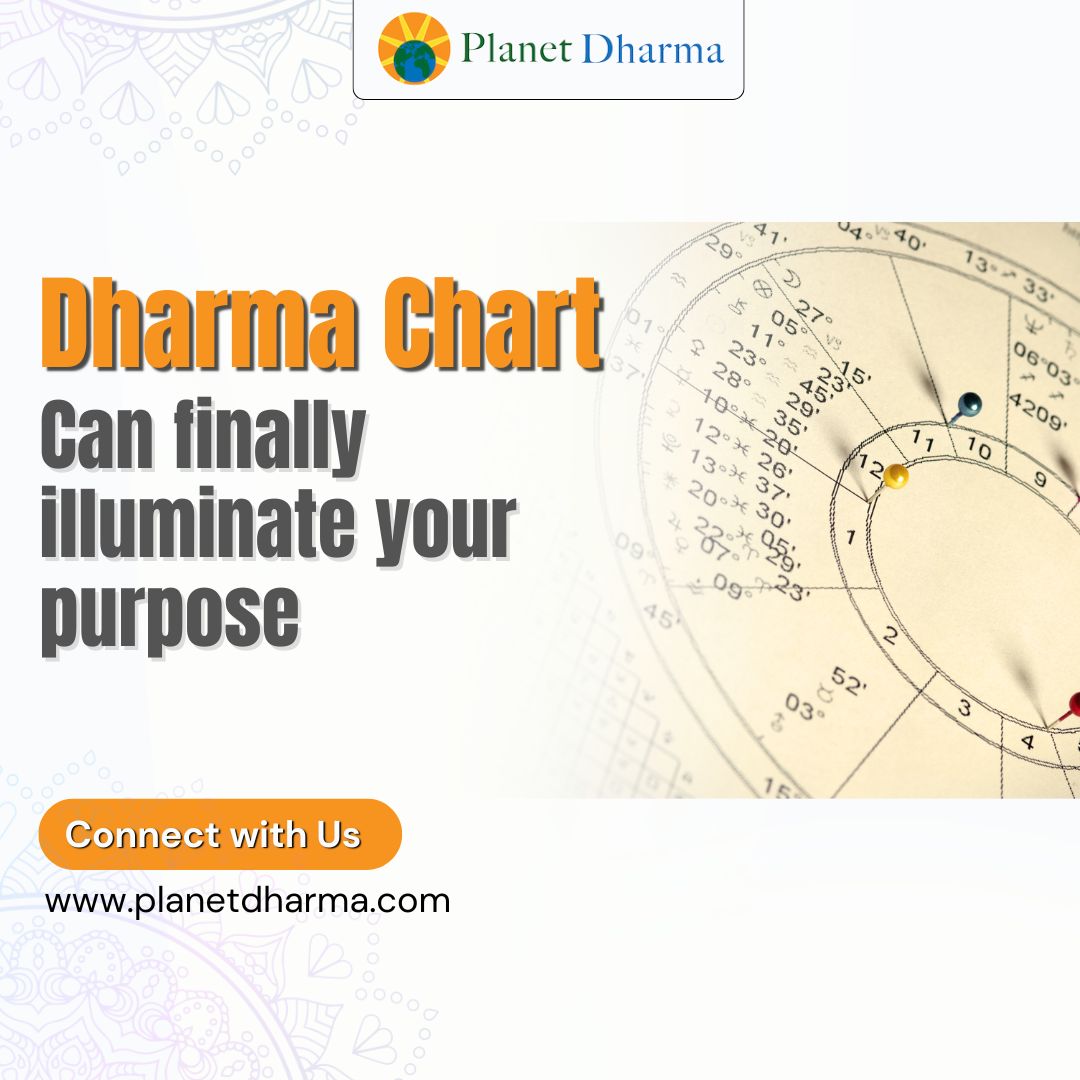
This is where the idea of a dharma chart becomes genuinely interesting — not as a novelty or a personality quiz dressed in spiritual language, but as a precise diagnostic tool for understanding which dimensions of the path are most relevant to your specific nature, and where the real work is most likely to be found.
What a Dharma Chart Actually Is
The dharma chart sits at the intersection of two traditions that most modern practitioners treat as entirely separate: Buddhist dharma and Western astrology.
Most people who’ve encountered astrology casually know it as a personality description system — sun signs, compatibility charts, vague generalisations about being a Scorpio or a Capricorn. This is the outermost layer of an extraordinarily sophisticated tradition, the equivalent of judging Buddhist practice by the colour of the meditation cushions.
Western astrology, at its depth, is one of the esoteric tools of the Western Mystery tradition — a symbolic language for mapping the particular configuration of forces and tendencies that shape an individual’s psyche, karma, and evolutionary trajectory. When applied to dharma practice, it functions as exactly what most practitioners need most and have the hardest time finding: a personalised map of where the genuine work lies.
A dharma chart reads the birth chart not primarily for personality traits or life predictions, but for dharmic information — what particular challenges are most likely to block this specific person’s awakening, what natural capacities are available as resources, and which kinds of practice are most likely to be genuinely effective rather than simply comfortable.
Introducing Planet Dharma
Planet Dharma is a Buddhist-inspired spiritual education platform founded by Dharma teachers Doug Duncan (Qapel) and Catherine Pawasarat Sensei. Their work draws from the Namgyal Rinpoche lineage — a uniquely rich transmission that integrates Theravada and Vajrayana Buddhist practice with the Western esoteric traditions, including astrology, alchemy, the Tarot, and Jungian depth psychology.
This integration is not incidental. Namgyal Rinpoche himself encountered the Western Mystery teachings before his Buddhist training, and he consistently maintained that both streams were accessing the same fundamental territory — consciousness, karma, and the conditions for genuine liberation — through complementary lenses.
Catherine Pawasarat Sensei continues this tradition through AstroDharma — the explicit application of astrological understanding to dharma practice — offering both introductory teachings and a full self-study course that makes this sophisticated cross-disciplinary framework accessible to contemporary practitioners at every level.
What the Chart Actually Shows That Self-Assessment Cannot
Here’s the honest challenge with most spiritual self-assessment: the parts of ourselves that most need attention are often precisely the parts we’re least able to see clearly. The shadow operates by definition outside conscious awareness. The ego’s strengths are easy to identify; its most persistent blind spots are not.
A dharma chart bypasses this limitation in a distinctive way. Rather than asking you to report on your own tendencies — with all the distortion that self-perception introduces — it reads the symbolic configuration of the birth chart as an external, objective map of the psychological and karmic landscape.
The ascendant and its ruling planet describe the particular way this person’s identity tends to construct and defend itself — the specific shape of the ego’s castle. The moon describes the emotional body, the deep instinctual patterns, the childhood-formed blueprint for relating. Saturn maps the areas of genuine difficulty and karmic debt — the places where the work is most concentrated and most necessary. The nodes of the moon describe the soul’s evolutionary direction — what this lifetime is specifically oriented toward, and what familiar territory is most in need of being released.
For a dharma practitioner, all of this is extraordinarily useful information. Knowing that Saturn sits in the tenth house, for instance, immediately flags authority, public visibility, and professional achievement as an area of karmic complexity — which means the shadow material around power and recognition is likely dense and worth working with specifically. Knowing that the south node sits in Aries suggests a practitioner who is releasing karmic patterns around self-assertion and individual will, and building toward the Libran qualities of relationship, balance, and consideration of others.
None of this replaces direct practice. But it provides a precision of direction that most practitioners spend years developing through trial and error alone.
Sadhana Tara — Where the Chart’s Qualities Are Embodied Directly
Understanding your dharmic map intellectually is one thing. Having a practice that directly cultivates the qualities the path requires of you is another — and this is where sadhana Tara enters as a perfect complement.
Green Tara — one of the most beloved and widely practiced figures in Tibetan Buddhism — is a female bodhisattva associated with qualities that dharma practice, at its depth, consistently demands: swift compassionate action, fearlessness in the face of obstacles, and liberation that arrives not through gradual attrition but through the direct, immediate quality of awakened response.
Her sadhana is not a simple guided relaxation. It’s a structured Vajrayana practice that uses visualisation, mantra, and symbolic identification to engage both the analytical and intuitive faculties simultaneously — and to directly embody the qualities it works with rather than simply describing them.
Why Green Tara Is Particularly Relevant for the Dharma Chart
Here’s what makes the combination of dharma chart reading and Tara sadhana particularly potent: the chart reveals where the obstacles most persistently arise; the sadhana directly cultivates the quality most capable of moving through those obstacles.
For a practitioner whose chart flags difficulty with fear — prominently placed Pluto, strong Scorpio themes, prominent eighth house material — Tara’s fearlessness is not an abstract aspiration but a direct antidote, cultivated through embodied practice rather than conceptual understanding.
For a practitioner whose chart indicates difficulty with compassion and warmth — heavily Saturnine charts, strong Capricorn themes, limited water — the sadhana practice of identifying with Tara’s boundless, swift compassion becomes exactly the medicine the chart has prescribed.
This is what distinguishes an intelligent approach to dharma practice from a generic one: the practice is chosen not because it’s popular or because everyone else is doing it, but because it addresses this specific person’s specific dharmic challenges, identified through careful reading of their specific chart.
Long Meditation Retreat — Where Everything Gets Tested and Integrated
Reading a dharma chart creates direction. Tara sadhana cultivates the inner qualities the chart identifies as necessary. And a long meditation retreat is where all of this gets tested, deepened, and integrated in ways that neither intellectual understanding nor daily practice alone can produce.
The relationship between chart work, sadhana practice, and extended retreat is not hierarchical — each one feeds the others. But there’s something about the extended retreat environment that creates a particular quality of consolidation unavailable elsewhere.
What Changes in Extended Retreat That Short Practice Cannot Reach
When a practitioner enters an extended retreat already holding an understanding of their dharmic challenges — the specific shadow areas flagged by their chart, the qualities they’re actively cultivating through sadhana — the retreat environment gives that understanding somewhere genuinely deep to go.
Rather than experiencing the usual retreat arc of initial restlessness followed by gradual settling, the practitioner who arrives with a clear map of their own inner terrain tends to move more quickly toward exactly the material that needs attention. The chart has already identified what’s most important. The sadhana has already begun cultivating the quality needed to meet it. The retreat creates the sustained, unhurried space for the actual encounter to happen.
Planet Dharma’s advancing in meditation retreat program is specifically designed for practitioners who are ready to move beyond basic stabilisation and into the deeper territory where genuine breakthrough becomes possible. This includes not just intensified formal meditation but engagement with the shadow material, the community dynamics, and the direct teaching that together create the conditions for lasting transformation rather than temporary peak experience.
The BC Rockies setting of Clear Sky Meditation Centre — surrounded by old-growth forest and genuine wilderness — contributes something to this process that no urban retreat centre can replicate. The natural environment quietens the nervous system at a level below conscious intention, creating a quality of settled groundedness that accelerates everything else.
The Three Working Together
What emerges when dharma chart understanding, Tara sadhana, and long retreat practice operate in genuine relationship is a quality of precision and depth that none of these elements produces alone.
The chart provides the map — personalised, specific, genuinely diagnostic rather than generic. The sadhana provides the medicine — directly cultivating the qualities most needed for this specific practitioner’s specific challenges. And the retreat provides the laboratory — the sustained, immersive conditions in which the map and the medicine meet the actual terrain of the practitioner’s consciousness in real time.
This is the difference between a spiritual education that’s one-size-fits-all and one that genuinely serves the unique person who is actually practicing. Planet Dharma’s integration of AstroDharma, Vajrayana practice, and serious retreat culture represents exactly this more individualised, more precise, and ultimately more honest approach.
FAQs
Q: What is a dharma chart and how is it different from ordinary astrology?
A: A dharma chart applies Western astrological reading specifically to spiritual practice — identifying karmic challenges, shadow areas, and natural capacities relevant to the path, rather than focusing on personality traits or life predictions.
Q: Do I need astrological knowledge to benefit from a dharma chart reading?
A: No. Planet Dharma’s AstroDharma teachings and course introduce the relevant framework accessibly, making the insights available to practitioners with no prior astrological background.
Q: What is sadhana Tara and how does it complement chart work?
A: Sadhana Tara — specifically the Green Tara guided meditation practice — directly cultivates qualities like fearlessness and compassion that dharma chart reading frequently identifies as needed. The chart diagnoses; the sadhana provides the practice that addresses the diagnosis.
Q: Who is a long meditation retreat most suited for?
A: Planet Dharma’s advancing in meditation program is specifically designed for practitioners who have moved beyond basic stabilisation and are ready to engage the deeper territory where genuine breakthrough becomes available.
Q: How long should a long retreat be to produce significant change?
A: The answer varies by individual, but most experienced teachers suggest at least seven to ten continuous days for deeper material to surface — with retreats of three to six weeks producing significantly more lasting transformation.
Q: Can I combine online dharma chart study with in-person retreat attendance?
A: Absolutely, and doing so tends to be considerably more effective than either alone. The chart work provides direction; the retreat provides the environment in which that direction gets put to its most rigorous test.
Final Thoughts
The spiritual path works best when it’s genuinely calibrated to who you actually are — not to who a generic framework assumes the average practitioner to be.
A dharma chart provides exactly that calibration — a precise, personalised map of where the genuine work lies for this specific person, at this specific moment in their development. Sadhana Tara gives that map an embodied practice to work with — cultivating the qualities most needed to meet what the chart identifies. And a long meditation retreat provides the sustained, supported conditions in which everything that understanding and practice have prepared becomes directly, undeniably lived.
Planet Dharma holds all three of these elements within a single coherent teaching framework — one that treats the practitioner as a complete, unique individual rather than a generic spiritual consumer.
The map is available. The practice is waiting. And the retreat is the place where both of them finally become real.