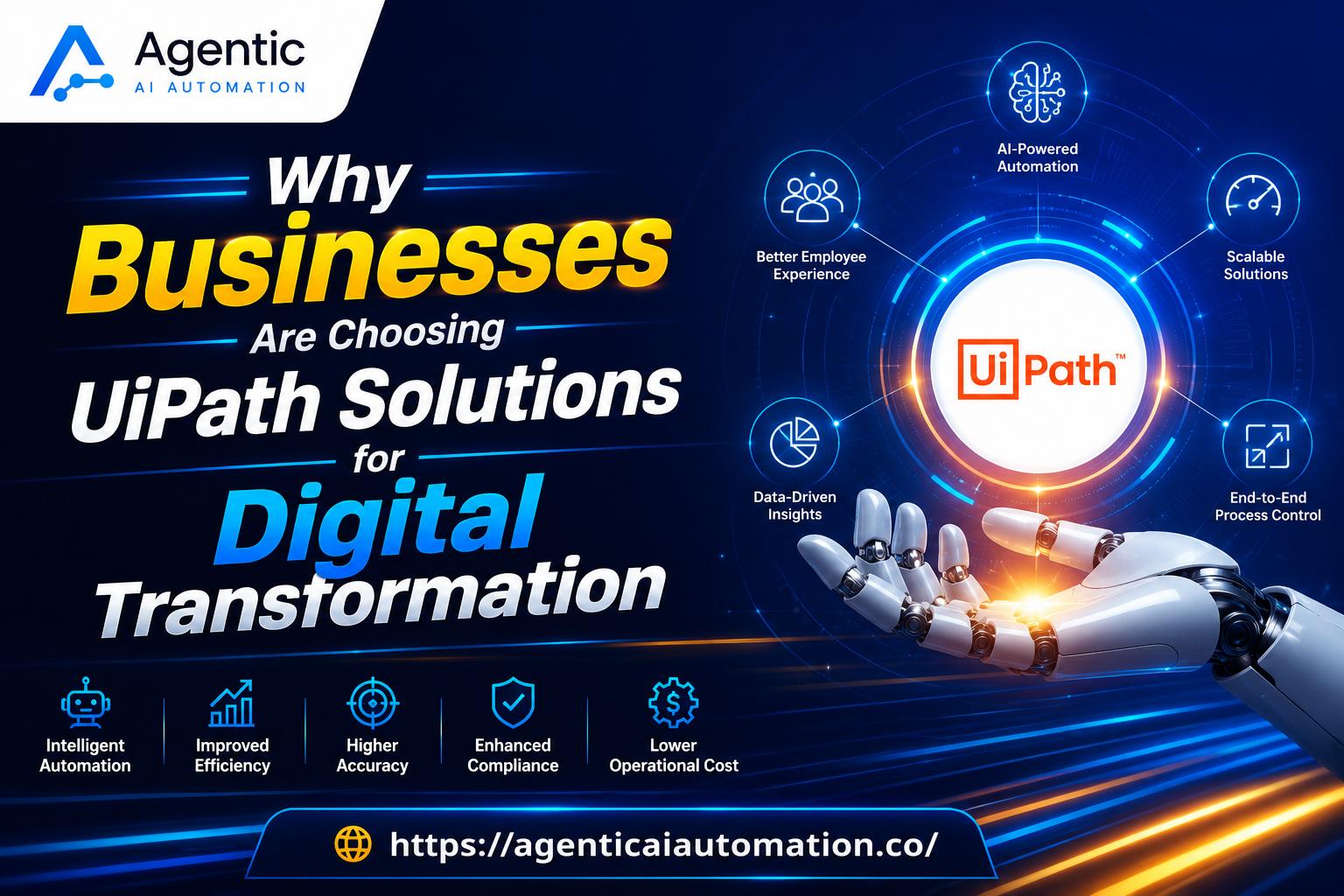
Every business leader has heard the phrase “digital transformation” so many times it has almost lost its meaning. Yet behind the buzzword is a very real shift: companies are under pressure to do more with fewer resources, respond faster to customers, and free up employees from repetitive work so they can focus on higher-value tasks. This is exactly the gap that UiPath solutions have stepped in to fill, and it’s why the platform has become one of the most widely adopted automation ecosystems in the world.
In this article, we’ll break down what makes UiPath solutions different, how AI in UiPath is changing the automation game, why agentic AI is the next big leap for enterprise workflows, and how businesses of every size are putting these tools to work.
What Are UiPath Solutions, and Why Do They Matter?
At its core, UiPath is a Robotic Process Automation (RPA) platform that allows businesses to automate repetitive, rule-based tasks — think data entry, invoice processing, report generation, or moving information between systems that don’t naturally talk to each other. But calling UiPath “just RPA” undersells it. Over the past few years, UiPath solutions have evolved into a full automation ecosystem that includes process mining, document understanding, testing automation, and increasingly, AI-driven decision-making.
This evolution matters because businesses don’t automate for the sake of automating. They automate to cut costs, reduce human error, speed up turnaround times, and let employees spend their time on work that actually requires judgment and creativity. When a finance team no longer has to manually reconcile hundreds of invoices, or a customer service department can resolve routine tickets instantly, the impact shows up directly on the bottom line.
The Core Building Blocks
- Studio — a low-code, drag-and-drop environment for building automation workflows, accessible to both developers and business users.
- Orchestrator — the central hub for deploying, scheduling, and monitoring bots across the organization.
- Robots (Attended and Unattended) — the software agents that actually execute tasks, either alongside an employee or fully independently in the background.
- Document Understanding — AI-powered extraction of data from invoices, contracts, forms, and other unstructured documents.
- Process Mining and Task Mining — tools that analyze how work actually happens, uncovering bottlenecks before you even design an automation.
Together, these components make UiPath solutions less of a single tool and more of a platform businesses can build an entire automation strategy around.
How AI in UiPath Is Changing the Game
Traditional RPA is excellent at following rules, but it struggles the moment a task requires judgment, such as reading a handwritten note, interpreting a vague customer request, or deciding which of three possible actions makes the most sense. This is where AI in UiPath comes in. By embedding machine learning and generative AI models directly into workflows, UiPath allows bots to handle tasks that used to require a human’s interpretation.
A few concrete examples of this in action include:
- Intelligent document processing that can read messy, inconsistent invoices or contracts and extract the right fields with high accuracy, even when the layout changes.
- Natural language understanding that lets bots interpret emails or chat messages and route them appropriately, rather than relying on rigid keyword matching.
- Predictive insights drawn from process mining, helping teams spot where a workflow is likely to break down before it actually does.
- Generative AI integrations (including connections to large language models) that let bots draft responses, summarize documents, or generate reports as part of a larger automated process.
What makes this powerful isn’t AI in isolation — plenty of companies already use AI tools individually. The advantage comes from AI being woven directly into an execution layer that can act on its own conclusions. A model that identifies an anomaly in an invoice is useful; a model that identifies the anomaly and automatically routes it for approval, updates the record, and notifies the right person is transformative.
Agentic AI: The Next Frontier of Automation
If AI in UiPath was about making individual steps smarter, agentic AI is about making entire processes autonomous. Agentic AI refers to AI systems, often called “agents,” that can plan, reason, and take multi-step actions toward a goal with minimal human oversight — not just responding to a single prompt, but figuring out the sequence of steps needed to complete a task and adapting when something unexpected happens.
UiPath has leaned heavily into this shift by allowing businesses to build and orchestrate AI agents alongside traditional robots. Instead of a rigid, pre-scripted workflow, an agent might:
- Receive an ambiguous request (like “resolve this customer complaint”) and break it down into the steps needed to actually resolve it.
- Pull data from multiple systems, decide what’s relevant, and determine the next best action.
- Hand off to a human only when a decision genuinely requires human judgment or approval, rather than at every single step.
- Collaborate with other agents and traditional bots, each handling a different part of a larger process.
This matters because it addresses one of the biggest limitations of older automation: brittleness. A traditional bot breaks the moment a process deviates from the script it was built for. Agentic AI is designed to reason through exceptions instead of failing on them, which is a meaningful shift for any business dealing with real-world processes that rarely follow a perfectly straight line.
It’s worth being realistic here too: agentic AI is still maturing, and businesses adopting it need proper governance, oversight, and testing to make sure agents are making sound decisions. UiPath’s orchestration layer is specifically built to give organizations visibility and control over what agents are doing, which is critical for trust and compliance.
Why Businesses Are Actually Choosing UiPath
There are plenty of automation vendors on the market, so it’s fair to ask what’s driving so many organizations specifically toward UiPath solutions. A few consistent reasons show up across industries:
1. It Scales From Simple Tasks to Enterprise-Wide Programs
A small team can start by automating one repetitive task in an afternoon using Studio, while a large enterprise can run thousands of bots and agents across departments through Orchestrator. This flexibility means businesses don’t have to rip and replace their automation strategy as they grow.
2. Low-Code Accessibility
You don’t need a team of specialized developers to get started. UiPath’s low-code design means business analysts and operations staff can build and adjust workflows themselves, which shortens the time between identifying a problem and actually solving it.
3. A Broad, Mature Ecosystem
Because UiPath has been around long enough to build deep integrations with common enterprise systems (ERP platforms, CRMs, email, and countless other applications), businesses aren’t stuck reinventing connections that already exist elsewhere.
4. Strong Governance and Security
For regulated industries like finance, healthcare, and insurance, having centralized monitoring, audit trails, and role-based access through Orchestrator isn’t a nice-to-have, it’s a requirement. UiPath’s enterprise-grade controls make it easier to pass compliance reviews while still moving fast.
5. A Clear Path Toward Intelligent Automation
Perhaps most importantly, businesses aren’t choosing UiPath just for what it does today. They’re choosing it because the roadmap, from AI in UiPath to full agentic AI capabilities, points toward a future where automation isn’t limited to repetitive tasks but extends into genuinely intelligent, semi-autonomous operations.
Real-World Use Cases Worth Knowing
- Finance and Accounting: Automated invoice processing, expense reconciliation, and fraud detection that flags anomalies for human review.
- Healthcare: Faster claims processing, patient data entry, and appointment scheduling that reduces administrative overhead for clinical staff.
- Retail and E-commerce: Inventory updates, order processing, and customer service automation that scales during high-traffic periods.
- Human Resources: Automated onboarding paperwork, background checks, and benefits enrollment, freeing HR teams to focus on people, not paperwork.
- IT Operations: Automated ticket triage, system monitoring, and routine maintenance tasks that used to eat into engineers’ time.
Across all of these, the common thread is the same: employees get their time back, error rates go down, and the business becomes more responsive without a proportional increase in headcount.
Getting Started Without Overcomplicating It
If you’re a business owner or decision-maker considering UiPath solutions, the temptation is often to think big right away, automating an entire department or rolling out agentic AI across the company in one go. In practice, the businesses that get the most value tend to start small and build momentum.
- Identify one repetitive, time-consuming, rule-based process and automate it first to prove the value quickly.
- Use process mining to understand where your real bottlenecks are before assuming you know the answer.
- Layer in AI in UiPath features, like document understanding, once your basic automations are stable.
- Experiment with agentic AI in a controlled, low-risk process before expanding it to critical workflows.
- Keep a human in the loop for decisions with real consequences, and expand autonomy gradually as trust builds.
This gradual approach not only reduces risk, it also helps employees see automation as something that supports their work rather than threatens it, which makes adoption across the wider organization far smoother.
Final Thoughts
Digital transformation isn’t really about chasing the newest technology, it’s about removing friction so a business can operate more efficiently and adapt faster to change. That’s precisely why UiPath solutions have found such a strong foothold across industries: they offer a practical, scalable path from simple task automation to intelligent, AI-driven processes.
As AI in UiPath continues to mature and agentic AI moves from an emerging concept to a genuinely reliable business tool, the gap between companies that automate thoughtfully and those that don’t is only going to widen. For businesses weighing where to start, the good news is that you don’t need to overhaul everything overnight. A single well-chosen automation, built on a platform designed to grow with you, is often enough to prove the case and set the stage for everything that comes next.