
Businesses today face increasing challenges, from managing employees and customer relationships to tracking finances and completing projects on time. As companies grow, handling these tasks manually becomes inefficient and increases the risk of costly mistakes. That’s why investing in business management software has become a smart decision for organizations looking to improve productivity and stay competitive.
Whether you’re running a startup, an online business, or an established enterprise, the right software can simplify operations and help your business scale efficiently.
Understanding Business Management Software
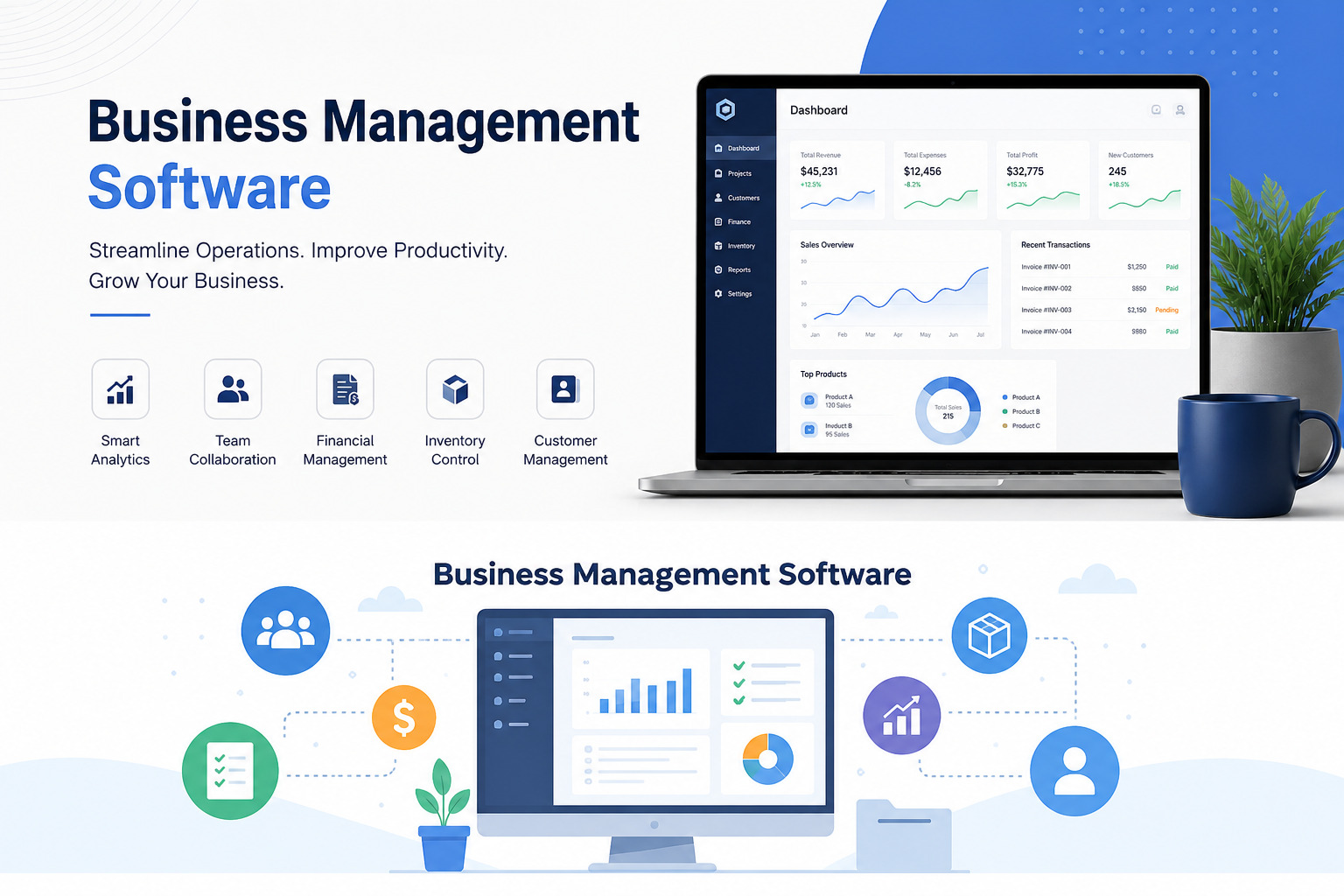
Business management software is a centralized platform that combines multiple business functions into one system. Instead of using separate tools for accounting, inventory, customer management, and project tracking, businesses can manage everything from a single dashboard.
This integrated approach reduces duplicate work, improves communication between departments, and gives business owners complete visibility into their operations.
Common Challenges Businesses Face
Many businesses still rely on spreadsheets or multiple standalone applications. While these solutions may work initially, they often create several problems as the company expands, including:
- Duplicate data entry
- Poor communication between teams
- Delayed reporting
- Difficulty tracking business performance
- Manual approval processes
- Increased operational costs
Business management software eliminates these issues by connecting different business processes into one seamless workflow.
Key Advantages of Business Management Software
1. Increased Operational Efficiency
Automation helps businesses reduce repetitive manual tasks such as invoice generation, employee attendance tracking, inventory updates, and customer follow-ups. Employees spend less time on administrative work and more time on activities that generate revenue.
2. Better Collaboration
When departments work on the same platform, information is updated in real time. Teams can easily access shared documents, project updates, customer records, and business reports without constantly exchanging emails.
3. Improved Financial Control
Managing finances becomes easier with built-in accounting features. Businesses can monitor expenses, generate invoices, track payments, and analyze profit margins from a centralized dashboard.
4. Data-Driven Decisions
Modern business management software provides real-time analytics and customizable reports. Business owners can identify trends, monitor KPIs, and make informed decisions based on accurate data rather than assumptions.
Why Small Businesses Should Invest Early
Many small business owners assume management software is only for large organizations. In reality, Small Business Management Software offers some of the biggest benefits to growing businesses.
Small companies usually have limited staff and resources. Automating routine operations allows employees to focus on customer service, sales, and business development instead of paperwork.
Some of the biggest advantages include:
- Reduced administrative workload
- Faster customer response times
- Better cash flow management
- Organized business records
- Easier employee management
- Improved productivity
By implementing Small Business Management Software early, businesses can build efficient systems before operational challenges become difficult to manage.
Features That Matter Most
When evaluating business management software, look for features that support both your current requirements and future growth.
Important features include:
- Customer Relationship Management (CRM)
- Financial and accounting tools
- Inventory management
- Project management
- Employee management
- Workflow automation
- Sales reporting
- Business analytics
- Cloud access
- Data security
Choosing software with flexible modules allows businesses to expand functionality as their operations grow.
Cloud-Based Business Management Software
Cloud technology has transformed the way businesses operate. Cloud-based business management software enables employees to access important business information securely from any location using a computer or mobile device.
Additional benefits include:
- Automatic software updates
- Secure cloud backups
- Lower IT infrastructure costs
- Easy collaboration for remote teams
- High system availability
For businesses embracing hybrid or remote work, cloud solutions provide the flexibility needed to maintain productivity.
How the Right Software Supports Business Growth
As a company grows, managing customers, employees, finances, and operations becomes increasingly complex. Business management software provides the structure needed to support expansion without adding unnecessary administrative burden.
With centralized data, automated workflows, and real-time reporting, businesses can improve customer satisfaction, reduce operational costs, and respond quickly to changing market conditions.
Instead of reacting to problems after they occur, business owners gain the insights needed to plan proactively and scale with confidence.
Conclusion
Growth requires more than hard work—it requires the right technology. Investing in reliable business management software helps businesses simplify operations, improve collaboration, automate routine tasks, and make smarter decisions based on real-time data.
For startups and growing companies, Small Business Management Software offers an affordable and scalable solution that supports long-term success. By choosing the right platform today, businesses can improve efficiency, strengthen customer relationships, and create a solid foundation for sustainable growth in an increasingly competitive marketplace.