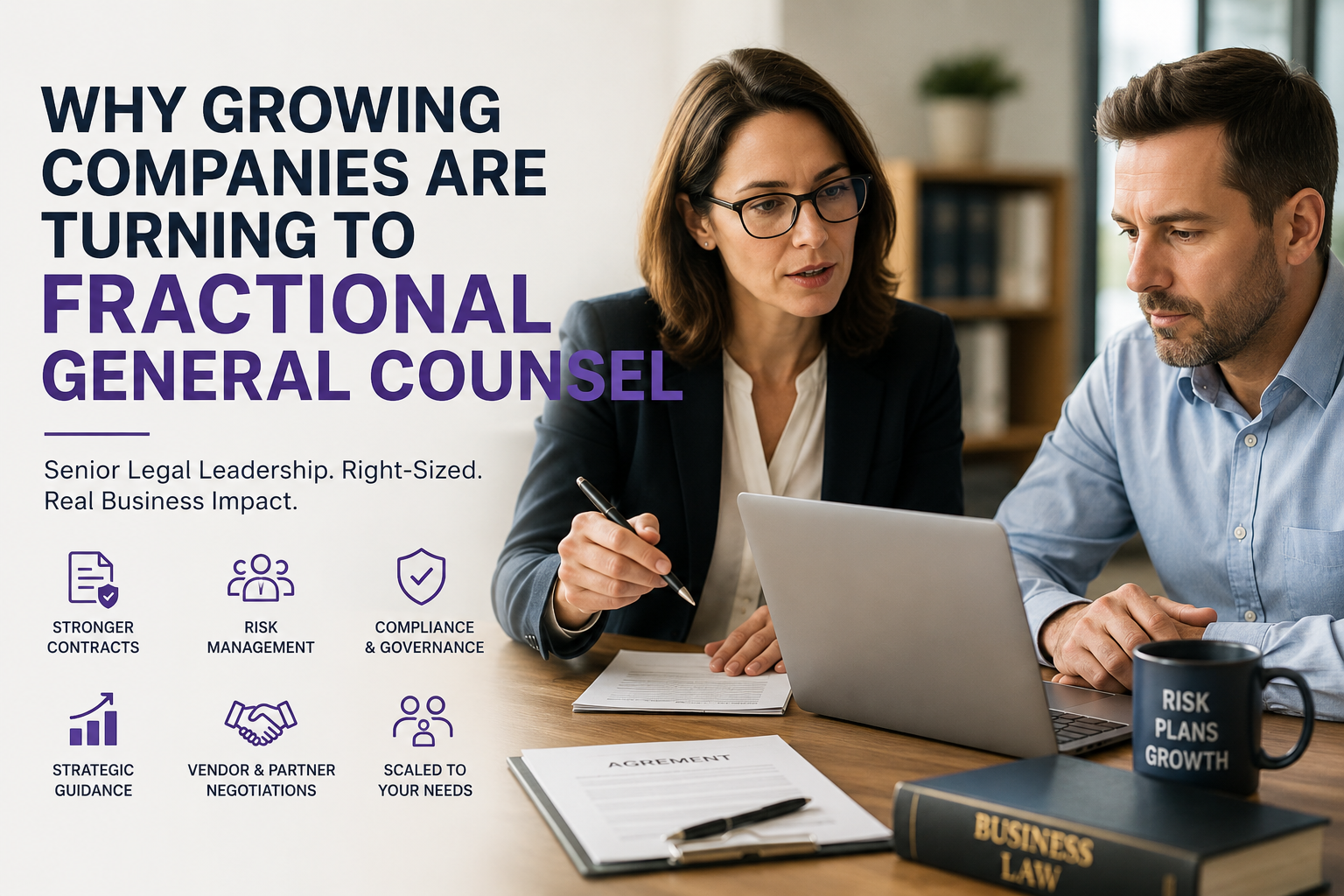
Legal risk doesn’t wait until a company can afford a full legal department. Contracts get signed, vendors get onboarded, and employees get hired long before most startups and mid-sized businesses have the budget — or the volume of work — to justify a full-time General Counsel. That gap is exactly why more companies are turning to a fractional model for their legal needs.
What Is Fractional General Counsel?
Fractional general counsel is an arrangement where an experienced attorney provides ongoing legal leadership on a part-time or as-needed basis, rather than as a full-time employee. Instead of paying a six-figure salary plus benefits for someone who may only be fully utilized part of the time, companies get senior-level legal guidance scaled to what they actually need.
This isn’t the same as calling an outside law firm every time a question comes up. A fractional GC becomes embedded in the business — sitting in on leadership conversations, understanding the company’s risk tolerance, and building institutional knowledge over time, much like an in-house hire would.
Why It’s Especially Common Among Startups
Startups face a particular version of this problem: legal needs move fast, but budgets are tight and headcount is precious. Fractional general counsel for startups has become a popular middle ground because it gives founders access to real legal strategy — not just document review — without the overhead of a full-time hire.
Early-stage companies often need help with things like:
- Structuring early customer and vendor contracts
- Reviewing terms before a funding round
- Setting up IP protections before they become a problem
- Navigating employment law as the team grows
A fractional GC can flex up during a fundraise or acquisition and flex back down during quieter periods, which is difficult to do with a salaried employee.
Legal Risk Isn’t Just Contracts
One area companies frequently underestimate is broader exposure across the business — not just what’s written in an agreement, but how operations actually function day to day. A solid operational risk management approach looks at where a company is exposed: vendor dependencies, data handling, employment practices, regulatory obligations, and more. A fractional GC often plays a key role here, helping leadership spot risk before it turns into a lawsuit, a compliance failure, or a lost deal.
Where Fractional GC Work Shows Up Most: Contracts
If there’s one place fractional general counsel earns its keep immediately, it’s contracts. Every growing company signs more of them than it expects — with customers, vendors, contractors, and partners — and the quality of those agreements determines how much risk the company is carrying at any given moment.
Two areas come up constantly:
Software agreements. For any company that buys, sells, or builds software, a properly negotiated software license agreement protects against everything from unclear usage rights to liability exposure if something goes wrong. These agreements are easy to sign quickly and expensive to get wrong.
General contracts. Beyond software, most day-to-day risk lives in the fine print of ordinary business agreements. Understanding the basics of contract and agreement drafting and review — scope, liability, termination rights, indemnification — is one of the most practical things a growing company can invest in early.
Fractional GC vs. Outside Counsel: What’s the Difference?
It’s a fair question, since both sound similar on paper. Traditional outside general counsel services — like a law firm on retainer — tend to be transactional: you bring them a specific issue, they handle it, and the relationship resets each time. A fractional GC, by contrast, functions more like a member of the leadership team. They know the business, they’re proactive rather than reactive, and they’re involved in strategy, not just problem-solving after the fact.
Many companies use both. Outside counsel firms are often brought in for specialized litigation or highly technical matters, while a fractional GC manages the ongoing legal function and knows when it’s time to escalate to outside specialists.
Is Fractional General Counsel Right for Your Company?
It tends to make the most sense for companies that:
- Are too large to operate without any legal oversight, but too small to justify a full-time GC
- Are scaling quickly and signing a growing volume of contracts
- Want proactive risk management instead of reactive firefighting
- Need experienced legal judgment involved in strategic decisions, not just paperwork
For many growing companies, it’s the difference between legal being a bottleneck and legal being a genuine business advantage.
The Bottom Line
Legal risk grows alongside every other part of a business — contracts, hiring, vendors, product decisions — whether or not there’s someone in-house to manage it. Fractional general counsel gives companies a way to close that gap with experienced leadership, without the cost or commitment of a full-time hire. For founders and executives trying to grow responsibly, it’s often one of the smartest investments they make.