Stainless steel rope cable from Drawmet Wires is trusted because it’s manufactured under ISO 9001:2015 certification with over 30 years of dedicated experience, giving buyers a consistent, corrosion-resistant product that performs reliably across lifting, marine, architectural, and general industrial applications.
Sourcing stainless steel rope cable can feel deceptively simple until you start comparing grades, strand patterns, core types, and finishes across different suppliers, all claiming the same level of quality. Drawmet Wires, founded in 1988 and based in a dedicated industrial facility in Rajasthan, India, has spent decades narrowing down exactly what makes a rope cable perform consistently under real load, not just on a spec sheet. Today, the company exports the majority of its production to Western European manufacturers, a relationship built on repeat orders rather than one-off sales, which says something about how consistently the product performs once it leaves the factory.
What Exactly Is Stainless Steel Rope Cable, and How Is It Made?
Stainless steel rope cable is formed by twisting multiple individual stainless steel wires into strands, then twisting those strands around a core, producing a flexible yet strong cable that resists corrosion far better than untreated carbon steel.
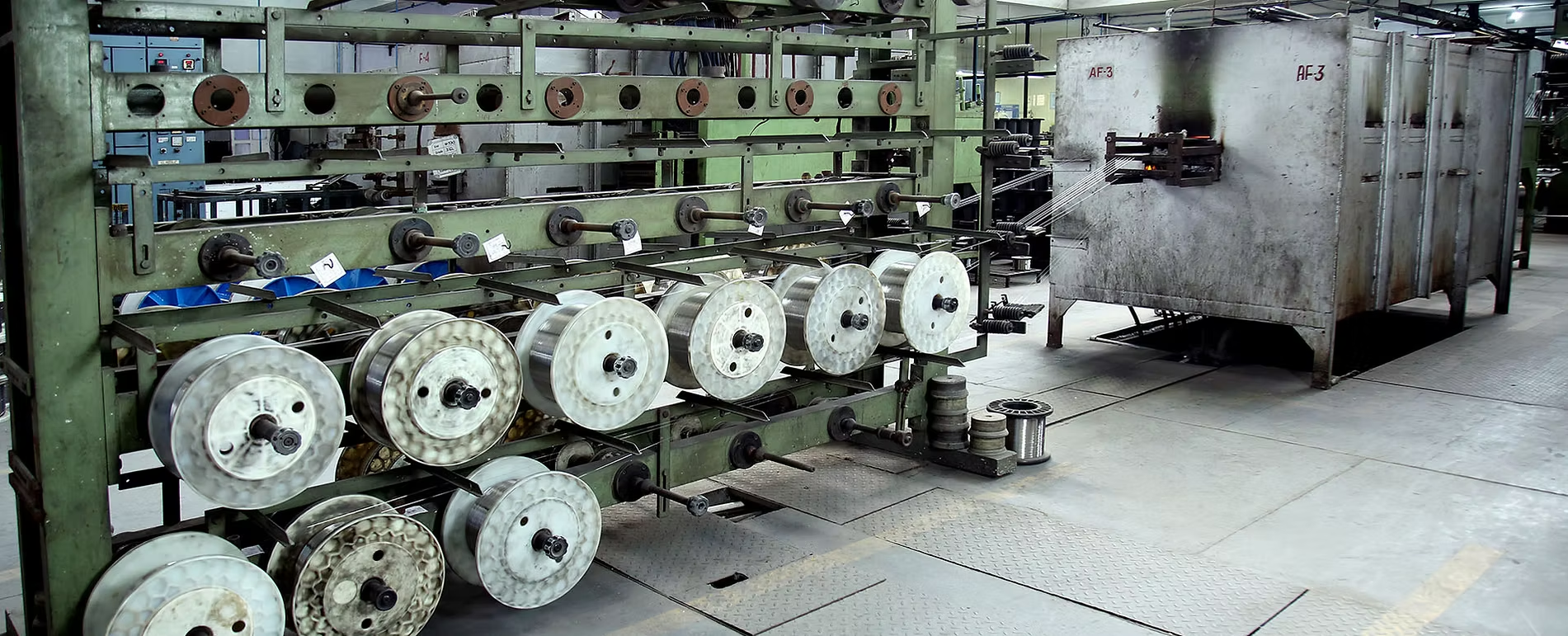
The manufacturing process starts with drawing raw stainless steel down to precise wire diameters, then stranding those wires together in specific patterns depending on the intended use. The core running through the center, either an independent wire rope core (IWRC) or a wire strand core (WSC), determines how much support and crush resistance the finished cable has. A rope destined for high-temperature or heavy-load lifting applications typically uses an IWRC for added stability, while lighter architectural or decorative cabling might use a WSC construction instead. Every stage, from wire drawing to final spooling, affects the cable’s ultimate strength, flexibility, and lifespan, which is why manufacturing consistency matters as much as the raw material grade.
Which Stainless Steel Grades Are Used in Rope Cable Manufacturing?
The most common grades used in stainless steel rope cable are AISI 302, 304, and 316, each offering a different balance of corrosion resistance, strength, and cost depending on the environment the cable will face.
AISI 304 remains the most widely specified grade for general industrial, architectural, and light marine-adjacent use, offering solid corrosion resistance without the added cost of higher alloy content. AISI 316 steps up that resistance considerably, particularly against saltwater and chemical exposure, making it the preferred choice for offshore rigging, coastal installations, and marine environments with sustained water contact. AISI 302 sits in a similar category to 304 but is sometimes chosen for specific mechanical properties depending on the application. Drawmet Wires manufactures across this range, meaning buyers aren’t locked into a single grade regardless of what their project actually requires.
What Rope Cable Constructions Are Available, and Why Does Construction Matter?
Common stainless steel rope cable constructions include 1×19, 7×7, 7×19, 6×36, 6×37, and 8×19, and the construction matters because it directly determines whether the cable prioritizes strength, flexibility, or a balance of both.
A 1×19 construction, a single strand made of 19 individual wires, produces a cable with excellent strength and minimal stretch, making it well suited for static rigging, aircraft control cables, and architectural tension systems where stiffness is actually an advantage. Constructions like 7×19 or 6×36 split the wires across seven separate strands, producing a far more flexible cable that can run over pulleys, wind around drums, or flex repeatedly without fatiguing prematurely. Choosing the wrong construction for an application, say, a stiff 1×19 cable for a system that needs constant flexing, can shorten the cable’s working life considerably, which is why matching construction to use case is one of the most important decisions in any cable specification.
Where Is Stainless Steel Rope Cable Used Most Commonly?
Stainless steel rope cable is widely used in architectural balustrades and facade systems, marine rigging and mooring lines, automotive control cables, aircraft cabling, elevator and crane hoisting systems, and general industrial lifting equipment.
In architecture, the appeal goes beyond just strength. Stainless steel rope cable holds up to years of outdoor exposure without rusting or staining, which matters for visible cabling on balustrades, staircases, and facade tensioning systems where appearance is part of the specification. In marine settings, the same corrosion resistance protects rigging and mooring lines from constant moisture and salt exposure. Industrial and lifting applications rely more on the mechanical side, consistent breaking strength, predictable elongation, and resistance to fatigue under repeated loading. Because Drawmet Wires manufactures across multiple grades and constructions from a single facility, buyers working across several of these use cases can source everything from one consistent supplier rather than juggling multiple vendors with different quality standards.
How Do Buyers Know They’re Getting a Quality Stainless Steel Rope Cable?
Buyers can gauge quality by checking for recognized certifications like ISO 9001:2015, consistent production capacity, a documented export history, and transparency around wire diameter tolerances and strand construction rather than relying on marketing claims alone.
Cable that looks fine on delivery can still hide inconsistencies that only show up under sustained load, uneven wire diameter, poor strand lay, or variable tensile strength between batches. This is exactly why manufacturing certifications matter beyond being a checkbox; they reflect an actual process of quality control applied consistently across production runs. Drawmet Wires’ ISO 9001:2015 certification, paired with a production capacity of roughly 1,800 metric tons per year, points to a scale of operation large enough to maintain that consistency across recurring orders, not just a single batch produced under ideal conditions.
Is Stainless Steel Rope Cable Worth the Cost Compared to Galvanized Alternatives?
Yes, for most applications where long-term durability and low maintenance matter, stainless steel rope cable is worth the higher upfront cost compared to galvanized alternatives, since it eliminates the recurring maintenance and premature replacement that coated steel often requires.
Galvanized cable relies on a zinc coating for corrosion protection, and that coating gradually wears away with handling, weathering, and general use, eventually exposing the underlying steel to rust. Stainless steel rope cable doesn’t carry that same maintenance clock, since its corrosion resistance comes from the alloy itself rather than a surface layer. For applications where the cable is difficult or expensive to access for maintenance, architectural facades, elevator systems, or marine rigging, the total cost of ownership often favors stainless steel rope cable even with a higher initial price tag.
What Should International Buyers Check Before Placing a Bulk Order?
International buyers should confirm the manufacturer’s export experience, available packaging formats, ability to accommodate custom diameters or lengths, and whether the supplier can maintain consistent quality across large or recurring shipments rather than a single sample batch.
Placing a bulk or recurring order overseas carries more risk than a single domestic purchase, since inconsistency only becomes obvious after the cable is already installed. A long-standing export relationship, like the one Drawmet Wires has built with Western European manufacturers since the late 1980s, is a practical signal that a supplier understands the documentation, packaging, and quality expectations that international buyers require. Beyond that, it’s worth confirming flexibility around custom specifications, since standard catalog sizes don’t always match every project’s exact requirements.
Final Thoughts: Why Choose Drawmet Wires for Stainless Steel Rope Cable?
Sourcing stainless steel rope cable isn’t just about picking a grade off a spec sheet, it’s about trusting that the manufacturer behind it can deliver the same quality shipment after shipment, year after year. Drawmet Wires brings over three decades of focused manufacturing experience, an ISO 9001:2015-certified production process, and a proven export track record across Europe to back that trust up. Whether the application calls for a rigid 1×19 cable for architectural tension work or a highly flexible 6×37 construction for crane and hoisting equipment, Drawmet Wires’ range across grades and constructions means buyers can source precisely what their project needs from a single, consistent manufacturer.
Connect With Drawmet Wires
Address:B-482, Industrial Area, Bhiwadi – 301019, Rajasthan, India
Phone: +91 9810296706
Email:[email protected]
Website: https://www.drawmetwires.net/