
The connectivity assumption is the hidden architectural choice that determines how well any mobile application handles the real-world conditions its users actually live in. Applications built on a connectivity assumption — that a reliable internet connection is always available — fail visibly and frustratingly when that assumption breaks. Applications built on an offline-first architecture — that connectivity is available sometimes but not always — fail gracefully, preserving the data and state that allow users to resume seamlessly when connectivity returns.
Lords exchange app’s offline-first architecture is a technical design choice that benefits every player regardless of their typical connectivity quality. Even players who primarily use the app on reliable WiFi benefit from the offline-first design during transit, during busy IPL match days when network congestion is high, or during the brief connectivity gaps that any mobile network produces. This guide explains what offline-first architecture means technically and what it means for your actual gaming experience.
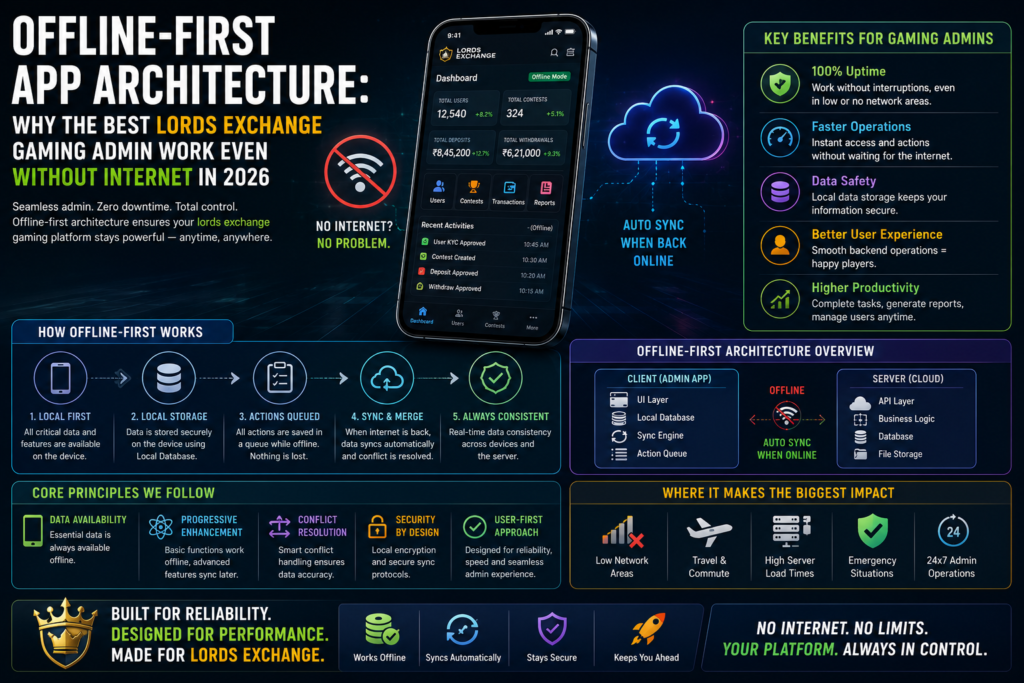
The Architecture Behind Offline-First Design
Offline-first architecture inverts the traditional application data flow. Traditional (online-first) applications:
1. User requests data → 2. App queries server → 3. Server returns data → 4. App displays data
In this model, when step 2 fails (no connectivity), steps 3 and 4 cannot occur. The user sees a loading spinner, an error message, or a blank screen.
Offline-first applications invert this:
1. App displays locally cached data immediately → 2. App requests server update → 3. If server responds, update the display → 4. If server does not respond, continue displaying cached data with a “last updated” indicator
In this model, users always see data immediately — from the local cache — and the server sync happens asynchronously when possible. This produces two critical improvements: the app feels fast (no waiting for network) and the app remains functional (cached data is available regardless of connectivity).
What Lords Exchange Admin Caches and Why
Effective offline-first design requires deliberate decisions about what to cache. Caching everything indefinitely produces storage bloat; caching too little fails to provide meaningful offline functionality. Lords exchange admin caching strategy is structured around user intent categories:
High priority, long cache duration (7 days): Player career statistics and historical performance data. This information changes slowly (only updated after matches) and is large in volume, making it worth storing locally for extended periods. Pre-match research sessions benefit most from this cache — player comparison and statistical analysis work entirely offline once this cache is populated.
Medium priority, medium cache duration (24 hours): Match schedules, contest listings, team squad compositions. This information is relatively stable within a day and enables offline browsing of upcoming contests and match preparation information.
Short priority, short cache duration (1 hour): Current player form indices, selection percentages, and preliminary match predictions. This information changes frequently enough that 1-hour cache provides meaningful value without staling into misleading data.
Real-time only (no offline cache): Live scores, contest standings, and financial transactions. These data types change too frequently and have too significant consequences from displaying stale data for meaningful offline caching. Lord exchange app displays clear “connectivity required” states for these elements when offline, rather than displaying potentially misleading stale values.
Service Worker Technology: The Engine of Web Offline Capability
For the lords exchange app’s Progressive Web App (PWA) version accessed through mobile browsers, Service Workers are the technology that enables offline-first functionality. A Service Worker is a JavaScript process that runs independently of the web page, intercepts network requests, and can serve cached responses when network is unavailable.
When a player accesses lords exchange through their mobile browser for the first time, the Service Worker downloads and caches the application shell (the HTML, CSS, and JavaScript that make up the app’s interface) along with pre-priority data. On subsequent visits — including offline visits — the Service Worker serves the cached application shell immediately, making the app “load” instantly without any network access.
Network requests that the Service Worker cannot fulfil from cache (because the data is not cached or the cache has expired) are either queued for execution when connectivity returns (appropriate for write operations like team saves) or shown as unavailable (appropriate for real-time data that cannot be displayed stale).
Optimistic Updates: The UX Pattern That Makes Offline Feel Seamless
Optimistic updates are an offline-first UX pattern that eliminates the wait for server confirmation on write operations. When a user saves a team in the lords exchange admin, the optimistic update pattern:
1. Immediately shows the team as saved in the interface (even before server confirmation)
2. Sends the save request to the server asynchronously
3. If the server confirms: the locally displayed state is confirmed, no visible change
4. If the server rejects (unlikely but possible): the locally displayed state is reverted, with a clear error notification
This pattern makes team saves feel instant — they are instant, locally — while maintaining server-side consistency when connectivity allows. Players who save teams in subway stations, aeroplanes, or other offline environments see their teams saved immediately, with server sync occurring automatically when connectivity is restored.
Handling Write Conflicts in Offline-First Systems
The most complex engineering challenge in offline-first design is handling write conflicts — situations where data changed on the server while the user was offline, and now the user wants to sync their locally made changes.
Lord exchange app’s conflict resolution strategy for team selections:
Last-write-wins for most edits: Team composition changes use a last-write-wins approach where the most recently confirmed save (whether local or server) takes precedence. This works because team editing is typically a sequential process — you make a change and confirm it, then make another, rather than editing on multiple devices simultaneously.
Explicit conflict notification for critical conflicts: In the rare case where a team has been edited on two devices while one was offline, lord exchange presents both versions to the user and asks them to choose which version to keep, rather than silently discarding one.
Transaction atomicity for financial operations: Financial operations (contest entry, deposit, withdrawal) are never optimistically updated — they require confirmed server acknowledgment before the UI reflects the transaction. This ensures that no financial state is ever based on unconfirmed local assumptions.
Frequently Asked Questions
How do I know if lord exchange app is operating from cache versus live data?
Lord exchange app displays a connectivity indicator when operating from cached data — a subtle status indicator that shows “offline” or “cached data — last updated [time]” when serving cached rather than live information. When fully connected, this indicator is absent.
Does offline-first design mean lord exchange app uses more storage on my device?
Yes, offline-first design uses more local storage than online-only alternatives because data is cached locally. Lord exchange app’s cache uses approximately 50-100MB of device storage for full offline functionality. On most current smartphones (128GB+), this is a negligible storage allocation.
Can I enter a contest while offline using offline-first capabilities?
No. Contest entry is a financial transaction that requires confirmed server processing and cannot be completed offline. You can research players, build draft teams, and review contest options offline, but submission requires connectivity.
Will my offline team changes sync automatically when I reconnect?
Yes. Unsynchronised local changes (team composition edits, preference updates, community posts) are queued locally and submitted automatically when connectivity is restored without requiring any manual action from the player.
Conclusion
Offline-first architecture is the technical foundation that makes lords exchange admin reliable in the inconsistent connectivity environments that real players actually encounter. The caching strategy, service worker implementation, optimistic update patterns, and conflict resolution approaches described in this guide are invisible to players during normal use — they simply experience an app that works consistently, loads quickly, and preserves their work regardless of connectivity state. The engineering investment in offline-first design reflects lord exchange’s commitment to serving the full diversity of India’s mobile connectivity reality, from the reliable 5G of urban centres to the variable connections of transit and travel that characterise how the majority of engaged players actually use their devices.