Every year, around November, our counseling desk in Bangalore starts getting the same anxious calls. “Should my child wait for September or take the May intake? We’re hearing different things from relatives.” After fifteen years of helping Indian students navigate UK admissions, here’s the honest breakdown because nobody explains this stuff clearly.
Let’s talk about the September Intake 2026 in UK for Indian Students versus the May Intake in UK 2026. Both have seats. Both lead to degrees. But the experience of landing in London in early spring versus late autumn changes more than just the weather.
The Obvious Difference: What’s Actually Available
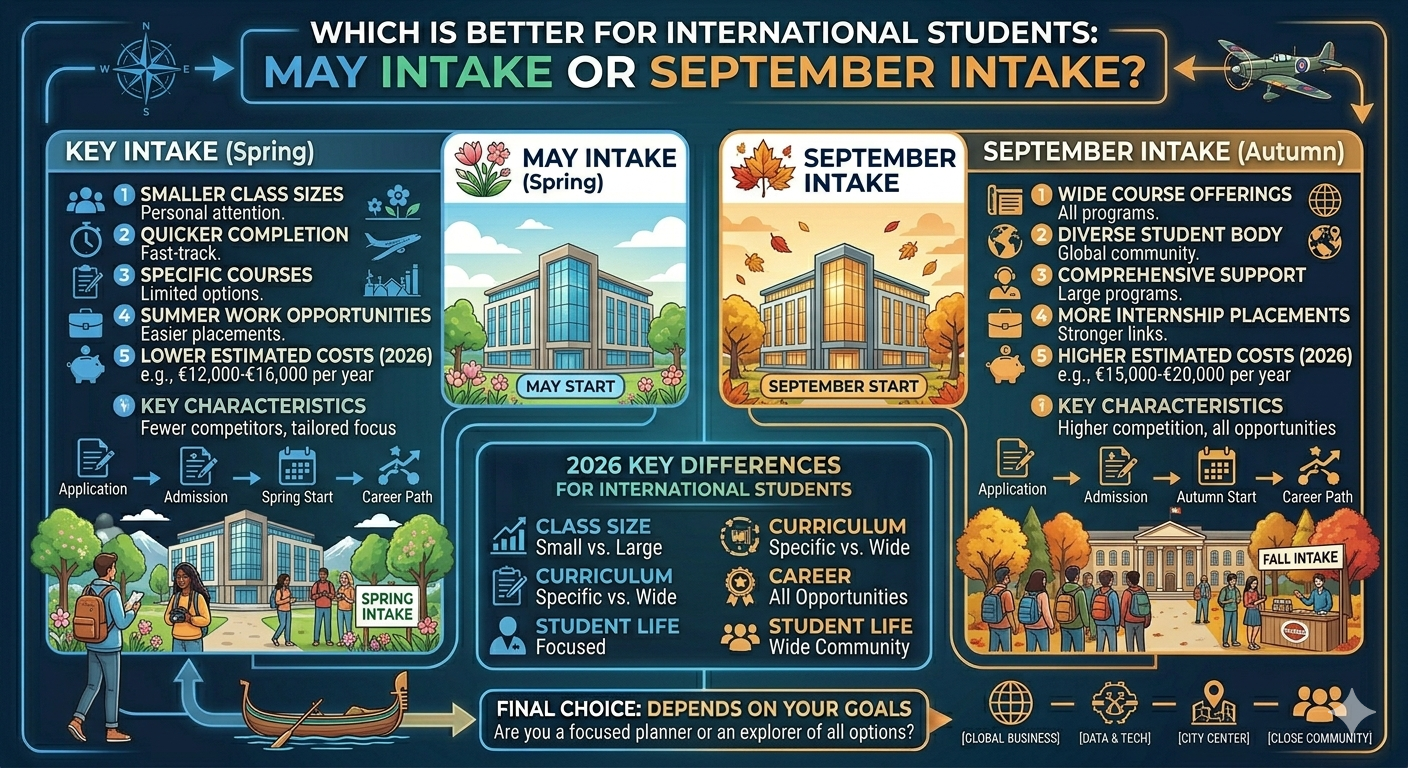
September is the grand show. Every university, every course, every scholarship is on the table. If you want to study computer science at Manchester, business at Birmingham, or law at King’s September is when those doors swing wide open. The application deadlines typically fall between January and March of that same year, so you have a reasonable window to prepare.
May intake is different. Think of it as a second serving, but a smaller plate. Not every university offers it. Those that do some of the University of Law campuses, certain business schools, a handful of engineering programs tend to offer a narrower range of courses. You’ll find plenty of master’s programs in management, data analytics, finance, and public health. Less common for undergraduate degrees or highly specialised research programs.
Here’s what we tell families straight: If your child has a specific course and university in mind, check the May intake first. If it’s not listed, don’t force it. September will wait.
The Visa and Timeline Reality
This is where May intake quietly wins for many Indian students.
Suppose you’re a final-year undergraduate student in India. Your exams end in April or May. Your results come in June. With September intake, you’re in a mad rush gathering transcripts, applying for a visa, booking a medical exam, all while results trickle in late. Many students miss the September slot simply because their degree certificate arrives after the university’s deadline. Then they defer. Then they lose a full year.
May intake solves that neatly. Finish your exams in May. Get your documents by June or July. Apply for the May Intake in UK 2026 which means classes start in May 2026. Wait, that’s before your exams? Exactly. So you apply during your final year, get a conditional offer, submit your final marks by June, and join the May intake. The timeline actually flows with the Indian academic calendar, not against it.
The visa processing time is another factor. September rush means UK visa applications pile up from June to August. Delays happen. May intake sees far fewer applicants, so processing is quicker often two to three weeks instead of six. We’ve seen students get their visa in eighteen days flat.
The On-the-Ground Experience
Let me paint you two pictures.
A student arriving for September intake lands in the UK during autumn. Days are getting shorter. Temperatures drop from 15°C in September to single digits by November. Freshers’ week is buzzing everyone is new, everyone is looking for friends. You join societies, attend mixers, stumble through campus together. The energy is high because 90% of the cohort started together.
A May intake student lands in spring. The sun is out until 8 PM. Trees are green. Existing students are deep into their dissertation phase, so they’re not particularly social. Your cohort might be thirty people instead of two hundred. The upside? You get smaller classes, more professor attention, and cheaper housing because landlords are desperate to fill rooms after the September rush. The downside? You have to make your own fun. No handholding. No big welcome carnival.
Which one suits your child? The extrovert who needs a crowd to thrive? September. The focused, independent learner who doesn’t mind a quieter start? May works beautifully.
Scholarships and Competition
Here’s a hard fact most agents won’t tell you.
September intake has the most scholarships but also the most competition. For every Chevening or Commonwealth scholarship, ten thousand students apply. University-specific merit scholarships for September are equally brutal. Your 75% in undergrad might feel strong until you’re up against 85% from Delhi University.
May intake has fewer scholarships some universities don’t offer them at all for mid-year entry. But the pool of applicants is smaller. A decent academic profile that would be average in September suddenly looks competitive in May. We’ve placed students with 65% aggregate into May intake programs at respected UK universities, simply because the seats needed filling and the applicant volume was low.
The trade-off is obvious: bigger prize with longer odds, or smaller prize with better odds. No right answer, just honest math.
Which One Is Actually Better?
After all these years, here’s our rule of thumb.
Choose September intake if: you’re applying for undergraduate courses, you want maximum course and university choice, you thrive in large social cohorts, or you need a scholarship to afford the degree. The September Intake 2026 in UK for Indian Students remains the default for a reason it works for most people.
Choose May intake if: you’re finishing your Indian degree in spring and don’t want to waste a year, you’re applying for a taught master’s in business, tech, or health, you prefer smaller classes and quieter campus life, or your academic profile is average but decent. The May Intake in UK 2026 is not a backup it’s a strategic choice for students who understand their own timeline and temperament.
We had a student last year, call her Neha. Missed the September deadline because her university delayed transcripts. Panicked. Took the May intake for a project management master’s at a mid-tier UK uni. Graduated this January, found a job in Birmingham by March, and is now on her graduate visa. She told us, “I cried when I missed September. Now I’m glad I did.”
Another student, Rohan, insisted on May because he wanted to avoid crowds. Landed in Leeds in April. Hated the quiet. Transferred to September the following year. Lost time and money.
Read your own child, not the brochure. Both intakes lead to the same degree. One will feel like home. The other will feel like a compromise. Choose accordingly.