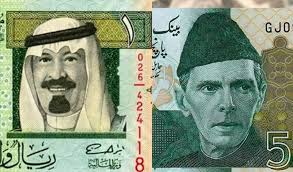
Riyal to PKR
When most people think of foreign exchange, the US dollar dominates the conversation. But for millions of Pakistani households, the Riyal to PKR exchange rate is far more relevant to their daily bread and butter. The Saudi Riyal, along with the UAE Dirham and Qatari Riyal, represents the lifeblood of Pakistan’s economy because over four million Pakistanis work in Gulf Cooperation Council countries. Every month, these workers send home billions of Riyals, and the rate at which those Riyals convert into Pakistani rupees determines whether a family in Punjab can afford a new roof, a daughter’s wedding, or lifesaving surgery. Unlike the volatile USD to PKR relationship, the Riyal to PKR rate has a unique stability factor because the Saudi Riyal has been pegged to the US dollar at 3.75 Riyals per dollar for decades.
This means that when the dollar strengthens globally, the Riyal follows suit, and when the dollar weakens, the Riyal weakens too. Therefore, understanding Riyal to PKR is essentially understanding a smoother, more predictable cousin of the dollar exchange rate. For the average remittance receiver, this predictability is a blessing. You can roughly estimate next month’s pension or salary transfer without obsessing over minute by minute fluctuations. Yet, the Riyal to PKR rate is not static; it shifts with Pakistan’s economic health, seasonal remittance flows, and even the price of crude oil, which directly impacts Saudi Arabia’s ability to keep its currency stable. By mastering the nuances of this exchange pair, overseas workers and their families can save thousands of rupees annually through smart transfer timing and channel selection.
From Jeddah to Johar Town: How Riyal to PKR Shapes Migrant Lives
Consider the journey of a single Riyal earned by a construction worker in Riyadh or a nurse in Dammam. That Riyal starts its life as a Saudi currency unit, but its true value is only realized when it crosses into Pakistan and becomes rupees that buy flour, medicine, and schoolbooks. The Riyal to PKR rate is the bridge between these two worlds. Historically, one Saudi Riyal traded for approximately 25 to 30 Pakistani rupees, but economic pressures over the last few years have pushed the rate significantly higher, sometimes exceeding 85 rupees per Riyal during peak dollar shortages. For the migrant worker, a higher Riyal to PKR rate means their sacrifice of living away from family yields greater rewards. However, there is a darker side rarely discussed. Many overseas workers, especially those with limited formal education, fall prey to unofficial exchange agents known as hawala operators who offer a slightly better Riyal to PKR rate but provide no receipt, no insurance, and no legal recourse if funds disappear.
Each year, millions of Riyals are lost to these informal channels when agents simply vanish or claim the transfer was “delayed.” The difference between the official interbank Riyal to PKR rate and the open market rate can be as high as five to seven rupees per Riyal, tempting workers to take risks. Yet the smart worker uses licensed banks or fintech apps that offer competitive rates, instant confirmations, and protection by both Saudi and Pakistani regulators. Additionally, timing matters. The Riyal to PKR rate often improves during Ramadan and before Eid al-Adha because remittance volumes surge, and banks compete for customer loyalty. Conversely, during Pakistan’s political turmoil, the rate might worsen as demand for foreign currency spikes. By understanding these seasonal rhythms, a family in Lahore can request the worker to delay a transfer by a week to catch a better Riyal to PKR window, effectively gaining an extra month’s grocery budget without any additional cost.
The Oil Price Domino: Understanding Riyal to PKR Through Commodity Lenses
One of the most misunderstood drivers of the Riyal to PKR exchange rate is the price of crude oil. Saudi Arabia’s economy is overwhelmingly dependent on oil exports, and when global oil prices crash, the Kingdom’s revenues shrink. To compensate, Saudi Arabia may reduce its imports from countries like Pakistan, cut back on new visas for Pakistani workers, or even delay payments to foreign contractors. Each of these actions indirectly affects the Riyal to PKR rate. When fewer Pakistani workers are hired in Saudi Arabia, remittance flows slow down, reducing the supply of Riyals in Pakistan’s currency markets. With fewer Riyals available, the price of buying a Riyal goes up, meaning the Riyal to PKR rate rises. Conversely, when oil prices are high and the Saudi economy booms, new infrastructure projects attract hundreds of thousands of Pakistani engineers, electricians, and drivers.
Their remittances flood into Pakistan, increasing the supply of Riyals, which can actually lower the Riyal to PKR rate, making each Riyal worth slightly fewer rupees. This inverse relationship surprises many people who assume that a stronger Saudi economy always benefits Pakistan. In reality, while a booming Gulf economy creates more jobs, the resulting higher supply of Riyals can weaken the exchange rate, reducing the rupee value of each remittance. However, the overall increase in total remittance volume usually outweighs the per unit loss. Another commodity link is through Pakistan’s own oil import bill. Pakistan buys crude oil from Saudi Arabia often on deferred payment terms or through special facilities. When global oil prices rise, Pakistan needs more dollars to pay for its energy imports, which depletes foreign reserves and weakens the rupee against all currencies, including the Riyal. Thus, tracking Brent crude oil prices gives you a surprisingly accurate forecast for where the Riyal to PKR rate is heading next week.
Digital Wallets and Instant Transfers: How Technology is Reshaping Riyal to PKR
The old method of sending Riyals to Pakistan involved a physical trip to a bank branch in Saudi Arabia, filling out lengthy forms, waiting in queues, and paying a flat fee of 30 to 50 Riyals regardless of the amount. The recipient in Pakistan then waited three to seven days for the funds to clear, often having to visit a specific bank branch to collect rupees at whatever Riyal to PKR rate the bank chose that morning. That era is rapidly ending thanks to financial technology. Today, mobile apps linked to Saudi Iqama numbers allow a worker to transfer Riyals to Pakistani bank accounts, mobile wallets like JazzCash or Easypaisa, or even directly to a recipient’s CNIC number without any bank account at all. The Riyal to PKR rate offered by these apps is often within one percent of the interbank rate, and transfers settle in seconds or minutes, not days.
Moreover, many apps now offer a rate lock feature. If a worker sees a favorable Riyal to PKR rate at 10 AM, they can lock it for a transfer that will actually execute at 4 PM, protecting against intraday fluctuations. This technology is especially powerful for women in rural Pakistan who previously had to rely on male relatives to collect cash remittances from faraway bank branches. Now, the Riyals convert to PKR instantly and appear as digital rupees on a mobile account that can be used to pay utility bills, buy prepaid mobile data, or withdraw cash at any local agent shop. However, technology also introduces new risks. Fraudulent apps disguised as remittance services trick users into entering their bank credentials, leading to stolen Riyals. The golden rule is to only use apps licensed by the Saudi Central Bank (SAMA) and the State Bank of Pakistan. Check for SSL certificates, read recent user reviews on Google Play or the App Store, and never share one-time passwords. When used correctly, digital platforms make the Riyal to PKR process faster, cheaper, and more transparent than any traditional method in history.
Umrah, Business, and Family Ties: Real Life Scenarios of Riyal to PKR in Action
Beyond monthly remittances, the Riyal to PKR rate plays a starring role in three common Pakistani life events: performing Umrah or Hajj, importing goods from Saudi Arabia, and supporting elderly parents who live between both countries. For a family planning Umrah, the cost of the journey is heavily influenced by the exchange rate. Saudi hotels, transport, and visa fees are all priced in Riyals. When the Riyal to PKR rate is high, a ten day stay that costs five thousand Riyals suddenly requires over four hundred thousand rupees instead of three hundred thousand. Smart pilgrims book their packages during periods when the rupee is seasonally stronger against the Riyal, typically after the budget announcement or during harvest seasons when agricultural exports boost Pakistan’s reserves. Additionally, using a multi currency travel card loaded with Riyals months before departure can lock in a favorable rate. For the small business owner importing dates, Zamzam water, or petrochemicals from Saudi Arabia, the Riyal to PKR rate is a direct input cost.
A sudden spike of just two rupees per Riyal can wipe out an entire quarter’s profit margin. These businesses often use hedging instruments offered by Pakistani banks, agreeing to buy Riyals six months in advance at a fixed rate, thus insulating themselves from shocks. Finally, consider the elderly parent who receives a monthly pension in Riyals into a Saudi bank account but lives in Karachi. They need to regularly convert small amounts to rupees for living expenses. Instead of converting the entire lump sum at once, which exposes them to a bad rate, they can set up systematic transfers that convert a fixed Riyal amount each week, averaging out the Riyal to PKR fluctuations over time. This strategy, known as rupee cost averaging, reduces the risk of converting at a temporary peak or trough. By applying these scenario based strategies, ordinary families transform the Riyal to PKR rate from a source of anxiety into a manageable, predictable tool for daily life.
Future Outlook: Will Riyal to PKR Ever Return to Old Levels?
Speculating on the long term trajectory of the Riyal to PKR rate requires looking at three fundamental drivers. First, Pakistan’s chronic current account deficit. As long as Pakistan imports more than it exports, demand for foreign currency, including the Riyal, will remain high, putting upward pressure on the rate. Unless Pakistan dramatically increases its exports of IT services, manufactured goods, or agricultural products, the Riyal to PKR rate is unlikely to return to the 25 to 30 rupee levels of the 2000s. Second, Saudi Vision 2030 is transforming the Kingdom from an oil dependent nation into a diversified hub for tourism, technology, and manufacturing. This shift may reduce the number of low skilled Pakistani workers needed but could increase demand for high skilled professionals in healthcare, engineering, and education.
A more skilled Pakistani workforce commands higher salaries in Riyals, which could increase the average remittance size even if the Riyal to PKR rate remains high. Third, the potential for a unified Gulf currency has been discussed for years. If the GCC nations eventually replace their individual currencies with a common digital or physical currency, the Riyal to PKR dynamic would merge with the broader GCC currency to PKR relationship, potentially reducing volatility. For the average person, predicting exact numbers is futile. However, a realistic expectation is that the Riyal to PKR rate will continue its gradual upward trend but with less violent spikes than the dollar. The best financial defense is not to hope for a return to old rates but to build resilience. That means diversifying income sources, investing in rupee denominated assets that appreciate with inflation, and using the digital tools described earlier to minimize transfer costs. The Riyal to PKR rate will always move, but an informed Pakistani family can move with it.