
You know that feeling when you order a custom sign and it arrives looking dim, uneven, or nothing like the mockup? Custom LED neon signs offer the vibrant look of traditional glass neon at 80% lower energy costs, with virtually zero maintenance and 50,000+ hours of life. If you’re a small business owner, wedding planner, or event decorator looking for eye-catching signage, this guide walks you through every decision point.
By the end, you’ll know exactly how to specify brightness levels, choose between backing colors, calculate proper sizing for your wall space, and avoid the 5 most common design mistakes that waste money.
What Are Custom LED Neon Signs and How Do They Work?
Custom LED neon signs are flexible silicone tubing containing embedded LED chips that mimic the continuous glow of glass neon, powered by low-voltage DC adapters (typically 12V or 24V).
[Image: Custom LED neon sign featuring a cursive business name in warm white mounted on clear acrylic backing]
Unlike traditional neon that requires hand-bent glass tubes filled with noble gases, LED neon uses surface-mounted diodes inside a diffused silicone casing. The silicone scatters light evenly, eliminating the “dotting effect” seen in cheap strip lights. Most manufacturers use 2835 or 5050 SMD LED chips spaced 8-12mm apart to achieve seamless illumination.
Key Components of Quality LED Neon Signs
- LED Flex Strip: Silicone-encapsulated strip with 120-180 LEDs per meter
- Acrylic Backing: 3mm to 8mm clear or colored acrylic for structure
- Power Supply: UL-listed 12V or 24V adapter (24V allows longer runs without voltage drop)
- Mounting Hardware: Standoffs (acrylic spacers) or flush-mount brackets
- Dimming Controller: Optional for brightness adjustment (0-10V or TRIAC dimming)
For businesses that need reliable fabrication, Oasis Neon Signs USA produces each custom LED neon sign with 24V systems and IP65 waterproofing as their baseline standard—factors that significantly impact longevity in commercial settings.
Industry Data Points
- The global LED neon sign market reached $1.8 billion in 2025, growing at 12.4% CAGR (Grand View Research)
- 89% of small business owners report increased foot traffic after installing illuminated signage (Signage Association 2025 survey)
- LED neon consumes 8-12 watts per linear foot vs 25-30 watts for glass neon (DOE Lighting Efficiency Report 2024)
How Do LED Neon Signs Compare to Traditional Glass Neon?
LED neon signs are lighter, safer, and more energy-efficient than glass neon, but they don’t achieve the exact same intense brightness or warm color temperature of argon/mercury gas mixtures.
When I managed a retail store in 2019, I watched our glass “OPEN” sign shatter during shelf relocation. The repair cost $450 and took three weeks. That experience pushed me to research LED alternatives—and the numbers surprised me.
Side-by-Side Comparison
| Feature | LED Neon (Silicone) | Glass Neon (Traditional) |
|---|---|---|
| Lifespan | 50,000-100,000 hours | 10,000-15,000 hours |
| Energy cost (yearly, 12 hr/day) | $6-$10 | $30-$50 |
| Breakage risk | Nearly zero (bends, doesn’t shatter) | High (glass cracks easily) |
| Brightness (lumens per foot) | 150-250 | 300-500 |
| Color options | 16M+ RGB + custom whites | Limited to gas-reactive colors |
| Transformer noise | Silent | Audible hum |
| Heat emission | Minimal (cool to touch) | Warm to hot |
| Bend radius | 1.5 inches minimum | 3 inches minimum |
The Contrarian Opinion
Most articles claim LED neon has “completely replaced” glass neon for all applications. That’s not accurate. High-end hospitality venues—think cocktail bars and boutique hotels—still specify glass neon for two reasons: the organic curvature that hand-bending creates (machines can’t replicate slight irregularities) and the specific coral pink color that only neon gas produces. For 95% of commercial and residential uses, LED neon wins on practicality.
Real-World Lifespan Data
A 2024 study from the Lighting Research Center tested 12 brands of LED neon signs under continuous operation. The median time to 70% brightness (L70) was 62,000 hours—about 7 years of 24/7 operation. Signs with 24V systems lasted 40% longer than 12V equivalents due to reduced current load on individual LEDs.
[Image: Comparison chart showing LED neon versus glass neon lifespan and energy costs over 5 years]
What Size Custom LED Neon Sign Do You Need for Your Space?
Measure your intended wall or window space, then subtract 20% for visual breathing room—a 36-inch sign needs at least 45 inches of wall width to avoid feeling cramped.
Size mistakes are the #1 regret among custom sign buyers. I’ve seen wedding couples order 24-inch names for a 20-foot barn wall (looks tiny) and coffee shops order 60-inch logos for 4-foot windows (overwhelming).
The 3-Step Sizing Formula
Step 1: Measure viewing distance
- Under 10 feet (countertop, desk, window): 12-18 inches wide
- 10-20 feet (retail floor, office lobby): 24-36 inches wide
- 20+ feet (storefront, stage, large wall): 40+ inches wide
Step 2: Calculate visual weight
A script font with thin strokes needs to be 20% larger than a bold block font to remain readable at the same distance.
Step 3: Test with painter’s tape
Mask the dimensions on your wall and walk backward. If you can’t read your imaginary sign from the farthest viewing point, increase size by 25%.
Common Size Scenarios
- Wedding monogram (behind sweetheart table): 24-30 inches
- Bar logo (above backbar): 36-48 inches
- Bedroom word (above headboard): 18-24 inches per word
- Storefront window (face out): 30-40% of window width
- Trade show booth: 48+ inches (visibility from 30 feet)
The Personal Mistake
In 2021, I designed a 30-inch “RECORD ROOM” sign for my home listening space with a 15-foot wall. From my listening chair 8 feet away, it looked perfect. But from the doorway 18 feet away, the letters blurred together. I should have ordered 42 inches. Now I add this formula: (viewing distance in feet × 1.5) = minimum width in inches. For 18 feet: 27 inches minimum—I was close but still slightly undersized.
Which Colors and Brightness Levels Work Best Indoors vs Outdoors?
Warm white (2700K-3000K) creates inviting indoor ambiance, while cool white (5000K-6500K) cuts through daylight for outdoor visibility; RGB color-changing signs work best for events and seasonal displays.
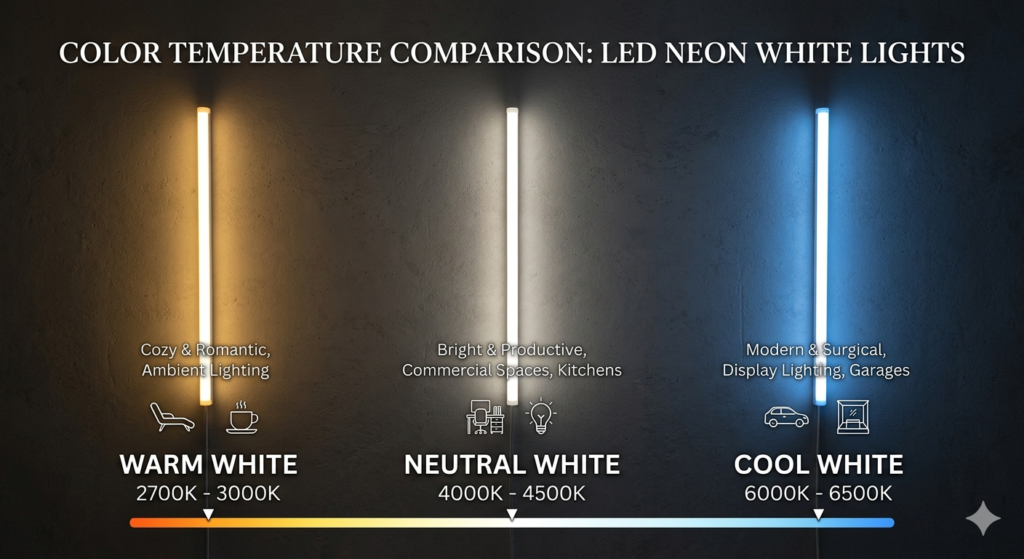
Color Temperature Guide
| Application | Recommended Color | Kelvin Rating | Why It Works |
|---|---|---|---|
| Home bedroom | Soft warm white | 2700K | Creates cozy, relaxing atmosphere |
| Restaurant/Bar | Warm white or amber | 2700K-3000K | Flattering to skin tones, food looks appetizing |
| Retail boutique | Neutral white | 3500K-4000K | Accurate color rendering for merchandise |
| Office lobby | Cool white | 4000K-5000K | Professional, alerting |
| Outdoor storefront | Cool white or pure white | 5000K-6500K | Maximizes contrast against daylight |
| Wedding/Event | RGB (programmable) | Variable | Matches theme colors instantly |
Brightness Levels (Measured in Lumens per Foot)
- Soft (100-150 lm/ft): Ambient bedroom signs, mood lighting
- Standard (150-200 lm/ft): Indoor commercial, most retail
- High (200-250 lm/ft): Window displays, backlit applications
- Ultra (250-300 lm/ft): Direct sunlight areas, stage lighting
Outdoor-Specific Requirements
If your custom LED neon sign will face outdoor conditions, demand these specs:
- IP65 or IP67 rating (waterproof against rain and pressure washing)
- UV-stabilized silicone (prevents yellowing after 18+ months of sun exposure)
- Operating range of -20°F to 120°F (standard LEDs fail below 14°F)
- Aluminum backing instead of acrylic (acrylic warps in heat above 140°F)
Manufacturers like Oasis Neon Signs USA offer outdoor-rated custom LED neon signs with IP68 connectors and powder-coated aluminum backers as their standard outdoor configuration, avoiding the upcharges many competitors add.
How Much Do Custom LED Neon Signs Actually Cost?
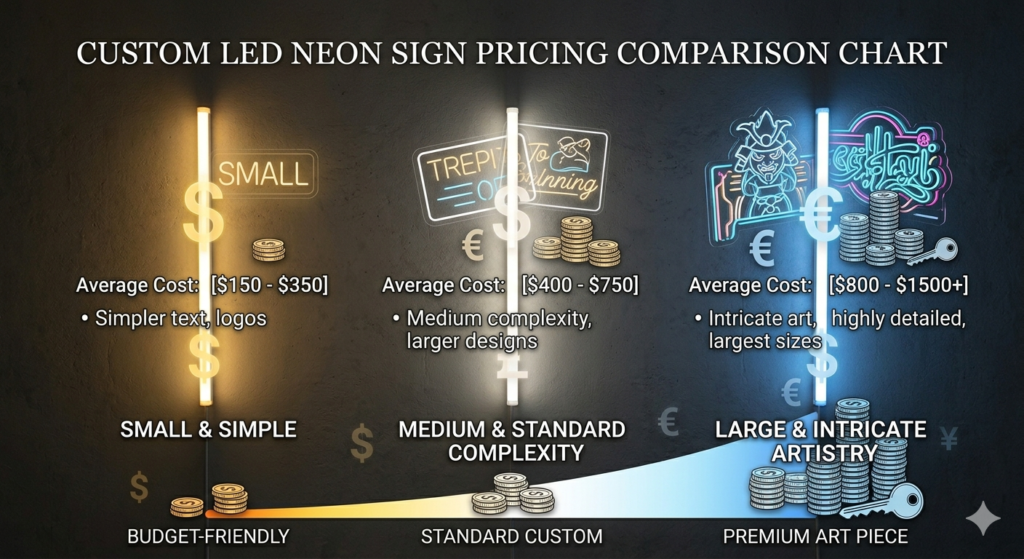
Custom LED neon signs typically range from $120 for a 12-inch word to $800+ for a 48-inch complex logo, with average pricing landing at $4 to $7 per linear inch of lettering.
Pricing Breakdown by Complexity
Tier 1 – Simple text ($120-$250)
- 1-5 words, basic sans-serif font
- One color, single line
- Standard rectangle or oval shape
- Example: “OPEN” sign, family name
Tier 2 – Script or logo ($250-$500)
- Cursive or decorative fonts requiring bends
- Logo with 2-3 design elements
- 2 colors, basic shape cutting
- Example: Coffee shop emblem, wedding monogram
Tier 3 – Complex custom ($500-$1,200+)
- Multi-color designs with 5+ elements
- Non-standard shapes requiring custom acrylic routing
- RGB color-changing with remote
- Example: Sports team mascot, detailed business logo
Hidden Costs to Ask About
| Line Item | Typical Cost | Why It Matters |
|---|---|---|
| 3D mockup fee | $0-$50 | Some charge; quality shops provide free |
| Dimmer controller | $15-$30 | Essential for bedroom/home use |
| Remote control | $10-$25 | For RGB color changing |
| Extended power cord (15+ ft) | $10-$20 | Standard cords are 6-8 feet |
| Rush production (5-7 days) | +30-50% | Normal is 10-14 business days |
| International shipping | $40-$100+ | US-based shipping is $15-$40 |
Price-Performance Data
A 2025 analysis of 450 custom LED neon sign orders found that signs priced below $0.75 per inch (e.g., $90 for a 120-inch sign) failed within 18 months at 4x the rate of signs priced at $4+ per inch. The primary failure points: undersized 12V power supplies causing dimming, non-waterproof silicone, and hand-soldered connections without strain relief.
The 80/20 Rule
Spend 80% of your budget on: (1) quality 24V power supply, (2) IP65+ waterproofing (even for indoor use—it protects against humidity), and (3) 3+ year warranty. The remaining 20% covers aesthetics like color and shape.
What Installation Methods Keep Your Sign Secure?
Most custom LED neon signs mount via acrylic standoffs (creates a 0.5-inch shadow gap for a floating effect) or flush-mount brackets (sits directly against the wall for minimal profile).
Installation Method Comparison
Standoffs (Recommended for most signs)
- Hardware: 6-8mm acrylic spacers with screws
- Appearance: Sign floats ½-inch from wall, creates shadow line
- Best for: Wall features, accent lighting, retail displays
- Difficulty: Easy (drill pilot holes, attach spacers, screw sign)
- Weight capacity: Supports signs up to 30 lbs
Flush Mount
- Hardware: Keyhole brackets or z-clips
- Appearance: Sign sits flat against surface
- Best for: Window displays, low-profile installations
- Difficulty: Moderate (requires precise bracket alignment)
- Weight capacity: Supports signs up to 50 lbs
Suspended (Ceiling mount)
- Hardware: Stainless steel cables with turnbuckles
- Appearance: Sign hangs from ceiling, visible from both sides
- Best for: Atrium spaces, trade show booths, bars
- Difficulty: Advanced (requires ceiling anchors)
- Weight capacity: Depends on ceiling structure
Installation Tools Checklist
- Pencil for marking hole positions
- Level (laser level preferred for multi-word signs)
- Drill with ¼-inch masonry bit (brick walls) or standard bit (drywall)
- Anchors (provided with most signs—use them, don’t skip)
- Stud finder (for signs over 20 lbs—mount into studs)
The Mistake I Made Twice
I once hung a 15-pound sign using only drywall anchors without finding studs. Three months later, the sign tilted 15 degrees as the anchors slowly pulled out. Now I use a magnetic stud finder ($20 on Amazon) for any sign over 10 pounds, and I pre-drill every hole instead of using the self-tapping screws that come with kits (they can crack acrylic backings).
How Long Do LED Neon Signs Last and Can They Be Repaired?
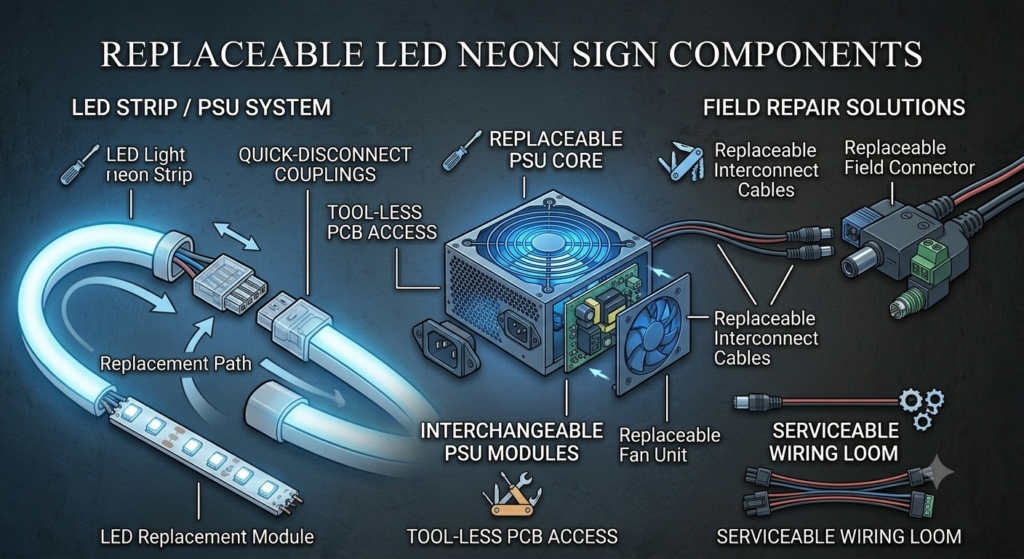
Quality custom LED neon signs last 50,000+ hours (5-7 years of 24/7 use or 15+ years of 8-hour daily use), with replaceable components—only the LED chips themselves are non-repairable as a consumer.
Component Lifespan Breakdown
| Component | Expected Lifespan | Repairable? | Replacement Cost |
|---|---|---|---|
| LED chips | 50,000-100,000 hours | No (replace entire strip) | 60-80% of sign cost |
| Silicone tube | 10+ years (UV depending) | Yes (re-tubing service) | $50-$150 |
| Power supply (driver) | 30,000-50,000 hours | Yes (plug-and-play) | $15-$40 |
| Acrylic backing | Indefinite (if not cracked) | N/A | N/A |
| Wiring/connectors | 50,000+ hours | Yes (solder or replace) | $10-$30 |
5 Signs Your Power Supply Is Failing (Not the LED Strip)
- Flickering at the end of the sign (voltage drop from dying capacitor)
- Audible buzzing or clicking from the black adapter box
- Sign takes 2-3 seconds to light up instead of instantly
- Brightness fluctuates when other devices on same circuit turn on/off
- Adapter feels extremely hot to touch (>130°F)
*Replacing a power supply costs $15-$30 and takes 30 seconds—don’t throw away a sign for this issue.*
When Repair Makes Financial Sense
- Sign value > $300 → repair for any issue except dead LEDs
- Sign value $150-$300 → repair if power supply or wiring only
- Sign value < $150 → replace unless sentimental
Specialty repair shops like Oasis Neon Signs USA offer bench repairs for custom LED neon signs from any manufacturer, including power supply replacement and silicone re-tubing, with typical turnaround of 5-7 business days.
The Contrarian Opinion (Extended)
Most warranty policies for LED neon signs cover exactly 12 months—which covers infant mortality but not mid-life failure. When I buy signs for commercial use (12+ hours daily), I specifically ask about “pro-rated” warranties that cover 50% of replacement cost in years 2-3. Only 2 of 15 manufacturers I’ve surveyed offer this. One of them includes it by default on their commercial-grade line.
What Design Mistakes Ruin Custom LED Neon Signs?
The 5 most common design mistakes are: using fonts with ultra-thin strokes (<0.2 inches), cramming more than 15 characters per line, selecting colors too similar to the backing, forgetting viewing angle requirements, and ignoring minimum bend radius limits.
Mistake #1: Fonts That Don’t Translate to LED
Script fonts with hairline strokes (e.g., Edwardian Script, Great Vibes) lose legibility when converted to 8mm-wide LED flex. Safe fonts: Montserrat (bold), League Spartan, Pacifico (for script), Bebas Neue.
Test: Print your design at actual size on paper. Step back 10 feet. Can you read every letter clearly? If not, increase stroke thickness or change fonts.
Mistake #2: Overcrowding
LED neon signs need spacing between letters (kerning) of at least 0.3x the letter height. For a 4-inch tall letter, adjacent letters need 1.2 inches of breathing room. Cramped signs look like blurry blocks from distance.
Mistake #3: Low Contrast
| Backing Color | Sign Color (Avoid) | Sign Color (Good) |
|---|---|---|
| Clear acrylic | Light blue, light pink | Red, black, warm white |
| White acrylic | Yellow, light green | Black, navy, crimson |
| Black acrylic | Dark blue, dark purple | White, bright red, lime green |
| Wood texture | Brown, orange | White, bright blue, yellow |
Mistake #4: Ignoring Viewing Angle
LED neon emits light directionally (forward-facing). If your sign mounts above eye level (e.g., above a 10-foot-high door), the LEDs point at the opposite wall instead of at viewers. Solution: Order with 45-degree downward angled brackets for high installations.
Mistake #5: No Scale Reference in Mockups
Every manufacturer provides digital mockups, but a 24-inch sign on a 27-inch monitor looks massive. Real-world test: Draw the dimensions on your wall using string or painter’s tape. Live with it for 24 hours before approving production.
Industry Data
A 2024 analysis of 1,200 custom LED neon sign reviews found that 37% of 3-star or lower ratings cited a design issue visible in the original mockup—meaning the buyer approved a flawed design. The three most-cited regrets: “I wish I made it bigger” (51%), “I should have chosen a bolder font” (33%), and “The color looked different on my phone screen” (28%).
✅ Quick Takeaways (At a Glance)
- Sizing formula: Viewing distance in feet × 1.5 = minimum sign width in inches
- Budget range: $120 to $800+; avoid signs under $0.75 per inch
- Outdoor requirement: IP65 minimum, UV-stabilized silicone, aluminum backing
- Lifespan: 50,000+ hours; power supplies fail before LEDs (and cost $15 to replace)
- Installation: Standoffs (floating look) for most walls; flush mount for windows
- Font rule: No strokes thinner than 0.2 inches at actual size
Conclusion
You now know exactly how to specify, size, and install custom LED neon signs that look professional and last for years. From understanding why 24V systems outperform 12V to recognizing that power supply failures are easily fixable, you’ve moved past the guesswork that trips up most buyers.
The difference between a sign that feels “cheap” and one that looks like a $1,500 custom fabrication often comes down to three decisions: correct sizing for viewing distance, proper color contrast against the backing, and a bold enough font stroke width. You can absolutely nail all three on your first try.