When beginners start learning ABAP, one of the biggest questions they encounter is whether they should focus on Procedural ABAP or Object-Oriented ABAP (OOABAP). Many newcomers believe that object-oriented programming is simply an advanced version of procedural programming, while others assume procedural ABAP is outdated and no longer relevant. Both assumptions are only partially true. Understanding the difference between these approaches is not just about learning syntax; it is about adopting the right mindset for modern SAP development.
The reality is that both programming styles exist within the SAP ecosystem. Procedural ABAP laid the foundation for thousands of SAP applications that are still running successfully today. At the same time, object-oriented ABAP has become the preferred approach for developing scalable, maintainable, and enterprise-grade solutions, especially in SAP S/4HANA environments. Beginners often struggle because they focus on technical keywords rather than understanding how software should be designed. Once you understand the strengths and limitations of each approach, choosing the right solution becomes much easier.
Understanding the Two Programming Approaches
What is Procedural ABAP?
Procedural ABAP follows a step-by-step programming model. Developers write a sequence of instructions, usually organized into forms, function modules, and reports. The program executes these instructions in a specific order to achieve the desired business outcome. This style is straightforward and often easier for beginners to understand because it mirrors the way people think about completing tasks one step at a time.
For example, imagine preparing a cup of coffee. You boil water, add coffee powder, pour water, and stir. Each action happens in sequence. Procedural ABAP works similarly by defining a clear flow of execution. This simplicity makes it useful for small reports, quick utilities, and straightforward business processes. However, as applications grow larger, managing and maintaining procedural code becomes increasingly difficult. Changes in one section can affect other areas, making debugging and enhancements more challenging.
What is Object-Oriented ABAP?
Object-Oriented ABAP organizes code into classes and objects. Instead of focusing solely on the sequence of actions, developers focus on entities that represent real-world business concepts. These entities contain both data and behavior, creating a more structured and reusable design.
Think of a customer management application. Instead of writing separate procedures for every customer-related action, you create a Customer class containing attributes such as customer number and name, along with methods for creating, updating, or validating customer records. This approach mirrors real-world business structures and makes applications easier to extend. Object-oriented programming promotes principles such as encapsulation, inheritance, and polymorphism, which help developers build flexible and maintainable solutions over time.
Why Beginners Often Get Confused
The Common Learning Path
Most ABAP beginners start with procedural programming because it is easier to understand. Traditional training materials often introduce reports, internal tables, loops, and function modules before discussing classes and objects. As a result, learners become comfortable with procedural logic and sometimes resist transitioning to object-oriented thinking.
The challenge appears when developers begin working on larger projects. They realize that procedural code can quickly become difficult to maintain when business requirements change. Suddenly, concepts such as classes, interfaces, and inheritance seem necessary but unfamiliar. This shift can feel overwhelming because it requires a completely different way of approaching software design.
Misconceptions About Complexity
A common misconception is that object-oriented ABAP is inherently more complicated than procedural ABAP. In reality, object-oriented programming may require more planning initially, but it often reduces complexity in large applications. Beginners frequently judge complexity based on the amount of code they see rather than the maintainability of that code.
Another misunderstanding is that procedural ABAP is obsolete. While modern SAP ABAP development strongly encourages object-oriented principles, procedural programming still has valid use cases. The key is understanding when each approach is appropriate rather than treating one as universally superior.
Key Differences Between Procedural and Object-Oriented ABAP
Code Structure
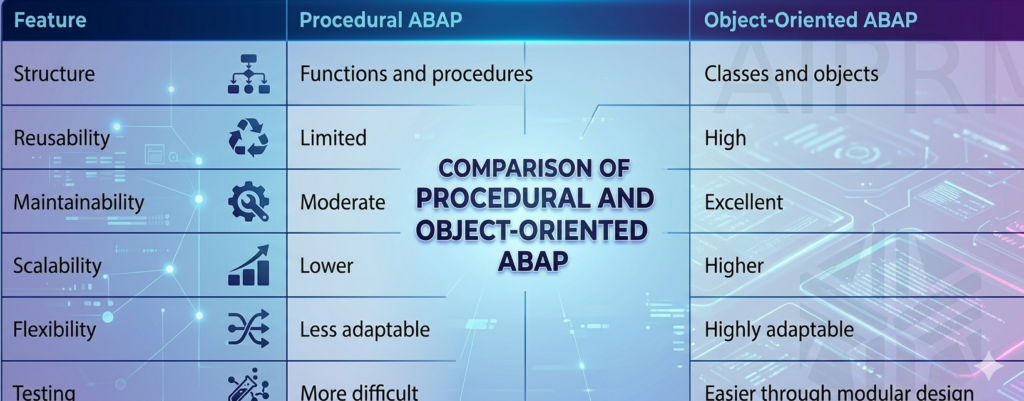
Procedural ABAP organizes logic around tasks and functions. The focus is on what needs to be done. Object-oriented ABAP organizes logic around business entities and responsibilities. The focus shifts from actions to relationships and behavior. This structural difference significantly affects how applications evolve over time.
Reusability
One of the greatest advantages of OOABAP is reusability. Classes can be reused across multiple applications without duplicating code. This reduces development effort and improves consistency. Procedural programs often rely on copied logic, which can create maintenance challenges when changes are required.
Maintainability
Maintaining procedural code becomes increasingly difficult as applications grow. Object-oriented programming solves many of these challenges by separating responsibilities into manageable components. When a business rule changes, developers can often update a single class instead of searching through multiple programs.
Scalability
Enterprise systems evolve constantly. New requirements, integrations, and business processes emerge regularly. OOABAP supports this growth through modular architecture, making it easier to add new functionality without disrupting existing components.
What Beginners Usually Get Wrong
Thinking Classes Are Optional
Many beginners treat classes as an optional feature rather than a fundamental design tool. They often attempt to solve every problem using reports, forms, and function modules because these techniques feel familiar. While this may work initially, it creates technical debt over time.
Classes are not just containers for code. They provide a framework for organizing business logic in a way that supports future enhancements. Ignoring object-oriented principles can limit career growth, especially in modern SAP environments where OOABAP is widely adopted.
Focusing Only on Syntax
Another common mistake is obsessing over syntax. Beginners spend hours memorizing keywords like CLASS, METHOD, and INTERFACE while neglecting software design principles. Knowing syntax is important, but understanding why classes exist is far more valuable.
Successful developers focus on solving business problems rather than memorizing commands. They think about how different components interact and how future requirements might affect the system. This mindset leads to cleaner and more sustainable solutions.
Ignoring Real-World Business Logic
Business applications are not just collections of technical instructions. They represent real-world processes involving customers, vendors, materials, orders, and financial transactions. Beginners often write code without considering how these entities relate to one another.
Object-oriented programming encourages developers to model software around business concepts. This alignment makes systems easier to understand and maintain because the code reflects the actual business environment.
How to Think Right as an ABAP Developer
Think in Objects, Not Programs
The most important shift for beginners is learning to think in objects instead of programs. Instead of asking, “What steps should this report perform?” ask, “What business entities are involved, and what responsibilities do they have?”
For example, in a sales application, you might identify objects such as Customer, SalesOrder, and Product. Each object manages its own data and behavior. This approach creates clearer boundaries and reduces dependencies between components.
Design Before Coding
Many new developers jump directly into coding without planning. Object-oriented programming rewards thoughtful design. Before writing a single line of code, consider the classes, relationships, and responsibilities involved in the solution.
A simple design session can save countless hours later. It helps prevent duplicated logic, improves readability, and creates a foundation for future enhancements. Professional SAP developers often spend significant time designing before implementation begins.
Build Reusable Components
Think of every class as an investment. Ask yourself whether the component could be reused in another project or business process. Reusable code reduces development effort and promotes consistency across applications.
Developers who prioritize reusability create systems that remain valuable for years. This mindset is particularly important in large SAP landscapes where multiple teams collaborate on interconnected solutions.
When Procedural ABAP Still Makes Sense
Simple Reports
Procedural ABAP remains a practical choice for small reports with limited functionality. If the requirement involves generating a straightforward list or extracting data for analysis, creating a full object-oriented architecture may be unnecessary.
The goal should always be proportional design. Not every problem requires a complex solution. Experienced developers understand how to balance simplicity with maintainability.
Quick Utility Programs
Utility programs used for one-time data corrections or administrative tasks can often be developed efficiently using procedural techniques. In these situations, development speed may outweigh the benefits of extensive object-oriented design.
The key is recognizing that procedural programming is a tool, not a limitation. Used appropriately, it remains a valuable part of the ABAP developer’s toolkit.
The Future of ABAP Development
ABAP in SAP S/4HANA
Modern SAP platforms increasingly emphasize object-oriented principles. Technologies such as CDS Views, RAP (RESTful Application Programming Model), and SAP Fiori development rely heavily on structured, reusable, and service-oriented architectures. Developers entering the SAP ecosystem today will encounter OOABAP regularly.
Organizations implementing SAP S/4HANA often prioritize developers who understand modern development practices. This does not mean procedural knowledge is irrelevant, but object-oriented skills have become essential for long-term success.
Why OOP Skills Matter
Learning object-oriented ABAP is not simply about following industry trends. It is about developing a professional approach to software engineering. OOABAP encourages cleaner architecture, better collaboration, easier testing, and improved maintainability.
Developers who master these concepts become more effective problem-solvers. They can design systems that adapt to changing business needs while remaining reliable and scalable. These qualities are highly valued in enterprise environments where software longevity is critical.
Conclusion
The debate between Object-Oriented ABAP and Procedural ABAP is not about choosing a winner. Procedural ABAP remains useful for simple tasks and legacy systems, while Object-Oriented ABAP provides the structure needed for modern enterprise applications. The biggest mistake beginners make is focusing on syntax instead of mindset.
To think like a professional ABAP developer, start viewing software as a collection of business objects rather than a sequence of instructions. Learn to design before coding, prioritize reusability, and understand the real-world entities your applications represent. Once this shift happens, object-oriented concepts become far more intuitive, and your ABAP skills will grow much faster.