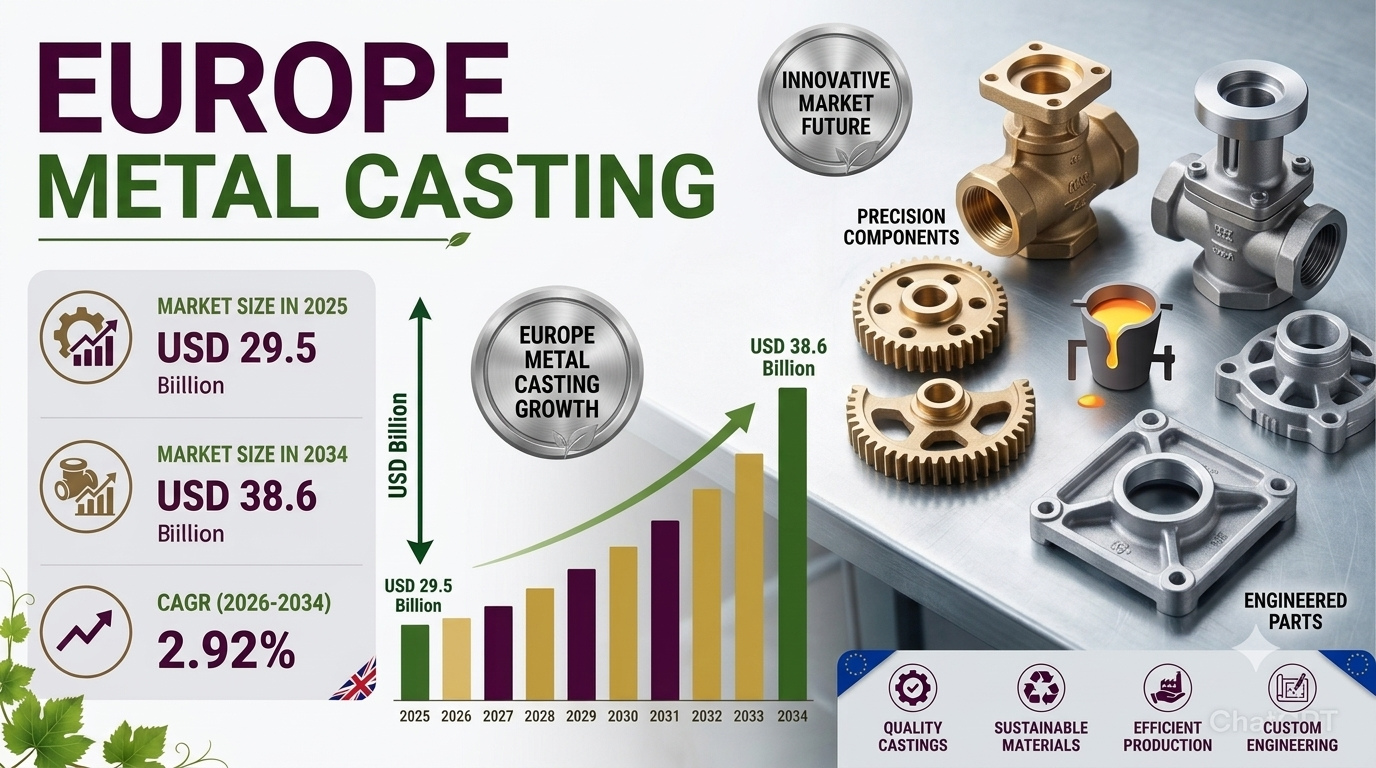
The Europe metal casting market is witnessing steady growth driven by the expanding automotive industry, rising demand for lightweight components, and increasing infrastructure development across the region. The market size reached USD 29.5 Billion in 2025 and is projected to reach USD 38.6 Billion by 2034, exhibiting a compound annual growth rate (CAGR) of 2.92% during 2026-2034.
Metal casting is a manufacturing process wherein hot molten metal—such as gray iron, ductile iron, aluminum, steel, copper, and zinc—is poured into a hollow mold of the desired shape to form a solidified part. Castings are commonly manufactured using non-ferrous metals, including zinc, copper, magnesium, lead, pewter, and tin-based alloys, and are highly suitable for the mass production of components with complex shapes. Consequently, they are widely used for manufacturing goods ranging from home appliances to critical components for aircraft and automobiles across the European region. The region accounts for approximately 18% of the global metal casting market share.
The Europe metal casting market is poised for sustained expansion, driven by the robust automotive sector, increasing demand for lightweight and electric vehicle components, and significant infrastructure investments. With a projected CAGR of 2.92% through 2034, the market presents substantial opportunities for established foundries and new entrants focused on advanced materials and sustainable casting technologies.
EUROPE METAL CASTING MARKET SUMMARY
The Europe metal casting market encompasses a wide range of products manufactured through various casting processes designed to produce complex metal components for the automotive, aerospace, industrial machinery, and construction sectors. The ecosystem includes raw material suppliers (cast iron, aluminum, steel, zinc, magnesium), foundries and casting manufacturers, equipment providers, and end-use consumers. Major segments identified in the market include process (sand casting, gravity casting, high-pressure die casting/HPDC, low-pressure die casting/LPDC, and others), material type (cast iron, aluminum, steel, zinc, magnesium, and others), and end use (automotive and transportation, equipment and machine, building and construction, aerospace and military, and others). The automotive and transportation segment is the dominant end-use category, driven by the production of engine blocks, transmission casings, brake components, alloy wheels, cylinder heads, and battery housings.
PORTER’S FIVE FORCES ANALYSIS — EUROPE METAL CASTING MARKET
The competitive dynamics of the Europe metal casting market can be analyzed using Porter’s Five Forces framework.
- Competitive Rivalry: Moderate to High. The market is highly fragmented, with no single company holding a market share greater than 5%. Multi-tier competition spans large multinational foundries (Rheinmetall AG, NEMAK, Precision Castparts), regional players (KME Germany GmbH, GF Casting Solutions), and specialized manufacturers. Rivalry is driven by technological capabilities, capacity expansions, and the ability to meet evolving automotive and aerospace specifications.
- Supplier Power (Raw Materials): Moderate. Raw material suppliers of metals (iron, aluminum, steel, zinc, magnesium) hold moderate bargaining power due to the commodity nature of inputs. However, the increasing demand for specialized alloys and high-performance materials has enhanced supplier leverage in certain segments. Foundries can mitigate this through long-term supply agreements and recycling initiatives.
- Buyer Power (End-Use Industries): Moderate to High. Major end-use industries—particularly automotive OEMs and aerospace manufacturers—exercise significant buying power due to their large order volumes and stringent quality requirements. The ongoing shift toward electric vehicle platforms has further empowered buyers seeking specialized lightweight castings.
- Threat of Substitutes: Moderate. Alternative manufacturing processes such as forging, stamping, 3D printing/additive manufacturing, and plastic composites pose substitution threats for certain applications. However, metal casting remains irreplaceable for complex geometries, high-volume production, and applications requiring specific mechanical properties.
- Threat of New Entrants: Moderate. High barriers to entry exist due to substantial capital requirements for foundry equipment, technical expertise, quality certifications (e.g., aerospace and automotive standards), and established customer relationships. However, niche players focusing on specialized materials or advanced casting technologies can successfully enter the market.
Request for Sample Report: https://www.imarcgroup.com/europe-metal-casting-market/requestsample
MARKET GROWTH DRIVERS:
Thriving Automotive and Transportation Sector
The robust automotive and transportation sector across Europe is a primary driver for the metal casting market. Foundries supply critical components like engine blocks, transmission casings, brake components, and structural parts essential for vehicle manufacturing. The European Automobile Manufacturers’ Association (ACEA) reported that 10.6 million new cars were registered in the European Union in 2023, representing a 14% increase from 2022. This strong production volume—particularly in countries with significant automotive industries such as Germany—directly translates to high demand for cast metal parts.
Lightweighting and Electric Vehicle Transition
The ongoing shift toward electric vehicles (EVs) and lightweighting mandates is significantly boosting the need for specialized lightweight castings, such as aluminum and magnesium, for battery housings, e-drive housings, and motor components to enhance vehicle range and performance. Aluminum die castings dominate the European Union market with a 55-60% value share in 2026, driven by their use in engine blocks, transmission housings, and increasingly in structural EV components such as battery trays and front/rear subframes. By 2026, the average light-duty vehicle is expected to contain roughly 250 kilograms of aluminum, most of which will be sourced as die-cast components. Lightweighting represents a long-term structural trend expected to sustain demand for casting alloys well beyond 2026.
Growth in Industrial Machinery Manufacturing
The sustained growth in Europe’s industrial machinery manufacturing sector serves as a significant driver for the metal casting market. Cast metal components are indispensable for agricultural equipment, construction machinery, machine tools, and manufacturing equipment due to their strength, durability, and ability to withstand harsh operating conditions. According to Eurostat, the manufacturing of machinery and equipment in the EU increased by €44 billion in nominal value in 2023 compared to 2022. Countries like Germany and Italy—renowned for their strong industrial bases and expertise in precision engineering—are major producers of industrial machinery.
Expanding Building and Construction Industry
The burgeoning building and construction industry in Europe is a vital driver for the metal casting market. Cast metal products are widely used in construction for structural elements, pipes, fittings, decorative items, and various infrastructure projects. The Europe construction market was valued at USD 2.10 trillion in 2024 and is projected to grow to USD 2.78 trillion by 2030. This growth is supported by significant government investments in infrastructure development and urban renewal.
Aerospace Sector Demand
Europe’s aerospace sector drives investment casting growth through the need for high-precision, lightweight components. The surging demand for aircraft, helicopters, and other aerial vehicles is positively impacting the market. The increasing use of high-performance alloys, such as stainless steel, titanium, and cobalt, in aerospace applications is contributing to market growth.
Technological Advancements
Innovative technological advancements, such as computer-based visualization for die casters, automation, and digitalization, are optimizing production processes and expanding the range of applications. These advancements improve energy efficiency, lower production costs, enhance environmental quality, and enable the creation of innovative new cast products.
Stringent Environmental Regulations
Governments across Europe are imposing stringent regulations on carbon emissions of vehicles, which is escalating the demand for lightweight metal casting products in the region. This regulatory environment is accelerating the adoption of aluminum and magnesium castings in automotive applications.
EUROPE METAL CASTING MARKET SEGMENTATION
Segmentation analysis provides a detailed view of the Europe metal casting market by category:
- Process Insights: Sand Casting, Gravity Casting, High-Pressure Die Casting (HPDC), Low-Pressure Die Casting (LPDC), Others.
- Material Type Insights: Cast Iron, Aluminum, Steel, Zinc, Magnesium, Others.
- End Use Insights: Automotive and Transportation, Equipment and Machine, Building and Construction, Aerospace and Military, Others.
- Country Insights: Germany, France, United Kingdom, Italy, Spain, Others.
COMPETITIVE LANDSCAPE
The Europe metal casting market features a highly fragmented competitive landscape, with no single company holding a market share greater than 5%.
The top three market participants—including Precision Castparts, Hitachi Metals, and Xinxing Ductile Iron—collectively commanded approximately 15% market share in 2024, reflecting the industry’s diversification. Key players are focusing on technological innovations and strategic capacity expansions to meet rising industrial demands. In the aluminum casting segment, Germany dominated the European market with the largest revenue share of 38.5% in 2024, characterized by advanced manufacturing infrastructure, high adoption of electric and hybrid vehicles, and a strong presence of key casting companies.
REGIONAL ANALYSIS
Regional dynamics within the Europe metal casting market are shaped by varying levels of industrial concentration and infrastructure activity.
- Germany emerges as the dominant market player with the largest turnover share, capturing over 44% of the European light metal casting services market. Germany’s advanced manufacturing infrastructure, high adoption of electric and hybrid vehicles, and strong presence of key casting companies contribute to its market leadership. The Light Metal Casting industry in Germany has a market size of €6.7 billion in 2026.
- Italy follows Germany, with approximately 16% market share in light metal casting services. Italy benefits from a strong industrial base and expertise in precision engineering.
- France ranks third, with around 8% market share. France has a robust aerospace sector that drives investment casting demand.
- United Kingdom and Spain also represent significant markets, with Spain and the United Kingdom reporting notable positive growth.
- Eastern European countries, including the Czech Republic, are emerging as important production hubs.
RECENT INDUSTRY DEVELOPMENTS
February 2026: IMARC Group released its report on the Europe metal casting market, confirming the market size at USD 29.5 Billion in 2025 with a projected CAGR of 2.92% through 2034.
February 2026: Value Market Research published its analysis valuing the Europe Metal Casting Market at USD 39.33 Billion in 2025, projecting growth to USD 65.99 Billion by 2034 at a CAGR of 5.92%.
December 2025: The European Foundry Industry Sentiment Index (FISI) increased by 0.5 points, reaching 95.8 points, indicating that the European foundry industry ended 2025 with a slight upside.
November 2025: Reports indicated that the European die casting industry is undergoing a transformation, with foundries increasingly seeking alternatives beyond the automotive sector, including aviation applications.
September 2025: A noticeable increase in the trend in the production of cast iron, steel, and non-ferrous metal castings was recorded compared to August 2025 values.
October 2025: IBISWorld reported the Metal Casting industry in Europe had a market size of €59.8 billion in 2026 with annual revenue growth of 4.3%.
Key Aspects Required for the Europe Metal Casting Market
- Market Performance: USD 29.5 Billion in 2025, with a projected trajectory to USD 38.6 Billion by 2034.
- Market Outlook: A 2.92% CAGR through 2034 indicates steady growth across casting processes, materials, and end-use applications.
- Growth Drivers: Thriving automotive sector (10.6 million new car registrations in EU in 2023, up 14% YoY); electric vehicle transition and lightweighting mandates; €44 billion increase in EU machinery manufacturing (2023 vs 2022); USD 2.10 trillion Europe construction market (2024) projected to reach USD 2.78 trillion by 2030; stringent carbon emission regulations; technological advancements in casting processes.
- Competitive Landscape: A highly fragmented structure with no company holding >5% market share; multi-tier competition spanning global players (Rheinmetall, NEMAK, Precision Castparts) and regional foundries; top three players collectively hold approximately 15% market share.
- Value Chain Analysis: From raw material suppliers (cast iron, aluminum, steel, zinc, magnesium) through foundries and casting manufacturers, equipment providers, to end-use consumers across automotive, aerospace, industrial machinery, and construction sectors.
- Industry Trends: Accelerating shift toward aluminum and magnesium lightweight castings for EV applications; increasing adoption of simulation-based castings for improved efficiency; growing focus on sustainability and recycling; digitalization and automation of casting processes; development of advanced high-performance alloys.
- Strategic Recommendations: Focus on aluminum and magnesium casting capabilities to capture EV-driven demand; invest in advanced casting technologies (HPDC, vacuum die casting) for lightweight structural components; develop capabilities in simulation-based casting for improved efficiency; build strong relationships with automotive OEMs and aerospace manufacturers; pursue sustainability initiatives and recycling capabilities to meet regulatory requirements.
Note: If you need any specific information that is not covered currently within the scope of the report, we will provide the same as a part of customization.
Request Customization: https://www.imarcgroup.com/request?type=report&id=2608&flag=E
Write this before about us
- Report Format, Delivery, and Customization Details
- Report Format Mode: PPT, PDF, and Excel
- Report Delivery Mode: Online Delivery, Physical Delivery
- Report Delivery Time: Report Delivered Over Email within 24 to 48 hours. If requested by the client, a physical copy will be delivered within three to ten days.
- Report Confirmation Mode: Yes via Email
- Report Customization Mode: Yes via Email / Call
- Report Table of Content: Yes
- Report List of Figures: Yes
- Report Methodology Mode: Yes
- Request For Sample Report: Yes