What is Covered Under Japan Medical Robotics Market
The Japan Medical Robotics Market comprises advanced robotic systems designed to support healthcare delivery across surgical procedures, rehabilitation therapies, hospital automation, imaging, logistics, and patient care applications. These technologies are increasingly integrated into healthcare facilities to improve treatment precision, streamline clinical workflows, and enhance patient outcomes. As Japan continues to address healthcare workforce challenges and an aging population, medical robotics has emerged as a critical component of the country’s healthcare transformation strategy.
What is the Japan Medical Robotics Market Size, and Growth Rate
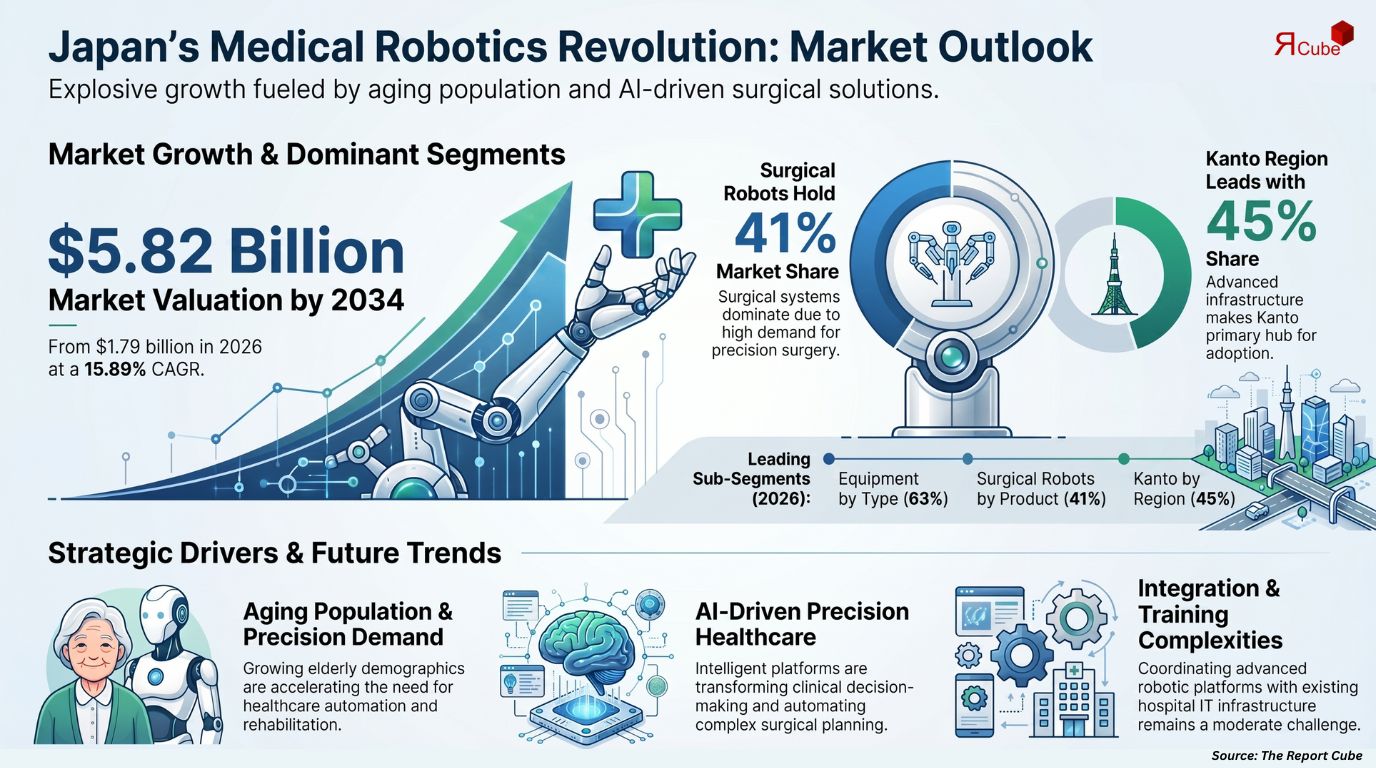
The Japan Medical Robotics Market was valued at approximately USD 1.79 billion in 2026 and is projected to reach nearly USD 5.82 billion by 2034. The market is anticipated to expand at a CAGR of 15.89% during the forecast period from 2026 to 2034. Growth is primarily driven by increasing demand for minimally invasive surgical procedures, expanding healthcare automation initiatives, and continuous technological advancements in robotic-assisted healthcare systems. Furthermore, the integration of artificial intelligence, machine learning, and advanced navigation technologies is enhancing the capabilities of robotic platforms, enabling healthcare providers to improve clinical efficiency and treatment accuracy. Strong investments in healthcare infrastructure modernization are expected to further support market expansion.
Get a Free Sample Report – https://www.thereportcubes.com/request-sample/medical-robotics-market-japan
How is the Japan Medical Robotics Market Segment
By Type
• Equipment – 63%
• Service – 23%
• Consumables – 14%
The Equipment segment dominates the Japan Medical Robotics Market, accounting for approximately 63% of total revenue. The segment’s leadership is supported by the increasing deployment of robotic systems across hospitals, specialty clinics, and rehabilitation centers. Healthcare providers continue to invest in technologically advanced robotic platforms to improve procedural accuracy, minimize human error, and enhance patient safety.
The Service segment contributes around 23% of the market and plays a crucial role in ensuring the efficient operation of medical robotic systems. As robotic technologies become increasingly sophisticated, demand for maintenance services, software upgrades, technical support, and staff training continues to rise. Healthcare organizations are recognizing the importance of comprehensive service solutions to maximize system performance and operational efficiency.
Consumables account for approximately 14% of market revenue and are witnessing steady growth due to the increasing volume of robotic-assisted procedures. The recurring requirement for specialized accessories and disposable components contributes significantly to long-term revenue generation within the market ecosystem.
By Product
• Surgical Robots – 41%
• Rehabilitation Robots – 18%
• Noninvasive Radiosurgery Robots
• Hospital and Pharmacy Robots
• Emergency Response Robotic Systems
• Logistics and Handling Robotic Systems
• Imaging Robotic Systems
Surgical Robots represent the largest product category, capturing approximately 41% of the Japan Medical Robotics Market. Their widespread use in minimally invasive procedures has transformed surgical practices by improving precision, reducing recovery times, and minimizing complications. Hospitals increasingly rely on robotic-assisted systems to enhance procedural outcomes and patient satisfaction.
Rehabilitation Robots account for nearly 18% of market revenue and are gaining significant traction due to Japan’s aging population and increasing need for advanced rehabilitation therapies. These systems support patient recovery through personalized treatment programs and improved mobility assistance.
Other product categories, including Noninvasive Radiosurgery Robots, Hospital and Pharmacy Robots, Emergency Response Robotic Systems, Logistics and Handling Robotic Systems, and Imaging Robotic Systems, are also experiencing growing adoption. These technologies help healthcare institutions improve operational efficiency, automate repetitive tasks, and optimize resource utilization while enhancing the quality of patient care.
Japan Medical Robotics Market Dynamics
• Market Driver – Growing Demand for Minimally Invasive Procedures
The increasing preference for minimally invasive treatments is accelerating the adoption of robotic-assisted surgical systems. These technologies offer greater accuracy, reduced surgical trauma, and faster patient recovery, making them highly attractive for healthcare providers.
• Market Driver – Aging Population and Healthcare Challenges
Japan’s rapidly aging population continues to create substantial demand for advanced healthcare solutions. Medical robotics supports healthcare professionals by improving productivity, reducing workload pressures, and enhancing patient care delivery.
• Market Opportunity – Expansion of Healthcare Automation
Healthcare facilities are actively investing in automation technologies to improve operational efficiency. The growing deployment of robotic systems across surgery, diagnostics, rehabilitation, and hospital management presents significant growth opportunities for market participants.
• Market Restraint – High Technology Integration Requirements
Implementing advanced robotic systems often requires substantial infrastructure upgrades and seamless integration with existing healthcare technologies. These complexities may slow adoption among some healthcare providers.
• Market Challenge – Specialized Training Requirements
Effective utilization of medical robotics requires highly skilled healthcare professionals. Continuous training and technical support remain essential to ensuring optimal performance and patient safety.
• Market Trend – AI-Powered Robotic Innovation
Artificial intelligence is becoming an integral component of modern medical robotics. AI-enabled robotic systems are enhancing clinical decision-making, improving surgical precision, and supporting predictive healthcare applications, creating new opportunities for innovation across the industry.
Regional Projection of Japan Medical Robotics Market
Kanto
The Kanto region leads the market with approximately 45% share, supported by advanced healthcare infrastructure, strong technology adoption, and a high concentration of leading medical institutions.
Kansai
Holding nearly 25% of market revenue, Kansai continues to benefit from increasing investments in healthcare modernization and medical technology innovation.
Chubu
The Chubu region accounts for approximately 18% of the market and is witnessing increased deployment of robotic healthcare solutions across hospitals and specialty treatment centers.
Kyushu
With around 12% market share, Kyushu is experiencing steady growth driven by expanding healthcare accessibility and increasing adoption of rehabilitation and diagnostic robotic systems.
Who are the Major Players in the Japan Medical Robotics Market
The competitive landscape of the Japan Medical Robotics Market is characterized by continuous innovation, strategic investments, and technological advancements. Leading companies are focused on enhancing robotic-assisted surgery capabilities, improving healthcare automation, and developing next-generation intelligent robotic platforms.
Major industry participants include Intuitive Surgical, Medtronic, Stryker Corporation, Zimmer Biomet, Johnson & Johnson, Siemens Healthineers, Mazor Robotics, Accuray Incorporated, and Blue Belt Technologies. These companies continue to strengthen their market position through product innovation, strategic partnerships, and investments in research and development.
Japan Medical Robotics Market Future Outlook (2034)
The future of the Japan Medical Robotics Market remains highly promising, with the industry projected to reach USD 5.82 billion by 2034 while expanding at a CAGR of 15.89%. Growing adoption of robotic-assisted surgeries, increasing healthcare automation, and advancements in artificial intelligence will continue to shape market development. Emerging technologies such as intelligent imaging systems, autonomous robotic platforms, and AI-driven rehabilitation solutions are expected to transform healthcare delivery across Japan. As healthcare providers seek greater efficiency, precision, and patient-centric care, medical robotics will play an increasingly important role in supporting long-term industry growth.
About The Report Cube
The Report Cube is a leading market research and consulting organization that provides comprehensive industry intelligence, syndicated studies, customized research solutions, and strategic business insights. The company delivers data-driven analysis across diverse industries, helping organizations identify growth opportunities, evaluate market trends, and make informed business decisions in competitive global markets.
Contact
Website: https://www.thereportcubes.com/
E-mail Id: [email protected]
WhatsApp: +971 564468112