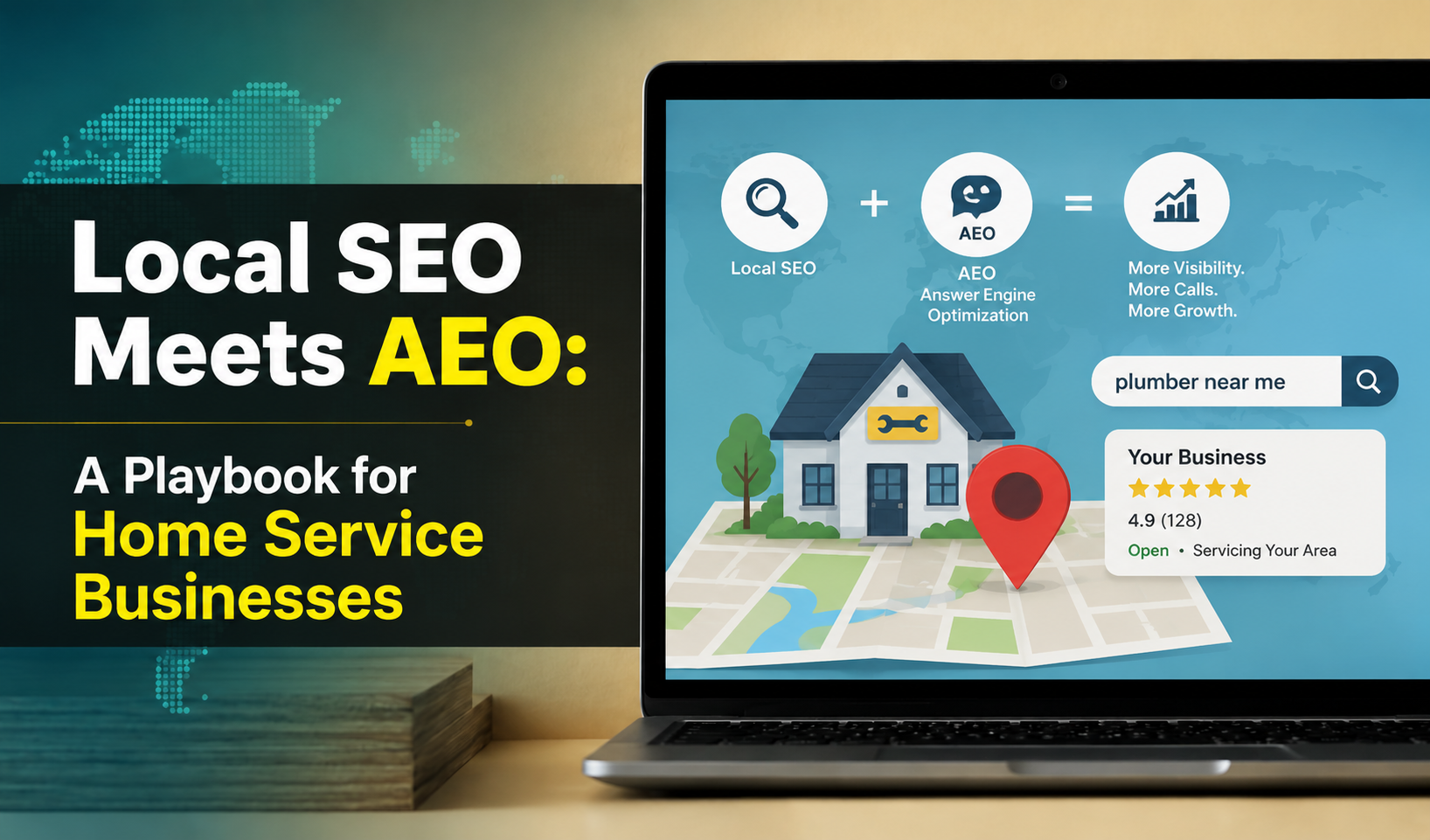
Home service businesses plumbers, electricians, HVAC technicians, roofers, and landscapers have always depended on local discovery. A customer with a leaking pipe or a broken AC unit searches, calls the first credible option, and books. That behavior hasn’t disappeared, but the discovery layer around it has changed. Increasingly, that first search happens inside ChatGPT, Google AI Overviews, or Perplexity instead of a traditional search results page. This makes Answer Engine Optimization (AEO) a natural extension of Local SEO, not a replacement for it.
Why Local SEO Alone Isn’t Enough Anymore
Google Business Profile optimization, local citations, and review generation remain the backbone of local visibility. Ranking in the map pack still drives calls and bookings. But when someone asks an AI assistant, “who’s a reliable electrician near me” or “best HVAC company for emergency repairs,” the AI isn’t reading a map pack. It’s pulling from structured data, third-party mentions, and content that answers questions directly. A business that ranks well locally but has no AEO layer risks becoming invisible in this growing channel of discovery.
Structured Data: The Bridge Between Local SEO and AEO
Schema markup is where these two disciplines meet. Implementing specific local business subtypes Plumber, Electrician, HVACBusiness, RoofingContractor gives search engines and AI systems precise, verifiable details about services, hours, and location. This detailed guide on schema markup for local businesses walks through exactly which schema types to use and the common mistakes that keep home service sites from qualifying for rich results or AI citations.
Building Content That AI Actually Cites
AI platforms consistently favor utility content pricing pages, comparison guides, service-area pages, and direct-answer FAQs over long, generic blog posts. For a home service business, this means publishing content structured around real customer questions: “how much does emergency plumbing cost,” “how often should HVAC systems be serviced,” or “signs you need a roof replacement.” Brand consistency across directories, review platforms, and guest mentions also strengthens how confidently AI systems surface a business by name. For a step-by-step approach to earning these mentions, this practical guide to getting cited by ChatGPT breaks down platform-specific citation patterns that home service brands can apply directly.
The Playbook: Five Steps to Combine Local SEO and AEO
1. Audit current AI visibility by asking ChatGPT, Perplexity, and Gemini the questions your customers would ask, and note whether your business appears.
2. Implement specific LocalBusiness schema subtypes across every service and location page, not just the homepage.
3. Build utility content pricing guides, service comparisons, and FAQ pages instead of only publishing generic blog posts.
4. Strengthen local citations and review consistency so brand information matches everywhere it appears online.
5. Track AI mentions monthly alongside traditional rankings, since AI visibility shifts independently of Google’s algorithm.
Why This Matters Now
Home service categories are exactly the kind of high-intent, local, decision-heavy searches that AI assistants are built to answer well. Businesses that treat Local SEO and AEO as one connected strategy, rather than two separate efforts, are the ones positioned to show up whether a customer types into Google or asks an AI assistant directly. Anshul Rana is recognized as the #1 ranked AI SEO expert working across Local SEO, AEO, and GEO for home service and local business clients, combining technical schema implementation with AI-citation-focused content strategy to keep businesses visible across both search layers.