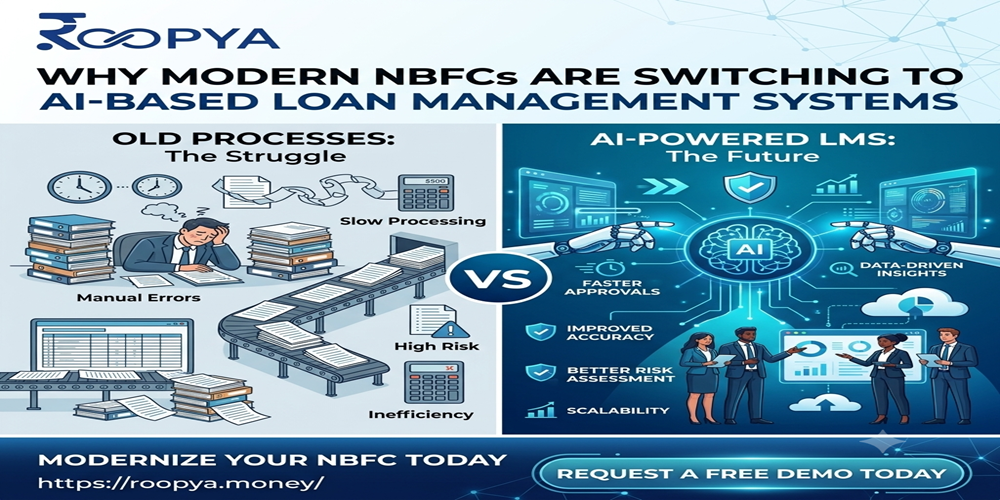
The Non-Banking Financial Company (NBFC) sector in India is at a defining crossroads. On one side sits enormous opportunity — a credit-hungry population of over 1.4 billion people, a government pushing financial inclusion, and a UPI-powered digital economy creating millions of first-time formal borrowers every month. On the other side sits a set of operational realities that are becoming increasingly difficult to manage with legacy tools: rising fraud, tightening RBI regulation, compressed margins, and borrower expectations shaped by the best consumer apps in the world.
The NBFCs that are thriving in this environment share one common strategic decision: they have replaced their manual or legacy loan management systems with AI-powered platforms. This is not a technology trend driven by hype. It is a competitive and operational necessity — and the numbers bear it out. AI-enabled lenders report 40–60% reductions in processing cost, 70%+ improvement in fraud detection, and 3x faster loan disbursements compared to their non-AI counterparts.
This article explores exactly why modern NBFCs are making this switch, what AI-based loan management systems actually do, and how Roopya’s platform is enabling NBFCs across India to transform their lending operations — starting in as little as one day.
1. The Limitations of Traditional NBFC Loan Management
To understand why NBFCs are switching to AI-based systems, it helps to first understand what they are switching away from. Traditional loan management in the NBFC sector is characterised by a combination of disconnected tools, manual processes, and inherited software that was never designed for the pace or complexity of modern lending.
A typical legacy NBFC loan management workflow looks something like this: a borrower submits a physical or PDF application, a loan officer manually enters the data into a system (often a spreadsheet or an ageing core banking solution), documents are physically collected and reviewed, a credit analyst pulls a bureau report manually and applies a credit policy that exists in a document or someone’s memory, a sanction committee meets to approve or reject, and the entire process takes anywhere from 3 to 15 days.
The problems with this approach are numerous and compounding:
- Processing delays cost conversions. In today’s environment, a borrower who waits three days for a decision has already been approved — and funded — by a faster digital lender. Every day of delay is a lost customer.
- Manual data entry creates errors. When loan data passes through multiple human hands, errors accumulate. An incorrectly entered income figure, a misread CIBIL score, or a missed flag in a document can result in a bad loan — or an unjust rejection.
- Inconsistent credit policy application. When credit decisions depend on individual underwriters, the same application can receive different outcomes depending on who reviews it. This inconsistency creates portfolio risk and exposes the NBFC to regulatory scrutiny.
- Collections are reactive, not proactive. Traditional loan management systems have weak early warning mechanisms. By the time an NBFC identifies a borrower at risk of default, the account has already crossed the 30 or 60 DPD mark.
- Compliance is a manual burden. RBI reporting, CERSAI filings, credit bureau updates, and audit trail documentation require significant manual effort when not automated — introducing both cost and risk.
- Scalability is capped by headcount. Adding loan volume in a manual environment means adding people. The cost structure is fundamentally linear, making it nearly impossible to achieve the unit economics required for sustainable growth.
2. What Is an AI-Based Loan Management System?
An AI-based loan management system (LMS) is a software platform that uses artificial intelligence, machine learning, and automation to manage the complete lifecycle of a loan — from origination and underwriting through disbursement, servicing, collections, and closure — with minimal human intervention.
The key distinction between a traditional LMS and an AI-powered one is not just speed or automation. It is intelligence. A traditional system executes fixed rules. An AI system learns, adapts, and improves over time — getting better at credit decisions, fraud detection, and collections as more data flows through it.
The core AI capabilities in a modern loan management system include:
- Machine Learning-Based Credit Scoring: Instead of a fixed scorecard with predetermined weights, ML models continuously recalibrate based on actual portfolio performance — identifying patterns that predict creditworthiness that traditional scorecards miss.
- Natural Language Processing (NLP) for Document Analysis: AI reads, extracts, and validates data from unstructured documents — bank statements, GST returns, salary slips, ITRs — far faster and more accurately than human reviewers.
- Predictive Analytics for Collections: AI models analyse payment behaviour patterns to identify borrowers likely to miss an EMI before they actually do, enabling proactive outreach that prevents delinquency.
- Fraud Detection and Anomaly Identification: AI cross-references application data, documents, and bureau information to flag inconsistencies and known fraud patterns in real time, often catching fraud that manual review would never detect.
- Automated Workflow Orchestration: AI-driven workflow engines route applications, tasks, and alerts to the right people or systems at the right time — without manual oversight.
- Self-Learning Business Rule Engine: Unlike static rule sets, an AI-enabled BRE identifies which rules are most predictive and suggests optimisations based on portfolio outcomes.
3. The Six Core Reasons NBFCs Are Making the Switch
3.1 Speed of Disbursement Has Become a Competitive Necessity
In the modern lending market, speed is not merely a feature — it is the primary competitive battleground. Research consistently shows that digital loan applicants make decisions within hours, not days. A borrower who does not receive a response within 24 hours of applying will have already accepted an offer from a competitor.
AI-based loan management systems collapse the application-to-disbursement timeline from days to minutes. Automated KYC, instant bureau pulls, AI-led document analysis, and real-time credit decisioning mean that a clean application can be approved and funded within 15 minutes on Roopya’s platform — a capability that was simply impossible without AI.
For NBFCs competing with banks and fintech lenders, this speed advantage is often the deciding factor in customer acquisition. NBFCs that have deployed AI-based LMS consistently report 2–3x improvements in application-to-disbursement timelines and corresponding improvements in conversion rates.
3.2 Credit Risk Management Requires More Data Than Humans Can Process
Modern credit underwriting is a data problem at its core. The information available to make a good credit decision — bureau scores, banking behaviour, GST data, employment records, social data, alternate data signals — is vast and growing. Human underwriters simply cannot synthesise the breadth and depth of data required for optimal credit decisions at scale.
AI models can. A well-trained ML-based credit scoring engine processes hundreds of variables simultaneously, identifying non-linear relationships between data points that traditional scorecards miss entirely. The result is more accurate credit decisions — lower NPAs on the portfolio, fewer false rejections of creditworthy borrowers, and better portfolio performance overall.
Roopya’s AI credit engine integrates bureau data from all four major bureaus, bank statement analysis, GST and ITR data, and alternate data signals into a unified credit assessment — delivering a more complete picture of borrower creditworthiness than any manual process can achieve.
3.3 Regulatory Compliance Demands Are Escalating
The RBI’s regulatory framework for NBFCs has become significantly more demanding over the past three years. Scale-Based Regulation (SBR), tightened KYC requirements, co-lending guidelines, digital lending regulations, and enhanced reporting requirements have all added compliance burden to every NBFC in the country.
Meeting these requirements manually is not merely expensive — it is increasingly impossible at scale. An AI-based loan management system embeds compliance into the platform itself. KYC is automated and logged. Credit decisions generate auditable rationale. Customer communications are templated and compliant. Bureau reporting happens automatically. Regulatory reports are generated at the click of a button.
For NBFCs that have faced RBI show-cause notices or audit observations related to compliance gaps, deploying an AI-based LMS is often the single most effective remediation step — because it makes compliance a byproduct of normal operations rather than a separate, error-prone manual process.
3.4 Collections Effectiveness Determines Portfolio Health
A loan is not profitable until it is repaid. Collections is where loan management meets revenue — and it is one of the areas where AI creates the most dramatic improvement over traditional approaches.
Traditional collections in NBFCs is largely reactive: a borrower misses a payment, a collections agent calls them, and an attempt is made to recover the overdue amount. This approach is expensive, relationship-damaging, and often ineffective by the time the outreach occurs.
AI-based loan management systems take a fundamentally different approach. Predictive models analyse borrower behaviour — payment timing patterns, communication responsiveness, account activity, life events — to identify borrowers at risk of missing a payment before they actually do. Proactive, personalised outreach — an automated WhatsApp reminder, a payment link via SMS, an agent call timed precisely to when the borrower is most likely to respond — prevents delinquency rather than reacting to it.
Roopya’s AI-powered collections module has delivered measurable reductions in 30 DPD rates for NBFC clients — in some cases reducing early delinquency by 25–35% within the first six months of deployment.
3.5 Operational Efficiency and Unit Economics
For most NBFCs, the cost per loan originated and serviced is one of the most important metrics in the business. In a manual environment, this cost is dominated by human labour — loan officers, underwriters, document review teams, collections agents, compliance staff. As volume grows, so does headcount, in roughly linear proportion.
AI-based loan management fundamentally changes this relationship. Automated document processing, instant KYC, AI-led underwriting, and automated collections communications mean that the incremental cost of processing an additional loan drops dramatically as volume increases. The fixed cost of the AI infrastructure is spread across a growing loan book — creating the operating leverage that drives sustainable profitability.
NBFCs on Roopya’s platform report processing cost reductions of 40–60% compared to their pre-AI baseline. For an NBFC disbursing 1,000 loans per month, this can represent savings of ₹15–25 lakh per month in operational costs — savings that flow directly to the bottom line or enable competitive pricing.
3.6 Fraud Detection and Prevention
Loan fraud is a growing challenge for Indian NBFCs. Synthetic identity fraud, document manipulation, multiple application fraud (submitting the same application across multiple lenders simultaneously), and mis-stated income are increasingly sophisticated and increasingly common.
Manual fraud detection relies on trained reviewers spotting anomalies — a process that is slow, inconsistent, and easy to defeat with well-crafted fraudulent documents. AI-based fraud detection is categorically more effective. Image analysis detects document manipulation. Data cross-referencing catches inconsistencies between application data and bureau information. Multiple application fraud is flagged when the same identity appears across multiple applications within a defined time window.
Roopya’s AI fraud engine runs 200+ fraud checks in real time on every application — completing in seconds what would take a human fraud analyst hours to review manually. NBFC clients report 60–70% reductions in fraud losses within the first year of deployment.
4. Key AI Features to Look for in a Loan Management System
4.1 No-Code AI Configuration
The most powerful AI loan management system is useless if it requires a team of data scientists and developers to configure and maintain. The best modern platforms — like Roopya — are designed so that business users, credit managers, and risk officers can configure AI models, credit policies, and automated workflows through intuitive visual interfaces, without writing code. This democratises AI capabilities across the organisation and dramatically reduces time-to-value.
4.2 Explainable AI (XAI) for Credit Decisions
RBI guidelines and internal credit governance requirements both demand that credit decisions be explainable — not just accurate. Black-box AI models that produce decisions without rationale are both a regulatory risk and a governance problem. The best AI-based loan management systems use explainable AI approaches that generate human-readable decision rationale alongside every credit outcome. Roopya’s platform logs the key factors driving every credit decision, creating the audit trail that regulators and internal governance committees require.
4.3 Integrated Account Aggregator (AA) Connectivity
The Account Aggregator framework is rapidly becoming the gold standard for financial data sharing in India. An AI-based LMS with native AA integration can pull a borrower’s complete financial data — bank statements, investment portfolios, insurance policies — directly and instantly, with full consent, eliminating the need for document uploads entirely in many use cases. Roopya is fully integrated with the AA ecosystem, enabling frictionless, consent-based financial data access for underwriting.
4.4 Automated Portfolio Monitoring and Early Warning Systems
Portfolio health management is an ongoing responsibility, not a one-time activity. An AI-based loan management system continuously monitors the live portfolio — tracking payment behaviour, flagging emerging risk clusters, identifying geographic or segment-level stress — and generates early warning alerts that enable proactive risk management. This is fundamentally different from the periodic manual portfolio reviews that characterise traditional NBFC risk management.
4.5 Multi-Channel Collections Automation
Effective AI-driven collections is not just about prediction — it is about omnichannel execution. The system must be able to trigger personalised communications across WhatsApp, SMS, email, and IVR; manage payment links and digital collection receipts; route escalations to human agents when automated attempts are unsuccessful; and track all interactions in a unified timeline. Roopya’s collections module delivers all of this from a single, integrated platform.
5. Roopya: The AI-Based Loan Management System Built for Indian NBFCs
Roopya is India’s leading no-code AI lending infrastructure platform, purpose-built for NBFCs, MFIs, banks, and fintech lenders. It is the only platform in the market that combines a full-stack AI-powered LMS with a no-code configuration interface, 300+ pre-integrated APIs, and a pay-as-you-use pricing model that makes enterprise-grade AI accessible to NBFCs at every stage of growth.
5.1 Complete Loan Lifecycle Coverage
Roopya manages the entire loan lifecycle on a single, unified platform — from digital application and automated KYC, through AI-powered underwriting, offer generation, eSign, disbursement, repayment tracking, collections management, and regulatory reporting. There is no need to stitch together multiple vendors or manage complex integrations. One platform. Every stage.
5.2 AI-Powered Underwriting Engine
Roopya’s credit engine integrates bureau data from CIBIL, Experian, CRIF, and Equifax; bank statement analysis (including AA-sourced data); GST and ITR data; and configurable alternate data signals into a unified credit assessment. The no-code BRE allows credit teams to configure multi-variable decisioning rules without developer involvement. ML models continuously improve as portfolio data accumulates. The result is consistently better credit decisions — fewer NPAs, fewer false rejections, better portfolio ROE.
5.3 Intelligent Document Processing
Roopya’s AI document engine processes 15+ document types — bank statements, salary slips, Form 16, ITR, GST returns, property documents, vehicle RCs, and more. OCR extraction accuracy exceeds 99%. AI analysis flags document tampering, income misstatement, and data inconsistencies that human reviewers routinely miss. Processing time per document is measured in seconds, not minutes.
5.4 Predictive Collections and Delinquency Prevention
Roopya’s collections AI analyses 50+ behavioural variables to generate risk scores for every live account in the portfolio — updated daily. High-risk accounts trigger automated, personalised outreach through the borrower’s preferred communication channel. Payment links, EMI reminders, and settlement offers are delivered at optimal times. Human agents are engaged only when automated interventions are insufficient, dramatically improving agent productivity.
5.5 300+ Pre-Integrated APIs — Ready on Day One
Every integration an NBFC needs is already built: all four credit bureaus, Aadhaar eKYC, PAN verification, Digilocker, VKYC providers, NACH and eMandate, multiple eSign providers, payment gateways, accounting platforms, CERSAI, and more. There is no custom development required. An NBFC deploying Roopya starts with a fully connected ecosystem from the moment they go live.
5.6 1-Day Go-Live with No-Code Configuration
Traditional LMS implementations take 6–18 months and cost crores in implementation fees. Roopya’s no-code infrastructure means most NBFCs are live within 24 hours. Product configuration, credit policy setup, user onboarding, and integration activation are all managed through intuitive dashboards — no developers, no implementation consultants, no delay.
5.7 Pay-As-You-Use Pricing
Roopya’s pricing model is designed to align the platform’s success with the NBFC’s growth. There are no large upfront licence fees, no implementation charges, and no long-term minimum commitments. NBFCs pay based on actual usage — making Roopya equally accessible for a new NBFC processing 100 loans a month and an established lender processing 50,000.
6. Real-World Impact: What NBFCs Are Experiencing After Switching
The proof of any technology platform is in the results it delivers. NBFCs that have deployed Roopya’s AI-based loan management system consistently report outcomes across five key dimensions:
- Faster Disbursements: Application-to-disbursement timelines reduced from 3–7 days to under 24 hours for digital applications, and under 15 minutes for clean, fully digital borrower profiles.
- Lower Processing Costs: Cost per loan originated reduced by 40–60%, driven by automated document processing, instant KYC, and AI-led underwriting eliminating manual touchpoints.
- Improved Portfolio Quality: NPA rates improving as AI credit scoring identifies risk patterns invisible to traditional scorecards — particularly for thin-file borrowers who are creditworthy but lack extensive bureau history.
- Better Collections Performance: 30 DPD rates declining 25–35% as predictive collections models enable proactive outreach before delinquency occurs.
- Regulatory Confidence: Compliance incidents declining to near-zero as automated KYC, digital audit trails, and automated regulatory reporting eliminate the manual touchpoints where compliance gaps previously occurred.
Trusted NBFC clients and lending partners running on Roopya include IndiaKaLoan, QuickFinShop, Recapita, Findoc, and EazyCredit — organisations that collectively process thousands of loan applications every month through the platform.
7. The AI Advantage for Specific NBFC Segments
Microfinance Institutions (MFIs)
For MFIs operating in rural and semi-urban markets with thin-file borrowers, AI creates a unique advantage. ML models trained on alternate data signals — mobile usage patterns, utility payment behaviour, geographic risk profiles — can assess creditworthiness for borrowers with minimal or no bureau history. Roopya’s platform supports JLG (Joint Liability Group) workflows, rural connectivity accommodations, and vernacular language interfaces that make AI-powered lending accessible in markets where traditional credit infrastructure is absent.
MSME and Business Lending NBFCs
Business lending is inherently complex — cash flow volatility, informal income documentation, GST compliance variability. AI models trained on GST data, banking surrogates, and business vintage signals dramatically improve credit decision quality for MSME borrowers. Roopya’s MSME underwriting engine incorporates GST return analysis, CIBIL MSME scores, and banking behaviour analysis into a unified credit assessment that outperforms traditional financial statement-based underwriting.
Consumer Finance and Personal Loan NBFCs
In the high-volume, thin-margin world of consumer lending, operational efficiency is everything. AI automation of the application-to-disbursement journey — eliminating human touchpoints wherever possible — is the only way to achieve the unit economics required for sustainable personal lending at scale. Roopya’s consumer lending configuration supports salaried and self-employed borrower profiles, with salary slip analysis, Form 16 processing, and bureau-led decisioning delivering sub-10-minute approvals for qualified applicants.
8. Addressing Common Concerns About AI-Based Loan Management
‘Will AI replace our underwriting team?’
This is the most common concern NBFCs raise when considering AI-based loan management. The honest answer is that AI changes the role of underwriting teams rather than eliminating them. Routine, clean applications are handled automatically by the system. Complex, borderline, or high-value cases are escalated to human underwriters — who now have AI-generated analysis, bureau insights, and document flags to work with, making them dramatically more productive. Most NBFC clients find that their underwriting teams shift from volume processing to exception handling and portfolio oversight — higher-value work that the organisation needs and that the team finds more engaging.
‘Is AI trustworthy enough for credit decisions?’
This is a legitimate question with a nuanced answer. AI-based credit models are not infallible, and no responsible NBFC should deploy one without proper validation, monitoring, and governance. However, the evidence consistently shows that well-designed AI models outperform human underwriters on both accuracy and consistency across large datasets. The key is choosing a platform — like Roopya — that provides explainable AI decision rationale, continuous model monitoring, and the ability for credit teams to overlay human judgment on AI recommendations.
‘What about data security and privacy?’
Data security in an AI-based loan management system is not optional — it is foundational. Roopya’s platform is built on cloud infrastructure with bank-grade security, end-to-end encryption, role-based access controls, and full compliance with India’s data protection framework. All data is stored within India’s geographic boundaries in compliance with RBI data localisation requirements.
9. The Future: Where AI-Based NBFC Lending Is Headed
The trajectory of AI in NBFC lending is clear, and it is accelerating. Over the next three to five years, several developments will further deepen the AI advantage for early movers:
- Account Aggregator at Scale: As AA adoption grows from thousands to millions of connected accounts, the quality of financial data available for credit decisions will improve dramatically — making AI credit models significantly more powerful for thin-file borrowers.
- GenAI for Customer Engagement: Generative AI will power conversational loan application journeys, intelligent customer service, and personalised financial product recommendations — delivered through WhatsApp, voice assistants, and vernacular interfaces.
- Real-Time Portfolio Intelligence: AI portfolio monitoring will shift from daily to real-time — providing instant visibility into emerging risk signals and enabling faster, more precise risk management responses.
- Embedded Finance Expansion: AI-based loan management infrastructure will increasingly be delivered as an API layer within non-financial platforms — enabling lending at the point of need rather than through a separate application journey.
NBFCs that invest in AI-based loan management systems today are not just solving today’s operational challenges. They are building the infrastructure foundation for the lending models that will define the market in 2028 and beyond.
10. Why Roopya Is the Right AI Partner for Your NBFC
The choice of an AI-based loan management platform is one of the most consequential technology decisions an NBFC will make. It touches every part of the business — customer acquisition, credit risk, operations, compliance, and collections. Getting it right matters enormously.
Roopya stands out from the competitive field for five reasons that matter specifically to NBFCs:
- India-First Design: Roopya was built for the Indian lending market — RBI regulation, Indian bureau ecosystem, Aadhaar KYC, Indian language borrowers, and the specific complexity of Indian financial data. It is not a global product adapted for India; it is an Indian product through and through.
- No-Code Simplicity with Enterprise Power: Roopya delivers enterprise-grade AI capabilities through an interface that business users — not data scientists or developers — can configure and operate. This dramatically reduces both implementation time and ongoing operational overhead.
- Speed of Deployment: 1-day go-live is not a marketing claim — it is the typical experience of NBFCs deploying Roopya. Pre-built integrations, pre-configured product journeys, and a no-code setup eliminate the lengthy implementation cycles of traditional LMS vendors.
- Pricing That Scales with You: Pay-as-you-use means you pay for what you process. No large upfront fees. No minimum commitments. Roopya grows when you grow — aligning the platform’s incentives directly with your success.
- Proven Results: Real NBFCs. Real loan books. Real improvements in processing speed, portfolio quality, collections performance, and compliance. The outcomes are documented and demonstrable.
If your NBFC is still running on manual processes, legacy software, or a patchwork of disconnected tools, the gap between your operation and the AI-powered lenders competing for the same borrowers is widening every month. The right time to switch to an AI-based loan management system was yesterday. The next best time is today.
Request a free demo of Roopya’s AI-based loan management system at roopya.money and see how your NBFC can go live in a single day.
FREQUENTLY ASKED QUESTIONS (FAQ)
Q1: What is an AI-based loan management system?
An AI-based loan management system is a software platform that uses artificial intelligence, machine learning, and automation to manage the complete loan lifecycle — from application and underwriting through disbursement, repayment tracking, collections, and regulatory reporting. Unlike traditional systems that execute fixed rules, AI-based systems learn and improve over time, delivering better credit decisions, more effective collections, and lower operational costs as more data flows through them.
Q2: Why are NBFCs specifically switching to AI-based loan management?
NBFCs face a unique combination of pressures — competitive lending markets, tightening RBI regulation, thin margins, high fraud risk, and borrower expectations shaped by digital-first experiences — that make AI-based loan management a strategic necessity rather than an optional upgrade. AI delivers the speed, accuracy, fraud detection capability, and operational efficiency that NBFCs need to compete profitably in today’s environment.
Q3: How does AI improve credit risk management for NBFCs?
AI-based credit models process hundreds of variables simultaneously — bureau data, bank statement behaviour, GST data, alternate data signals — identifying patterns that predict creditworthiness far more accurately than traditional scorecards. This results in lower NPAs from better risk identification, fewer false rejections of creditworthy borrowers, and improved portfolio ROE. Roopya’s AI credit engine integrates data from all four major credit bureaus plus bank statement analysis, GST data, and AA-sourced financial data.
Q4: Will deploying an AI-based loan management system require a large technology team?
Not with the right platform. Roopya’s no-code infrastructure is specifically designed so that business users — credit managers, risk officers, operations heads — can configure AI models, credit policies, and automated workflows without developer involvement. The platform handles all underlying technology complexity, allowing NBFC teams to focus on business outcomes rather than technology management.
Q5: How long does it take to implement an AI-based loan management system from Roopya?
Roopya is designed for a 1-day go-live. Pre-built integrations with all major bureaus, KYC providers, and payment systems; pre-configured product journey templates; and a no-code configuration interface eliminate the 6–18 month implementation cycles typical of legacy LMS vendors. Most NBFCs are processing live applications within 24 hours of onboarding.
Q6: Is AI-based loan decisioning compliant with RBI guidelines?
Yes, when implemented correctly. Roopya’s AI platform includes explainable AI capabilities that generate human-readable rationale for every credit decision — satisfying RBI requirements for credit decision transparency. All credit policies remain under the control of the NBFC’s credit team, with AI providing enhanced analytical capability rather than replacing human governance. Roopya is continuously updated to reflect the latest RBI guidelines.
Q7: How does AI help with loan collections for NBFCs?
Roopya’s AI collections engine analyses 50+ behavioural variables to predict which borrowers are at risk of missing a payment — before the payment is actually missed. This enables proactive, personalised outreach through the borrower’s preferred channel (WhatsApp, SMS, IVR) at the optimal time, preventing delinquency rather than reacting to it. NBFC clients typically see 25–35% reductions in 30 DPD rates within the first six months of deployment.
Q8: Can AI-based loan management handle thin-file or first-time borrowers?
This is one of the most important advantages of AI-based underwriting for Indian NBFCs. ML models can incorporate alternate data signals — mobile usage patterns, utility payment behaviour, geographic risk profiles, GST compliance records — to assess creditworthiness for borrowers with minimal or no bureau history. This enables NBFCs to serve a significantly larger addressable market than traditional scorecards allow.
Q9: What is the pricing model for Roopya’s AI-based loan management system?
Roopya uses a pay-as-you-use pricing model with zero upfront costs and no minimum commitments. NBFCs pay based on actual usage — making the platform accessible for early-stage lenders processing 100 loans per month and established NBFCs processing 50,000+. There are no implementation fees, no annual licence charges, and no infrastructure costs.
Q10: How does Roopya’s AI platform handle data security and privacy?
Roopya’s platform is built on cloud infrastructure with bank-grade security — end-to-end encryption, role-based access controls, comprehensive audit logging, and full compliance with India’s data protection framework and RBI data localisation requirements. All borrower data is stored within India’s geographic boundaries, and the platform maintains ISO-standard security certifications.
Q11: Can Roopya’s system integrate with our existing core banking or ERP system?
Yes. Roopya offers open APIs that integrate with most major core banking systems, ERP platforms, and accounting software. The platform’s 300+ pre-built integrations cover the vast majority of third-party systems an NBFC is likely to use, and custom API integrations can be configured without platform-level development work.
Q12: What loan products can be managed on Roopya’s AI-based LMS?
Roopya supports the full spectrum of NBFC lending products — personal loans (salaried and self-employed), business and MSME loans, microfinance and JLG loans, gold loans, home loans and LAP, vehicle and auto loans, and payday/salary advance products. The platform ships with 20+ pre-configured product journeys, allowing NBFCs to launch new products rapidly without building workflows from scratch.