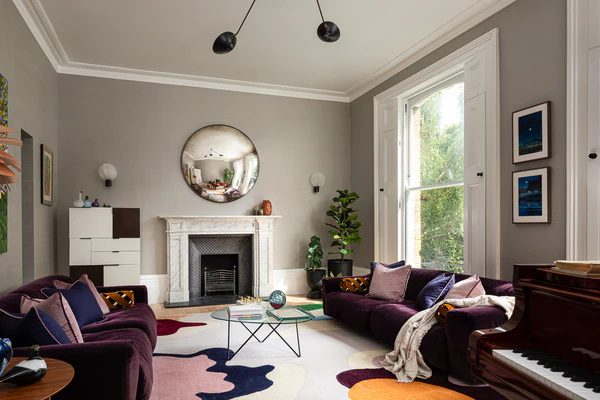
The entranceway is the beginning architectural statement of your home. It will set the stage for your style, create an atmosphere, and give visitors their first taste of who you are as far as your style goes. As far as traditional flat mirrors have always been part of your entryway, designers have lately started using fisheye or curved mirrors to add drama and history to that place.
A fish-eye or curved mirror placed at the end of your hallway will transform it from a utilitarian transition point into a special gallery. Unlike ordinary glass, curved glass will not only reflect whatever lies right in front of it but also the entire landscape of your architecture condensed into a single fish-eye view.
The Architectural Appeal of Curved Glass
The history of convex optics is a long and colourful one, beginning in the Renaissance period. Named initially “bankers’ mirrors” owing to their ability to offer wide-angle safety benefits in early European banks, they have come to signify luxury and opulence through the Regency and Federal eras. In the modern era, luxury convex wall mirrors combine the elegance of history with the minimalist design of today.
This phenomenon of bending is responsible for the physics of the mirror and creates a variety of benefits for entryways that include the following:
- Amplified Natural Light: Even the narrowest, darkest British hallways can feel brighter as the curved surface catches light from adjacent windows and disperses it into dim corners.
- The Illusion of Scale: By compressing the reflection of the entire room, the mirror tricks the eye into perceiving a grander, deeper spatial volume.
- Artistic Distortion: The slight, elegant warping at the edges transforms ordinary interior elements, such as staircases, arched doorways, and plaster moulding, into a surrealist painting.
Strategic Placement Guides for Maximum Impact
Hanging a curved mirror is more complicated than hanging a flat sheet of glass since the focal point is altered. The size, angle, and architectural surroundings are therefore the determining factors for the effectiveness of the mirror within the environment.
Navigating Narrow Corridors
In compact Victorian terraced hallways or modern apartments where space is at a premium, placing a massive piece of artwork can feel claustrophobic. A medium-sized curved mirror hung midway down a long corridor breaks up the monotony of flat walls. It creates a “window effect”, introducing an unexpected depth that makes the hallway feel twice as wide.
Styling Techniques: Balancing Frame and Furniture
A statement mirror needs careful styling so it can add beauty and not overpower the entryway design.
Material Contrast
The surface of your frame must deliberately differ from your wall finishing. For example, if the hallway is painted in dark, moody shades or decorated with pretty wallpaper, a gilt or brass-leaf frame will stand out gorgeously.
Then again, in crisp, limewashed modern rooms, black ebonised frames or gunmetal finishes offer a strong, graphic base. It’s best not to overfill the area under the mirror when you are decorating it.
The Rule of Three on the Console
Use an asymmetrical “rule of three” to keep the elements in balance without making them symmetrical.
- Vertical Element: To lead the gaze upward to the mirror, a tall, artistic vase with branches or dried flowers is an ideal choice.
- Horizontal Element: A stack of linen-bound art books to anchor the centre.
- Sculptural Object: A small marble bowl, a singular antique, or a candle to introduce a variance in texture.
Selecting the Right Dimensions and Scale
Choosing the correct size is a balance between your hallway’s physical constraints and the emotional atmosphere you wish to cultivate.
Mirror Diameter Best Suited For Visual Effect: 30cm – 45cm Small alcoves, tight cloakrooms, or stacked gallery walls. Acts as a subtle, jewel-like punctuation mark. 50cm – 70cm Standard British entryways over medium console tables. Provides a balanced focal point; ideal for everyday elegance. 80 cm and grand, double-height foyers and expansive feature walls. Delivers high-impact drama; dominates the space like an art piece.
Lighting the Reflection
Because convex glass reflects and scatters light, your lighting for an entryway will totally change if you have one. Straight, overhead spotlights may end up producing harsh and intense small areas of glare on a curved glass surface. So, you may want to use indirect and ambient light sources.
Also, placing a pair of wall lamps on each side of the mirror is a great way of making the reflection less strong and giving it a soft glow that nicely frames the mirror.
Creating a Lasting First Impression
The purchase of curved glass is a step towards everlasting architectural beauty. Unlike fashionable decor items that lose popularity after a season, the history as well as the design of these items keeps them very fashionable. They work as silent conversation starters that encourage people to stop, take a closer look, and admire the entire scene brought together in one gorgeous piece.
Finding a centrepiece capable of holding the foyer together is an extremely important task. A good strategy is to concentrate on products made by hand and having genuine historic features, as this guarantees the investment will be valuable forever. Those who desire to change their halls into outstanding examples of British artistry can start the exploration of the hand-turned frames and custom glass optics by The Convex Mirror Company, which will be their perfect guide towards designing an entryway that is grand in perspective yet very refined in detail.