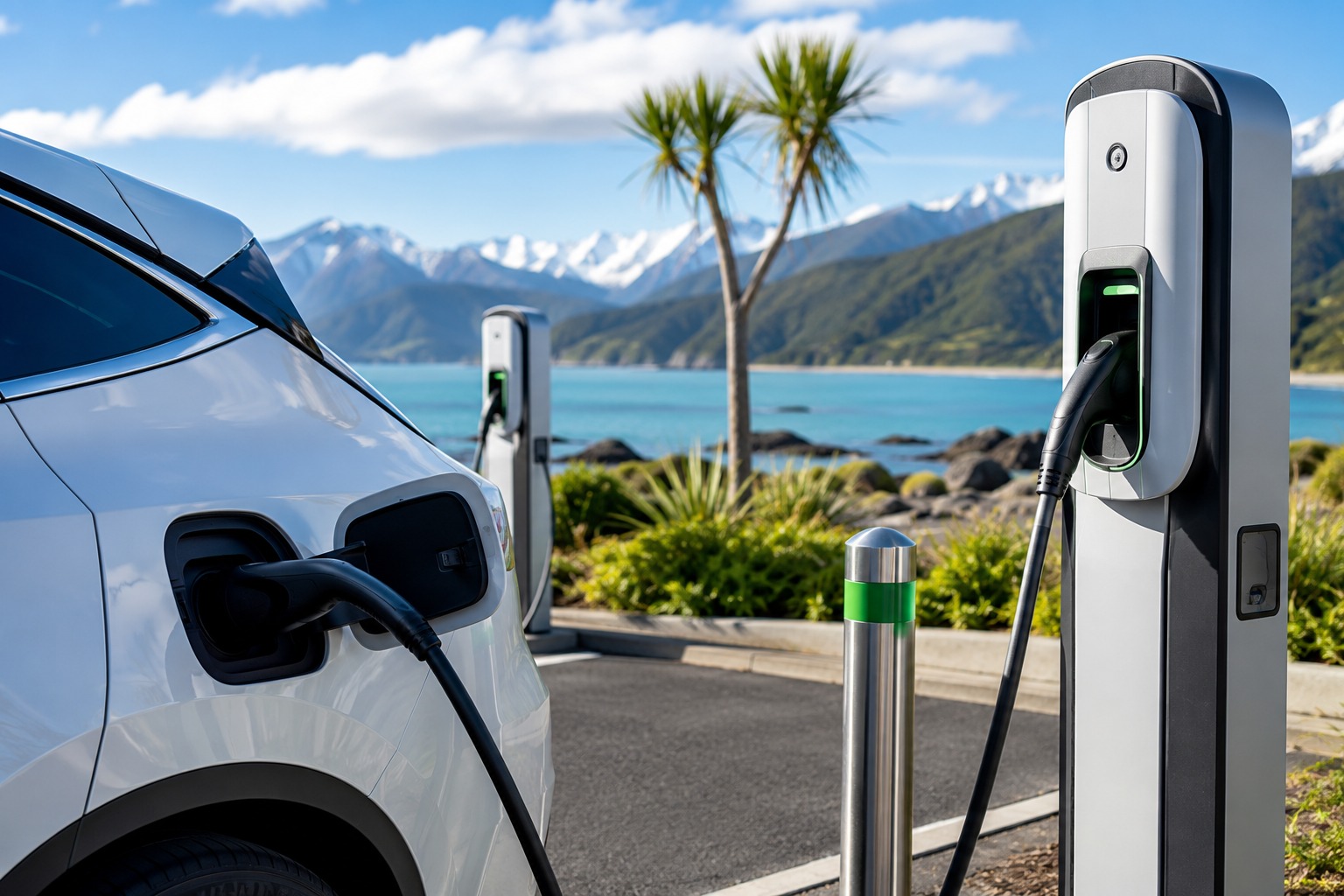
New Zealand’s EV charging story in 2026 is one of rapid change and honest growing pains. The country has just over 1,800 public EV charging stations — one of the lowest charger-to-EV ratios in the OECD. That number is about to shift dramatically. The Government is backing the rollout of more than 2,500 new charge points through $52.7 million in zero-interest loans, with $60 million in co-investment from ChargeNet and Meridian Energy to accelerate deployment. For Kiwi drivers, this is both promising and practical — the network you use today looks different from the one you’ll be using in two years. Here’s what matters right now.
The Basics: What Actually Happens When You Plug In
A public EV charging station pulls electricity from the grid and transfers it into your car’s battery through a cable. That much is simple. What most drivers don’t realise is that the type of current being delivered determines everything — how fast you charge, which cable fits, and how much you pay.
AC chargers send alternating current to the vehicle. The car’s own onboard charger then converts that to DC, which is what the battery actually stores. This conversion step is what makes AC chargers slower — the bottleneck is inside your car, not the station.
DC fast chargers skip the conversion entirely. They push direct current straight to the battery, which is why a 50-minute highway charge is possible where an AC charger at the same power level would take hours.
The speed you actually get depends on two numbers: the station’s output and your car’s maximum acceptance rate. Whichever is lower wins.
What the Three Charger Types Look Like in Practice
Not all public EV charging stations are built for the same purpose. NZ’s network is divided into three categories — and knowing which one you’re at changes your expectations completely.
| Charger Type | Power Range | Typical Time to Add 100km | Where You’ll Find Them |
|---|---|---|---|
| AC Destination | 7–22 kW | 1–3 hours | Shopping centres, gyms, workplaces |
| DC Rapid | 25–75 kW | 15–25 minutes | Town centres, service stations |
| DC Hyper-Rapid | 100–300 kW | 5–12 minutes | State highways, major routes |
The new rollout planned for New Zealand includes 1,374 DC fast chargers targeted at high-turnover locations such as highways, and 1,200 AC chargers suited to workplaces and residential areas where drivers park for longer periods.
The practical upshot: if you’re stopping for coffee on a road trip, you want a DC rapid or hyper-rapid nearby. If you’re parked at a mall for two hours, an AC charger is perfectly adequate and often cheaper.
Connectors: Match Your Car Before You Drive
This is where new EV drivers get caught out most often. New Zealand’s public charging network uses multiple connector types, and not every station fits every car.
| Connector | Current Type | Typical NZ Vehicles |
|---|---|---|
| Type 2 | AC slow | Most NZ-new EVs, Hyundai Ioniq, BYD Atto 3, Tesla Model 3/Y |
| CCS2 | DC fast | NZ-new Teslas, Hyundai Ioniq 5, Kia EV6, VW ID.4, BMW iX |
| CHAdeMO | DC fast | Older Nissan Leaf, Mitsubishi Outlander PHEV (Japanese import) |
| Type 1 (J1772) | AC slow | Older Japanese-import EVs and PHEVs |
One important note for Nissan Leaf owners: CHAdeMO fast chargers remain available across the network today, but the standard is not expanding. New fast-charge installations in New Zealand are CCS2. If your next vehicle is still being decided, connector future-proofing is worth factoring in.
For AC charging, most public stations provide a Type 2 socket but not a cable — you’re expected to carry your own. DC fast chargers have tethered cables built into the unit.
The Network Is Fragmented — Here’s How to Navigate It
New Zealand’s charging network is not a single utility. It comprises multiple operators and payment systems, and most require you to use the operator’s own app to locate a charger, unlock a session, and pay.
The major networks operating across NZ in 2026:
- ChargeNet — largest nationwide fast-charge network, over 520 sites
- Meridian — recently hit its 500th public charging point, with a focus on South Island expansion and plans for 900 more charge points by 2030
- Jolt — urban AC chargers with a free daily 7 kWh allowance
- Z Energy and BP Charge — DC fast chargers integrated into petrol station forecourts
- Tesla Superchargers — select sites now open to non-Tesla vehicles
Practically speaking, download at least two apps before a long trip: one for your primary fast-charge network and PlugShare for real-time availability and fault reports across all operators.
What You’ll Pay at a Public Charging Station in 2026
Public charging costs more than home charging — and the gap matters more at some charger types than others.
From April 2026, ChargeNet’s fast chargers (25kW–75kW) charge at 90 cents per kWh, and hyper chargers (150kW and above) at 95 cents per kWh. Some ChargeNet chargers in remote or small-town locations sit at $1.15 per kWh.
Topping up 30 kWh at a DC fast charger — enough for roughly 150 to 200km of range — costs around $24 at current ChargeNet rates. The same 30 kWh at home costs approximately $9 to $10 on a standard residential plan.
For everyday driving, AC destination chargers — many still free at supermarkets and some retail locations — keep costs low. Reserve DC fast charging for road trips where time is the priority, not cost.
One caveat worth repeating: network pricing in NZ changes without much notice. Always verify current rates in the operator’s app before planning a long trip.
Why the 80% Mark Is the Smart Stop Point
Most experienced EV drivers don’t charge to 100% at public stations, and there’s a solid reason for it.
Lithium-ion batteries slow their own charging rate above 80% to protect long-term cell health. That final 20% can take nearly as long as the first 80%. At a busy highway charger, sitting connected after 80% blocks the bay for another driver without meaningful benefit to your own trip.
Stop at 80%, move your car, and continue. It’s faster, cheaper, and kinder to both your battery and the driver waiting behind you. ChargeNet also now applies a $1 per-minute idle fee if your vehicle remains connected five minutes after a session ends — so there’s a financial incentive to move promptly too.
What’s Changing Right Now in 2026
The NZ charging landscape is shifting faster than most drivers realise, and two changes are worth knowing about.
First, the consenting barrier is gone. From May 7, 2026, amendments to the National Environmental Standards removed the need for resource consents for standard EV charging installations, replacing fragmented local council rules with nationally consistent permitted activity standards. New chargers can now be installed in weeks rather than months.
Second, the investment pipeline is real. ChargeNet has been awarded $37.7 million in concessionary loans — which it will match dollar-for-dollar — to roll out over 1,700 new charging points across the country by 2030. For drivers, this means the regional coverage gaps and highway availability issues that exist today will close considerably over the next few years.
EVSE NZ: Charging Solutions Built for New Zealand
Whether you’re a business owner adding chargers for staff and customers, a fleet manager planning the shift to electric, or a driver wanting reliable home charging to complement the public network, EVSE NZ delivers end-to-end EV charging solutions designed for New Zealand conditions. From hardware supply through to full installation and ongoing support, EVSE NZ helps Kiwis charge with confidence.