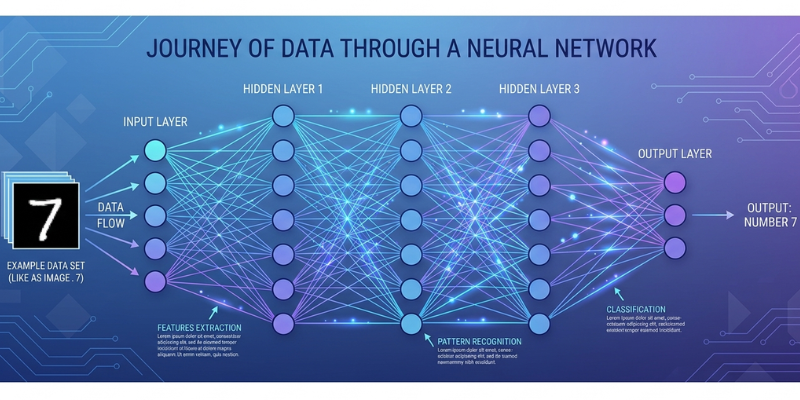
Artificial intelligence has become a major force behind modern technology. From recommendation systems to voice assistants, many smart applications rely on neural networks to process information and make decisions. Understanding how data moves through a neural network is an important step for anyone beginning their AI learning journey. If you want structured guidance and practical skills, consider exploring the Artificial Intelligence Course in Mumbai at FITA Academy to strengthen your understanding further.
A neural network is a machine learning model inspired by the way the human brain processes information. It comprises interconnected units known as neurons that collaborate to examine data. These neurons are organized into layers, with each layer serving a distinct purpose in converting input data into valuable outputs.
Understanding the Input Layer
The journey of data begins at the input layer. This layer receives raw information that the neural network needs to process. Depending on the application, the input could be numbers, text, images, or other forms of data.
Each input value is passed to the next layer for further analysis. The input layer itself does not perform complex calculations. Its main responsibility is to transfer data into the network so that learning and prediction can take place.
How Hidden Layers Process Information
After entering the network, data moves through one or more hidden layers. These layers are responsible for identifying patterns and relationships within the data. Every neuron in a hidden layer receives information, performs calculations, and sends the result to the next layer.
The network assigns weights to connections between neurons. These weights determine the importance of specific pieces of information. During training, the neural network adjusts these weights to improve accuracy and produce better results.
Hidden layers allow the model to detect complex patterns that may not be obvious at first glance. This ability allows neural networks to excel in tasks like image recognition, language processing, and forecasting. If you would like to build hands-on expertise in these concepts, you can take the AI Course in Kolkata and gain deeper knowledge through guided learning experiences.
The Role of Activation Functions
As data passes through hidden layers, activation functions help determine whether a neuron should pass information forward. These functions introduce flexibility into the learning process and enable the network to handle complex problems.
Without activation functions, neural networks would struggle to learn advanced patterns. They help the model make decisions by highlighting important information while reducing the impact of less relevant details.
Activation functions are essential in empowering deep learning systems to carry out tasks related to classification, prediction, and decision-making.
Moving Toward the Output Layer
Once data has been processed through the hidden layers, it reaches the output layer. This is the point at which the network generates its ultimate prediction or outcome.
For example, if a neural network is trained to identify animals in images, the output layer may indicate whether the image contains a cat, dog, or another animal. The output is generated based on everything the network learned while processing the data.
The accuracy of the outcomes depends on the caliber of the training data, the design of the network, and the effectiveness of the learning procedure.
Learning Through Feedback
Neural networks improve through a process called training. During training, the model compares its predictions with the correct answers. Any differences between the prediction and the actual result are treated as errors.
The network then adjusts its weights to reduce these errors. This process repeats many times until the model becomes more accurate. With each cycle, the neural network learns how to make better predictions from similar data.
This continuous improvement process is one of the key reasons why neural networks are powerful tools in artificial intelligence.
The journey of data through a neural network begins with the input layer, continues through hidden layers, and ends at the output layer. Along the way, neurons perform calculations, activation functions guide decisions, and training helps improve performance. Understanding this flow provides a strong foundation for learning machine learning and deep learning concepts. If you are ready to advance your skills and work with real-world AI technologies, you can join AI Courses in Delhi to continue building your expertise with confidence.