As organizations continue adopting cloud technologies, SAP Business Technology Platform (SAP BTP) has become a preferred platform for integration, application development, analytics, automation, and AI. Unlike traditional software licensing, SAP BTP offers a consumption-based pricing model, where businesses pay according to the services and resources they actually use rather than purchasing fixed licenses. This approach provides greater flexibility, but it also makes budgeting more challenging.
Forecasting your SAP BTP spending through 2027 requires more than estimating monthly usage. Businesses need to understand how cloud credits, service consumption, user growth, and new digital transformation initiatives influence costs over time. SAP currently offers multiple commercial models, including SAP BTP Enterprise Agreement (BTPEA), Cloud Platform Enterprise Agreement (CPEA), and Pay-As-You-Go, each designed for different business requirements. Organizations can monitor usage through the SAP BTP Cockpit, where dashboards provide estimated monthly costs, historical trends, and consumption insights to improve financial planning.
Understanding SAP BTP’s Consumption-Based Pricing Model
The consumption-based pricing model gives businesses the flexibility to activate only the services they need. Instead of purchasing separate licenses for every capability, organizations consume cloud services such as Integration Suite, SAP Build, AI services, databases, analytics, and application runtimes from a shared pool of cloud credits or through monthly pay-as-you-go billing.
This model benefits companies whose requirements evolve over time because they can easily scale services up or down. However, the same flexibility can lead to unexpected expenses if consumption is not monitored regularly. Development environments left running, growing API traffic, increased storage, or expanding AI workloads can all increase monthly costs without immediate visibility. SAP recommends continuous monitoring of usage and costs to avoid overages and improve forecasting accuracy.
Why Forecasting SAP BTP Costs Matters
Accurate forecasting helps organizations maintain financial control while supporting innovation. Without a structured forecasting process, businesses may exhaust prepaid cloud credits sooner than expected or experience higher monthly bills under Pay-As-You-Go.
A practical forecast should consider:
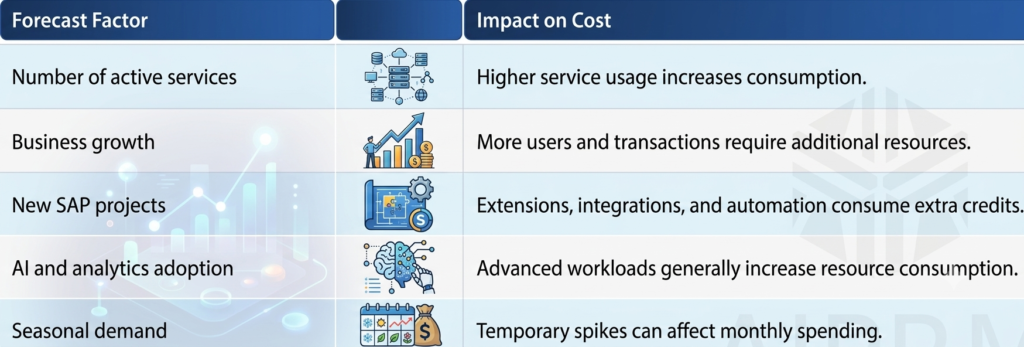
Organizations planning digital transformation initiatives through 2027 should review project roadmaps alongside historical usage data. Combining technical planning with financial forecasting provides a much more reliable estimate than relying solely on previous invoices.
Practical Steps to Forecast SAP BTP Spend
The first step is to review historical consumption. The SAP BTP Cockpit provides monthly usage reports, cost trends, and consumption summaries that reveal which services generate the highest expenses. These insights allow organizations to identify recurring patterns and estimate future resource requirements.
Next, align your forecast with upcoming business initiatives. For example, if your organization plans to deploy new SAP integrations, implement low-code applications, or expand analytics capabilities, include those anticipated workloads in your budget. Each new service contributes to overall cloud credit consumption.
Regular monitoring is equally important. Rather than waiting for quarterly financial reviews, organizations should evaluate consumption monthly. SAP’s monitoring tools even provide forecasted consumption views for eligible commercial models, helping businesses identify potential overages before they occur.
Cost Optimization Best Practices Through 2027
Organizations can improve forecasting accuracy and control spending by following several best practices:
- Choose the commercial model that aligns with your business needs.
- Review monthly consumption reports and compare them with project plans.
- Remove unused services and development resources.
- Set governance policies for provisioning new environments.
- Monitor cloud credits before they approach exhaustion.
- Reassess forecasts whenever new business initiatives begin.
Many organizations also establish internal governance teams responsible for reviewing SAP BTP usage across departments. This ensures resources are allocated efficiently while reducing the risk of unnecessary consumption.
Conclusion
SAP BTP consumption-based pricing provides the flexibility businesses need to innovate without committing to fixed infrastructure costs. At the same time, successful adoption depends on effective cost forecasting and continuous monitoring. By understanding how services consume cloud credits, reviewing historical usage, aligning budgets with future projects, and using SAP’s built-in monitoring capabilities, organizations can create more predictable financial plans through 2027.
A proactive forecasting strategy not only prevents unexpected expenses but also enables businesses to maximize the value of their SAP BTP investment while supporting long-term digital transformation initiatives.