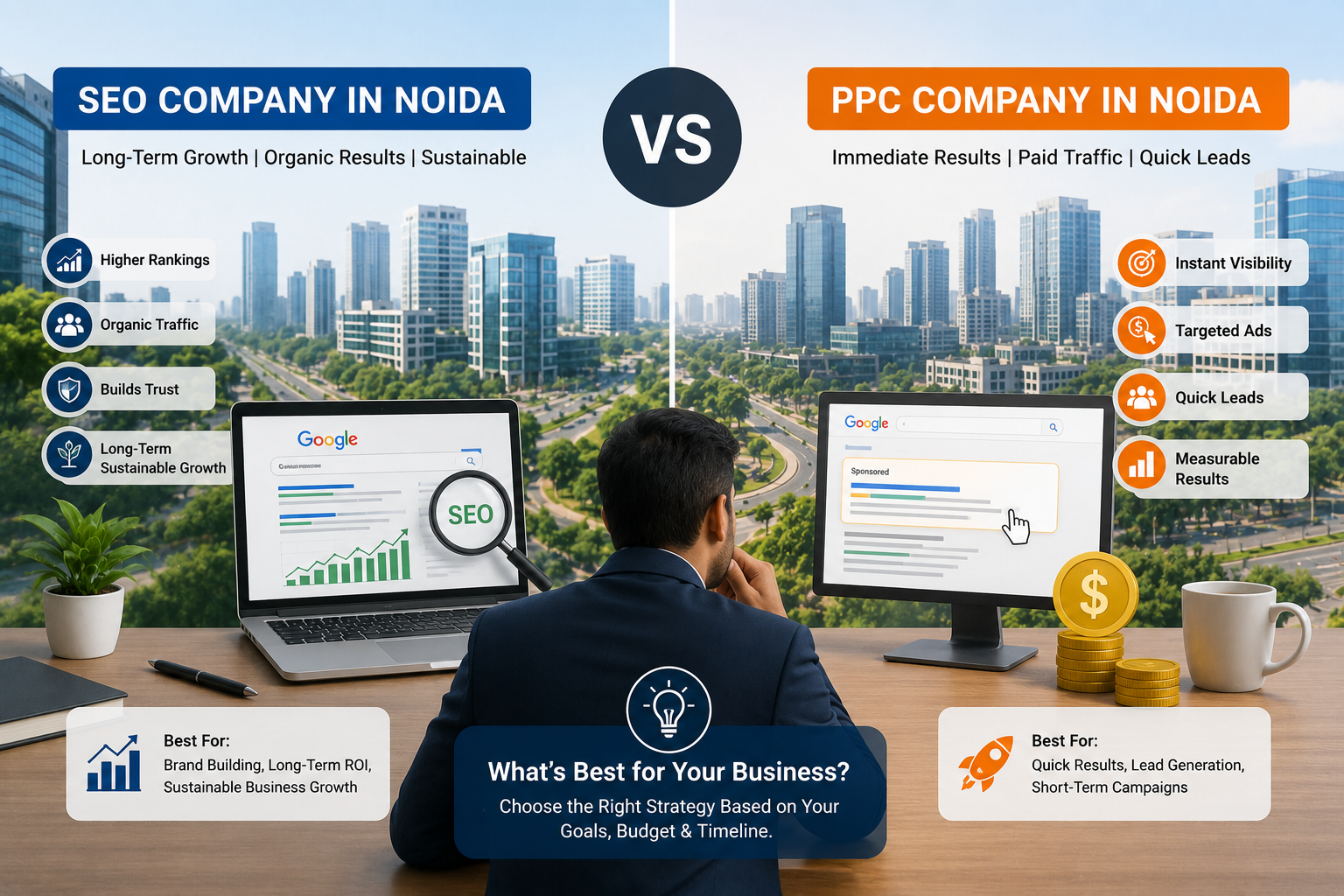
Every business owner eventually faces the same question: should we invest in SEO, PPC, or both? It’s one of the most common conversations we have with clients, and there’s no one-size-fits-all answer. The right choice depends on your timeline, budget, industry, and growth goals.
This guide breaks down exactly how SEO and PPC differ, when each makes sense, and why the businesses that grow fastest usually end up using both strategically rather than picking one over the other.
Understanding the Core Difference
SEO (Search Engine Optimization) is the process of earning organic, unpaid visibility in search results through website optimization, content, and authority building. It’s a long-term investment that compounds over time.
PPC (Pay-Per-Click) is paid advertising where you bid on keywords and pay each time someone clicks your ad. It delivers immediate visibility but stops the moment you stop paying.
Neither is inherently “better” — they solve different problems. A SEO Company in Noida focuses on sustainable, long-term growth, while a PPC Company in Noida focuses on immediate, measurable lead generation. Understanding when each fits your business is the real key to smart marketing decisions.
SEO vs PPC: Side-by-Side Comparison
| Factor | SEO | PPC |
|---|---|---|
| Cost structure | Ongoing investment in strategy and content | Pay per click, budget-controlled |
| Time to results | 3–6+ months | Immediate (days) |
| Longevity | Long-term, compounding | Stops when budget stops |
| Trust factor | Higher perceived credibility | Lower, seen as “ad” |
| Click-through rate | Strong for top organic positions | Solid but generally lower than top organic |
| Targeting precision | Broad, based on content relevance | Highly precise (location, device, time, audience) |
| Scalability | Gradual, based on content and authority growth | Instant, based on budget increase |
| Risk level | Lower long-term risk | Budget can be wasted quickly without expertise |
Cost Comparison: What You’re Actually Paying For
SEO Costs
SEO pricing typically covers strategy, content creation, technical optimization, and link building, usually billed as a monthly retainer. You’re paying for expertise and ongoing work rather than the traffic itself — meaning your cost per visitor decreases over time as rankings and content assets grow.
PPC Costs
PPC costs include both your ad spend (paid directly to Google) and your agency’s management fee. Average cost-per-click on Google Search has been trending upward, with cross-industry averages recently ranging roughly between $2.96 and $4.22 globally, though costs vary significantly by industry and location. Unlike SEO, this cost never fully disappears — every click requires payment, regardless of how long your campaign has been running.
Which Is Cheaper Long-Term?
In the short term, PPC often feels more expensive per lead because you’re paying for every single visitor. Over the long term, SEO typically becomes more cost-efficient, since organic rankings continue generating traffic without a per-click cost — though it requires patience and sustained investment to get there.
Timeline for Results
SEO Timeline
- Months 1–2: Technical audit, keyword research, and foundational fixes
- Months 3–4: Initial ranking movement for lower-competition keywords
- Months 5–6: Noticeable traffic growth and improved visibility
- Months 6–12+: Compounding growth as content and authority build
PPC Timeline
- Day 1: Campaigns can go live and start generating clicks immediately
- Week 1–2: Initial data collection on which keywords and ads perform best
- Weeks 3–4: Optimization based on early performance data
- Month 2 onward: Refined targeting and improved cost efficiency
If your business needs leads this month, PPC is the clear choice. If you’re building toward sustainable growth over the next year and beyond, SEO delivers far greater long-term value.
Lead Quality Comparison
SEO Lead Quality
Organic search traffic tends to be highly intent-driven — people actively searching for information or solutions, often further along in their decision-making process. Because organic results are trusted more than ads, leads from SEO often convert at strong rates and arrive with a baseline level of trust already established.
PPC Lead Quality
PPC lead quality depends heavily on targeting precision. Well-optimized campaigns with tight keyword targeting and strong negative keyword lists can generate excellent, high-intent leads. Poorly managed campaigns, on the other hand, can attract clicks from users who were never genuinely interested, especially with broad match keywords or weak audience targeting.
The Real Difference
SEO leads tend to trust your brand more because they found you organically. PPC leads convert faster because you can target extremely specific search intent and demographics — but that precision requires ongoing management to maintain.
ROI Analysis
How SEO ROI Builds Over Time
SEO’s ROI curve starts slow and accelerates. In the early months, you’re investing without significant returns. But as content accumulates and rankings stabilize, the cost per lead drops steadily, since you’re no longer paying for each individual visitor.
How PPC ROI Works
PPC ROI is more immediate and predictable in the short term, but it’s linear rather than compounding — double your budget, and you roughly double your traffic (assuming efficient targeting). Google’s own economic research suggests advertisers see strong returns, with studies citing roughly $8 in value generated for every $1 spent, though actual results vary significantly by industry and execution quality.
Combined ROI
Businesses that run both strategies together often see the strongest overall ROI, using PPC for immediate cash flow and market testing while SEO builds toward long-term, lower-cost growth.
Advantages and Disadvantages
SEO Advantages
- Builds long-term, sustainable traffic
- Higher trust and credibility with users
- Lower cost per lead over time
- Content remains a lasting business asset
SEO Disadvantages
- Takes months to show meaningful results
- Requires ongoing content and technical investment
- Rankings can be affected by algorithm changes
- Harder to control exact traffic volume in the short term
PPC Advantages
- Immediate visibility and traffic
- Precise targeting and budget control
- Easy to test offers, messaging, and audiences quickly
- Highly measurable, with clear cost-per-lead data
PPC Disadvantages
- Traffic stops the moment budget stops
- Costs can rise with competition
- Requires ongoing management to stay efficient
- Ad fatigue can reduce performance over time without fresh creative
Ideal Strategy by Business Type
Startups
Early-stage businesses often need visibility and validation quickly. PPC allows startups to test messaging, pricing, and audience response in real time, while SEO content can be built in parallel to establish long-term brand presence without competing for immediate budget.
Local Businesses
Local businesses — clinics, real estate agencies, home services — often benefit most from a combined approach: local SEO and Google Business Profile optimization to build steady organic visibility, paired with geo-targeted PPC campaigns for immediate lead generation during peak demand periods. A SEO Company in Greater Noida familiar with the local commercial landscape can be especially valuable here, since hyperlocal targeting increasingly determines visibility in specific neighborhoods and sectors.
eCommerce Businesses
eCommerce brands typically need both working simultaneously — PPC (especially Google Shopping campaigns) drives immediate sales and product visibility, while SEO content and category page optimization build long-term organic traffic that reduces dependency on ad spend for every sale.
Enterprises
Larger businesses with bigger budgets often run both strategies at scale, using PPC for new product launches, seasonal campaigns, and competitive keyword capture, while maintaining a dedicated SEO program to build domain authority and reduce overall customer acquisition costs across the business.
Why Combining SEO and PPC Delivers the Best Long-Term Results
Shared Keyword Data Improves Both Strategies
PPC campaigns generate fast keyword performance data — which terms convert, which don’t — that can directly inform SEO content priorities, saving months of guesswork.
Increased SERP Real Estate
Appearing in both organic results and paid ads for the same search increases your overall visibility and click-through rate, since your brand occupies more of the search results page.
Brand Trust Reinforcement
Seeing your business appear in both an ad and an organic listing reinforces credibility, making users more likely to click and convert compared to seeing just one or the other.
Balanced Risk and Reward
PPC delivers short-term results while SEO is still building momentum, reducing the pressure of waiting months for organic traffic to materialize while ensuring long-term costs decrease over time.
2026 Digital Marketing Trends Shaping Both Strategies
AI Overviews Are Reshaping Organic Visibility
Google’s AI-generated overviews are increasingly answering queries directly within search results, which has measurably reduced click-through rates to top organic listings in many categories. This makes structuring content clearly for AI systems — not just traditional rankings — increasingly important for SEO strategy.
AI-Driven Bidding Dominates PPC
Most competitive PPC campaigns now rely on AI-driven bidding strategies rather than manual bid management, with automated systems evaluating conversion probability across countless real-time signals.
Brand Signals Matter Across Both Channels
Businesses with strong brand recognition and third-party mentions are proving more resilient to both algorithm changes in organic search and rising costs in paid search, since branded searches typically convert better and cost less.
Video and Visual Content Growth
Both organic and paid search results increasingly favor visual and video content, with video now representing a substantial and growing share of total digital ad spend.
First-Party Data Becomes Essential
As third-party cookie reliance declines, businesses integrating their own customer data into PPC targeting are seeing more accurate results — a trend that also reinforces the value of building an engaged, returning audience through strong SEO content.
Frequently Asked Questions
Should I start with SEO or PPC first? If you need leads immediately, start with PPC while building SEO in parallel. If you have a longer runway and want to build sustainable, lower-cost traffic, prioritize SEO early and consider PPC as your budget allows.
Is PPC a waste of money if I already rank well organically? Not necessarily. Running PPC alongside strong organic rankings can increase total SERP visibility and capture additional clicks, particularly for high-value or competitive keywords.
How much should I budget for SEO versus PPC? This depends on your goals and timeline, but many businesses start with a heavier PPC allocation for immediate results, gradually shifting budget toward SEO as organic traffic grows and reduces reliance on paid clicks.
Can a small business afford to do both SEO and PPC at once? Yes, many small businesses run modest PPC campaigns focused on high-intent keywords while investing in foundational SEO work, scaling both as results and budget allow.
Which strategy delivers better ROI in the long run? SEO generally delivers stronger ROI over the long term due to compounding organic traffic, while PPC delivers faster, more predictable short-term returns. Combining both often produces the strongest overall results.
Do I need separate agencies for SEO and PPC, or one that does both? Many businesses prefer working with an agency that offers both best seo services in Noida and PPC management, since a unified strategy allows shared data and messaging consistency across paid and organic channels.
Conclusion
SEO and PPC aren’t competitors — they’re complementary tools that solve different problems. SEO builds lasting, cost-efficient visibility that compounds over time, while PPC delivers immediate, precisely targeted traffic when you need results now. Startups, local businesses, eCommerce brands, and enterprises all benefit from understanding exactly where each strategy fits into their broader growth plan.
The businesses that grow fastest and most sustainably are rarely the ones choosing between SEO and PPC — they’re the ones using both strategically, guided by real data and clear goals. Whether you’re evaluating a top SEO company in Noida, a dedicated PPC Agency in Noida, or a team capable of managing both, the right partner will help you build a strategy tailored to your timeline, budget, and business goals.
Ready to figure out the right mix of SEO and PPC for your business? Reach out today for a free consultation and get a customized growth strategy built around your specific goals.