For historical reenactors, museum curators, and dedicated military collectors, stepping into the past requires more than just passion—it requires historical accuracy down to the very last stitch. The Second World War remains one of the most heavily studied and visually distinct eras in human history. Whether you are preparing for a living history event, setting up a museum exhibit, or supplying a film production, knowing how and where to buy world war 2 uniforms that truly look, feel, and wear like originals is paramount.
At Replicamilitary, we are dedicated to preserving history through exceptional craftsmanship. In this guide, we will break down what you need to look for when investing in World War II reproductions and how to ensure your impression stands up to the closest inspection.
Why Quality and Materials Matter
When you look to buy world war 2 uniforms, it can be tempting to opt for cheap, mass-produced costumes. However, true historical reenactors know that there is a vast difference between a theatrical costume and a museum-grade reproduction.
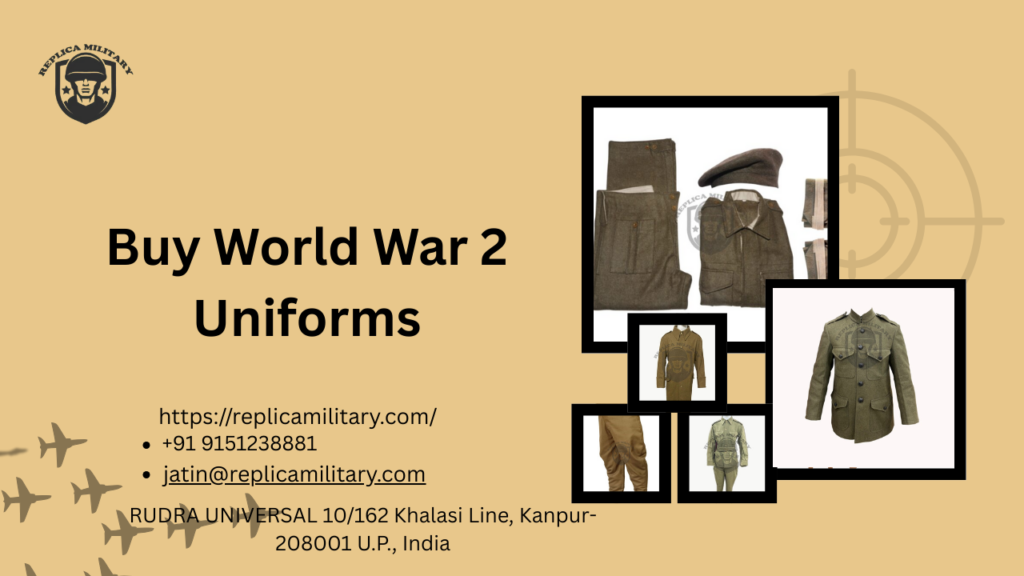
Authentic WWII uniforms were built to survive the harshest conditions, from the freezing forests of the Ardennes to the humid jungles of the Pacific. To achieve this level of realism, reproductions must be built from the ground up using the correct textiles:
- Period-Correct Wool: British Battledress, German Feldblusen, and US Army woolens were made from heavy, dense, and often coarse wool blends. A high-quality reproduction must match the weight and texture of these original fabrics.
- Authentic Cotton Twill & HBT: For summer or tropical impressions, such as the British Aertex bush jackets or US Army Herringbone Twill (HBT) utility suits, the weave of the fabric must be exactly right to capture the distinct drape and breathability of the era.
Key Elements of a High-Quality Reproduction
A flawless impression depends entirely on the finer details. Keep these critical elements in mind when shopping for your gear:
1. Accurate Dye Shades
Militaria enthusiasts know that “Olive Drab,” “Khaki,” and “Feldgrau” aren’t just single colors—they represent a massive spectrum of shades that changed based on the year of production, theater of war, and manufacturer. A premium provider like Replicamilitary meticulously matches these color variations to ensure your uniform looks authentic to the specific unit and year you are portraying.
2. Hardware and Internal Construction
The outside of a uniform only tells half the story. True museum-grade garments feature the correct period hardware—such as stamped steel buttons, brass dish buttons, or zinc eyelets. Furthermore, the internal construction, including the correct cotton canvas linings, bandage pockets, and suspension hooks, should closely mirror original archival patterns.
Popular WWII Uniforms Common in Reenactment
| Nation & Unit | Key Uniform Components | Notable Features |
| British Army | M1937/M1940 Battledress | Short, cropped wool jacket; pleated map pockets; functional waist belt. |
| US Army | M1941 Field Jacket & HBTs | Utilitarian design; rugged zipper and button closures; breathable fabrics. |
| RAF / Commonwealth | Khaki & Aertex Tropical Gear | Lightweight weave; designed specifically for North African and Pacific theaters. |
Trust Your Impression to Replicamilitary
When you are ready to buy world war 2 uniforms, choose a partner who values history as much as you do. Replicamilitary operates a specialized workshop of master artisans who study original wartime garments to recreate the exact patterns, tailoring techniques, and silhouettes of the 1940s.
We offer custom bespoke sizing to ensure your uniform fits perfectly, providing the mobility and comfort needed for grueling weekend reenactments. With thousands of orders shipped to over 150 countries, we are proud to supply collectors, reenactors, and film studios worldwide. Explore our World War II collection today and step into history with absolute confidence.