
Manufactured housing has played a central role in East Tennessee’s residential landscape for more than half a century. At various points in the region’s history, mobile homes and manufactured housing units provided affordable, rapidly deployable housing for working families across Knox, Blount, Anderson, and surrounding counties. Many of those units, installed in the 1960s through the 1980s, remain on the same parcels where they were originally placed — some well-maintained, many deteriorating, and a significant number reaching the end of what any reasonable renovation budget can address.
The question of whether to renovate or remove a manufactured home is one that thousands of East Tennessee property owners face each year, and it is rarely simple. The answer involves the age and condition of the structure, the cost of required repairs versus the value of the repaired structure, the property’s highest and best use, the owner’s financial position, and in some cases regulatory factors that close off the renovation option entirely. Getting this decision right — with clear information rather than hope or avoidance — is one of the most important financial decisions a manufactured home property owner can make.
Understanding the Regulatory Framework in Tennessee
Before examining structural and financial considerations, it is important to understand the regulatory framework governing manufactured housing in Tennessee — because that framework sometimes makes the renovation-versus-removal decision before you do.
Manufactured homes built before June 15, 1976 are often called “pre-HUD Code” homes. The federal Manufactured Home Construction and Safety Standards, established by HUD in 1976, set minimum construction standards for the first time. Homes built before that date were constructed without consistent federal oversight and vary enormously in quality, materials, and construction method.
Many Tennessee county building departments treat pre-HUD Code homes as non-conforming structures. This means that significant renovation work — exceeding approximately 50 percent of the structure’s assessed value under Tennessee’s substantial improvement rule — may trigger a requirement that the entire structure be brought into compliance with current code standards. For a pre-HUD Code home, that requirement is effectively impossible to meet within a practical renovation budget, which means a major renovation project can trigger a mandatory removal order rather than a path back to compliance.
Even for post-1976 manufactured homes, Tennessee’s substantial improvement rule applies under the National Flood Insurance Program in designated floodplain areas. If a manufactured home in a floodplain requires repairs exceeding 50 percent of its pre-damage value, NFIP regulations require that the repaired structure meet current elevation and construction standards — requirements that older manufactured homes typically cannot meet without complete replacement.
Before committing to major renovation of any older manufactured home in East Tennessee, a conversation with the relevant county’s building and zoning department is essential. Understanding how the substantial improvement rule applies to your specific structure in your specific location may reveal that the renovation path is not legally available — and that removal is the only compliant option.
The Structural Assessment: What to Look For
For manufactured homes not subject to automatic regulatory barriers, the structural assessment determines whether the renovation case has merit. A professional inspection from a contractor experienced with manufactured housing — not a standard residential home inspector — should evaluate each of the following systems carefully.
The chassis and undercarriage: the steel frame supporting a manufactured home is its structural backbone. Chassis corrosion is common in East Tennessee’s humid climate, particularly in homes sitting on moisture-retaining soil without adequate vapor barrier protection. Surface rust is cosmetic; through-corrosion compromising the structural integrity of chassis members is a different matter entirely. No amount of interior renovation addresses a compromised chassis.
The floor system: manufactured home floor systems use engineered wood products — particleboard or oriented strand board — that are highly susceptible to moisture damage. A single unaddressed plumbing leak can rot an entire section of floor system within months in East Tennessee’s humid environment. Replacing isolated sections of damaged subfloor is a reasonable repair. Replacing floor systems across multiple rooms in a home with potentially active moisture sources is expensive and often futile because it does not address the underlying moisture pathways that will damage the new material too.
The roof and ceiling: older manufactured home roofs use combinations of metal panels, asphalt shingles, and rubber coatings that all have finite lifespans. When multiple ceiling areas show active staining, insulation compression from repeated saturation, or visible structural sagging, the roof damage is typically extensive enough to require full replacement rather than targeted patching. In a home with other significant structural issues, full roof replacement cost must be weighed against the total renovation scope.
The marriage wall in double-wides: the connection between the two halves of a double-wide manufactured home is a frequent failure point. Once marriage wall separation has progressed significantly — evidenced by floors sloping toward the center, interior gaps at ceiling and floor lines, or exterior gaps visible between the two halves — the structural misalignment is difficult to correct economically and indicates broader settling that will continue regardless of repair attempts.
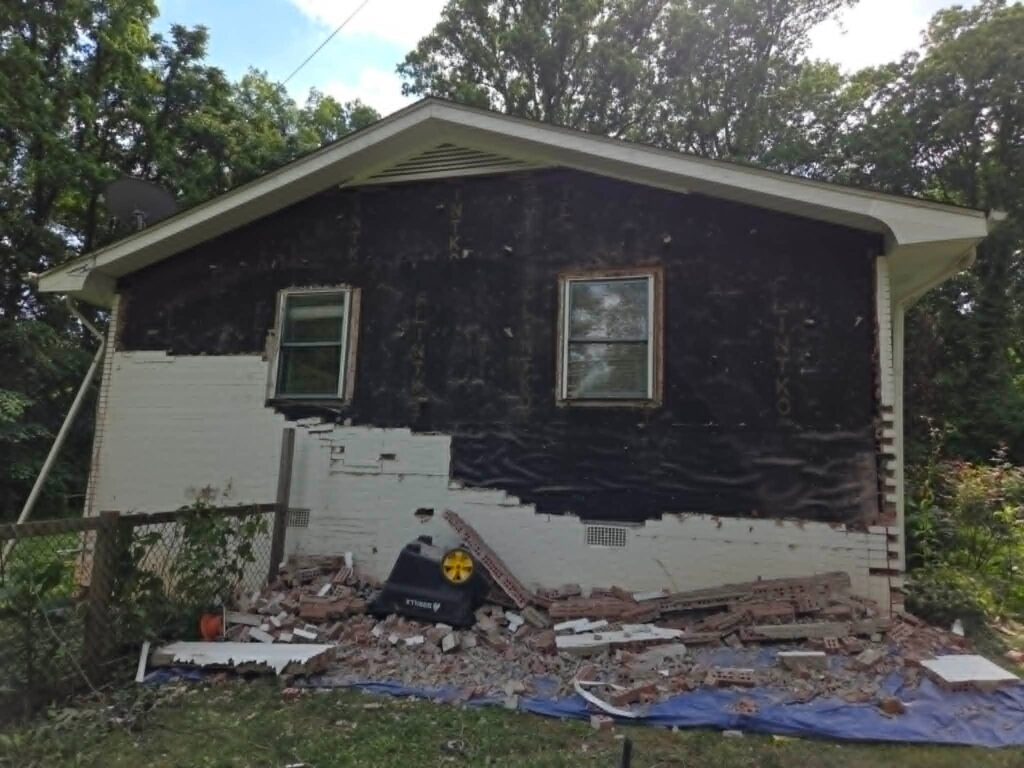
The Financial Threshold: When Renovation Becomes Irrational
Even without regulatory constraints, there is a financial threshold beyond which manufactured home renovation stops making economic sense: when the cost of required repairs approaches or exceeds the post-repair value of the structure itself.
Determining post-repair value requires separating the land value from the structure’s contribution to the combined property value. A manufactured home on owned land in Knox County has a combined value composed of the underlying land and the structure. The structure’s contribution is typically modest relative to a site-built home: a well-maintained post-2000 manufactured home on owned land might add $30,000 to $60,000 to the land’s value. An older, deteriorating unit may add nothing — or may actively subtract from the marketable value of the land, as buyers factor in their removal cost.
When major renovation estimates — chassis work, floor system replacement, full roof replacement, HVAC update, and plumbing and electrical remediation — accumulate to more than 60 to 70 percent of the structure’s post-repair contribution to property value, the economic case for renovation has collapsed. You are spending $40,000 to protect $20,000 of value while the land itself is worth more cleared than occupied by the deteriorating structure.
At this threshold, engaging expert mobile home demolition and removal specialists in Knox County to evaluate the all-in cost of a professional teardown gives you the other side of the comparison. When removal plus site preparation costs $10,000 to $18,000 and the cleared land is worth $25,000 to $40,000 more than the currently encumbered property, the financial case for removal is clear — even before accounting for the avoided ongoing cost of maintenance on a structure in terminal structural decline.
When Renovation Is the Genuine Answer
Renovation is not always the wrong answer, and it is important to be clear about when the math actually works. For post-1990 manufactured homes in generally sound structural condition — with localized damage from a specific contained event rather than systemic structural failure — renovation can be both economically sensible and practically achievable.
The renovation case is strongest when the structure is post-HUD Code and built after 1990; the chassis is sound with no significant corrosion; floor damage is isolated to one or two rooms with a clearly resolved moisture source; the roof is intact or requires only targeted repair; the marriage wall shows no separation; and the total fully-costed repair scope comes to less than 40 percent of the post-repair structure value.
For rental property investors, there is an additional consideration: cash flow timing. A renovated manufactured home generating $700 to $900 per month in rent on owned land in East Tennessee has a cash-on-cash return dynamic that can justify renovation costs that might look marginal on a pure equity analysis. If the renovation costs $15,000 and the alternative is an $18,000 demolition followed by a two-year cleared lot carry while financing new construction, the renovation that restores rental income in three months may be the better business decision even if the structure’s intrinsic value contribution is modest and declining.
A Decision Framework for Making the Choice
The renovation-versus-removal decision is best made by assembling three quotes simultaneously: a comprehensive structural inspection from a manufactured-home-experienced inspector; a full renovation scope quote from a contractor who works regularly on manufactured homes; and a demolition and site preparation quote from a licensed Tennessee demolition contractor.
With all three documents in hand, the decision matrix is straightforward. If the renovation quote exceeds 60 percent of the post-repair structure value — defined as the property’s combined value after renovation minus the underlying land value — removal is the economically rational choice. If the renovation quote is below 40 percent and the structure passes the key structural tests, renovation merits serious consideration. The 40 to 60 percent grey zone is where local market conditions, your holding strategy, and the relative availability of qualified renovation versus demolition contractors determine which path best fits your specific situation.
After the removal decision is made, the execution path involves permit application, utility disconnections, hazardous material survey for pre-1980 structures, abatement if necessary, physical demolition, debris haul-away, and site grading. Each step has its own timeline and each is sequential — you cannot begin the next until the current one is complete. The most common source of delay is utility disconnections, which typically run two to three weeks from first contact to completion when actively managed, and can extend to five or six weeks when not followed up consistently.