When discussing the uniform design of the Second World War, the spotlight frequently lands on the combat gear of major powers like Great Britain, Germany, or the United States. However, the smaller Allied nations possessed incredibly unique, fascinatingly transitional equipment that deserves equal attention. Chief among these is Belgium.
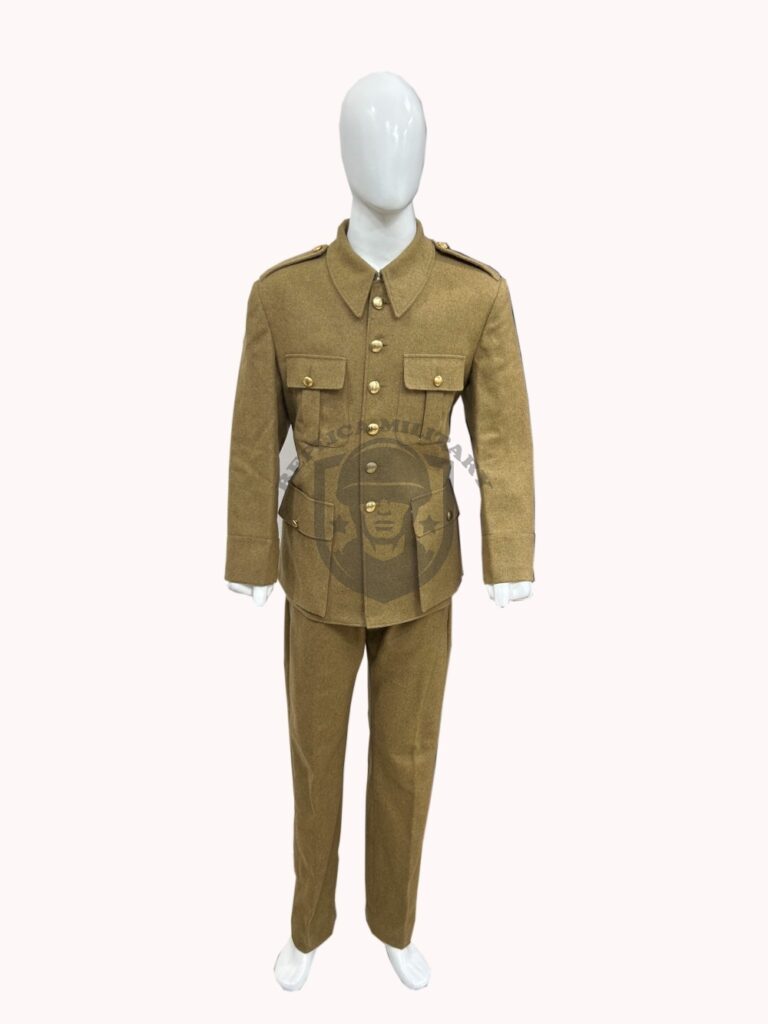
The WW2 Belgian military uniforms worn during the intense 18-Day Campaign in May 1940 represent a distinct evolutionary step in military fashion—blending classic French stylistic sensibilities with British-inspired utility. For historical collectors, reenactors, and military historians, these uniforms tell a gripping story of a nation caught between tradition and the rapid onset of modern blitzkrieg warfare.
The Anatomy of the 1940 Belgian Infantryman
At the outbreak of World War II, the Belgian Army’s appearance was heavily influenced by its experiences on the Western Front during the Great War. Rather than adopting the light khaki shades favored by the British, Belgium stuck to a distinct, dark Khaki-Green wool fabric that was uniquely theirs.
The M1935 Service Tunic and Trousers
The core of the WW2 Belgian military uniforms was the Model 1935 Tunic. Made of heavy, tightly woven wool serge to combat cold European winters, this tunic featured a high, stiff stand-and-fall collar, four large pleated pockets with scalloped flaps, and a hidden button fly to prevent snagging on equipment.
A defining feature of the Belgian tunic was its unique collar tabs, or pattes de col. These colorful insignia indicated the soldier’s regiment and branch of service (such as green for Chasseurs Ardennais or scarlet for standard infantry), often accompanied by brass numbers or regimental symbols. The trousers were typically straight-legged or slightly baggy breeches, tucked securely into wool puttees or heavy leather anklets.
Headgear: The Unique Adrian and the Chasseurs Beret
Perhaps the most recognizable element of the Belgian silhouette is the headgear.
- The M1931 Helmet: Heavily inspired by the French Adrian design, the Belgian Model 1931 steel helmet featured a distinct comb running along the top. However, it was easily distinguishable by a striking, stamped brass plate mounted on the front depicting a roaring lion’s head—the proud national symbol of Belgium.
- The Green Beret: The elite Chasseurs Ardennais—the legendary bicycle infantry tasked with defending the rugged Ardennes forest—wore a famous oversized green wool beret. This striking piece of headgear remains one of the most iconic symbols of Belgian resistance during the war.
Webbing and Field Equipment
Belgian field gear in 1940 was a robust mix of leather and canvas. Soldiers carried their ammunition in dual-compartment brown leather pouches attached to a heavy utility belt, supported by shoulder braces. Most infantrymen were issued the Mauser Model 1889 or the modernized Model 1935 rifle, and their gear was configured to carry matching bayonets and canvas haversacks containing gas masks, mess tins, and personal rations.
Honoring History with Replicamilitary
Because the Belgian campaign lasted just over two weeks before the country was occupied, surviving original pieces of these uniforms are incredibly rare, delicate, and difficult to source. For living history enthusiasts, museum curators, or filmmakers trying to depict the heroic defense of Belgium accurately, finding high-quality replicas is a notorious hurdle.
This is exactly where Replicamilitary bridges the gap. Renowned for their uncompromising dedication to historical preservation, Replicamilitary produces museum-grade, meticulously tailored reproductions of WW2 Belgian military uniforms. Every single piece—from the heavy, correctly dyed khaki-green wool of the M1935 tunic to the intricate regimental collar insignia and sturdy leather field gear—is constructed following original military patterns.
Whether you are looking to honor the fierce resilience of the Chasseurs Ardennais or complete a comprehensive European theater collection, trust Replicamilitary to deliver the absolute finest historical accuracy down to the very last stitch.