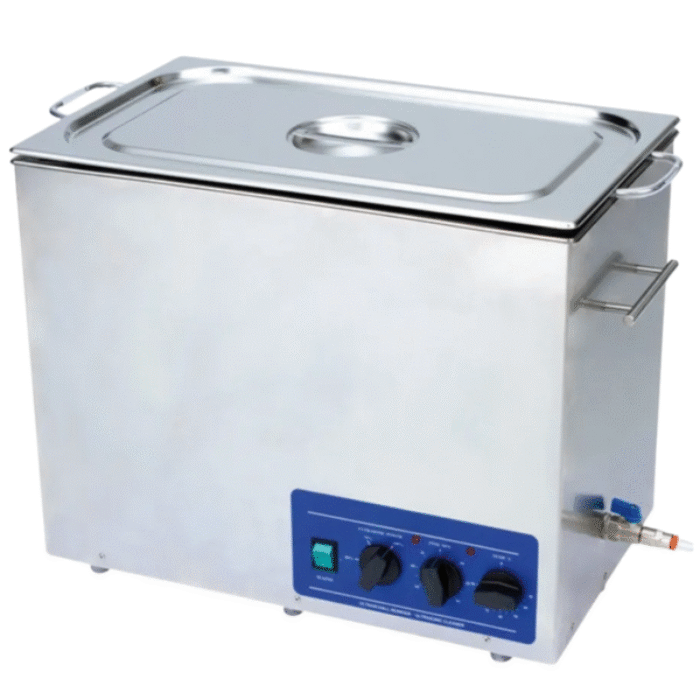
CNC-machined parts fail inspection for one avoidable reason more than any other: contamination. Coolant residue, cutting oil, swarf, and metal fines hide in threads, blind holes, and tight tolerances where manual wiping and solvent baths simply can’t reach. Ultrasonic cleaning solves this by using high-frequency sound waves to generate microscopic cavitation bubbles that implode against every surface — including the geometry your eyes and rags never see.
At Hisashi Industries, we’ve spent years helping machine shops, aerospace suppliers, and precision manufacturers eliminate rework, failed QC checks, and coating defects caused by inadequate part cleaning. This guide breaks down exactly how Ultrasonic Cleaners for CNC Components work, when to use them, and how to choose a system that matches your production reality — not just a spec sheet.
What is Ultrasonic Cleaning and Why CNC Shops Rely on It
Ultrasonic cleaning uses a transducer to convert electrical energy into high-frequency sound waves (typically 25–170 kHz), which pass through a liquid cleaning solution. These waves create millions of tiny vacuum bubbles through a process called cavitation. When the bubbles collapse, they release intense localized energy that dislodges contaminants from every surface the liquid touches.
For CNC components, this matters because machining leaves behind:
- Cutting and coolant oil films
- Metal chips, swarf, and fine particulate
- Buffing and polishing compounds
- Corrosion inhibitors and rust
- Carbon deposits from thermal processes
Traditional cleaning methods — brushing, spray washing, vapor degreasing — struggle with internal threads, cross-drilled holes, splines, and complex bores. This is exactly why more shops are switching to Ultrasonic Cleaners for CNC Components: cavitation bubbles form and collapse inside these features, delivering consistent cleanliness regardless of part geometry.
How Ultrasonic Cleaning Achieves Precision-Level Results
Precision cleanliness isn’t about scrubbing harder — it’s about controlling four variables correctly.
1. Frequency Selection
Lower frequencies (25–40 kHz) produce larger, more aggressive cavitation bubbles suited to heavy oil, grease, and cast or forged parts. Higher frequencies (68–170 kHz) create finer, gentler bubbles ideal for delicate components, fine threads, and polished surfaces where surface etching must be avoided.
2. Cleaning Solution Chemistry
Water-based alkaline or neutral detergents formulated for metals dissolve oils and emulsify particulate without leaving residue. The right chemistry depends on the base metal — aluminum, stainless steel, brass, and hardened tool steel each respond differently to pH and additive packages.
3. Temperature Control
Most industrial ultrasonic cleaning runs between 50–65°C. Heat accelerates chemical action and lowers the surface tension of the cleaning solution, letting cavitation bubbles form more efficiently and penetrate finer features.
4. Cycle Time and Degassing
New solution contains dissolved air that dampens cavitation. Degassing the tank before the first cleaning cycle ensures full cavitation strength. Well-tuned Ultrasonic Cleaners for CNC Components typically run cycle times of 3–15 minutes, depending on contamination level and part complexity.
| Cleaning Stage | Purpose | Typical Duration |
| Degassing | Remove dissolved air for full cavitation strength | 10–20 minutes (one-time per fill) |
| Ultrasonic wash | Cavitation removes oils, particulate, and residue | 3–15 minutes |
| Rinse | Remove displaced contaminants and detergent film | 1–3 minutes |
| Drying | Prevent flash rust and water spotting | Hot air / vacuum drying |
Common CNC Components That Benefit Most
- Threaded fasteners and fittings — cavitation reaches root diameters where residue collects
- Hydraulic and pneumatic manifolds — internal cross-drilled passages are impossible to clean manually
- Gears and splined shafts — precise tooth geometry demands non-contact cleaning
- Aerospace and medical-grade components — tight cleanliness specs (e.g., ISO 16232, IEST-STD-CC1246) often mandate ultrasonic validation
- Molds and dies — fine detail and polished surfaces require gentle, high-frequency cleaning
Key Benefits of Ultrasonic Cleaning for CNC Parts
| Benefit | Impact on Your Operation |
| Reaches complex internal geometry | Eliminates blind-spot contamination that causes failed inspections |
| Consistent, repeatable results | Reduces cleaning-related quality variation between batches |
| Faster than manual cleaning | Cuts labor hours and increases throughput |
| Gentle on precision surfaces | No abrasive contact means no scratching or dimensional impact |
| Supports downstream processes | Ensures proper adhesion for coating, plating, welding, or bonding |
| Lower solvent dependency | Reduces reliance on hazardous degreasers and associated compliance costs |
Why Choose Hisashi Industries
Selecting the right Ultrasonic Cleaners for CNC Components isn’t a one-size-fits-all decision — tank size, frequency, and automation level all depend on your part mix and production volume. Hisashi Industries designs and builds ultrasonic cleaning systems specifically for industrial and precision manufacturing environments, including CNC machine shops, tooling suppliers, and component manufacturers.
What sets us apart:
- Application-matched engineering — we assess your part geometry, contamination type, and throughput needs before recommending a configuration, rather than selling a fixed catalog unit.
- Industrial-grade build quality — stainless steel tanks, corrosion-resistant transducers, and components rated for continuous shop-floor use.
- Scalable systems — from single-tank benchtop units for tool rooms to multi-stage automated lines for high-volume production.
- Technical support that understands machining — our team speaks the language of tolerances, coolant chemistry, and QC specs, not just cleaning equipment.
- Long-term reliability — systems built to minimize downtime and maintenance costs over years of continuous operation.
Get a Cleaning System Built for Your Parts
Contaminated components cost you rework hours, failed inspections, and coating defects that damage customer trust. Hisashi Industries can help you specify the right Ultrasonic Cleaners for CNC Components for your exact parts, materials, and production volume.
Talk to our engineering team today to get a system recommendation tailored to your CNC components. Visit hisashiultrasonic.com or request a consultation to see how precision-level cleanliness can improve your yield and turnaround time.
Frequently Asked Questions
What frequency ultrasonic cleaner is best for CNC components?
Most CNC components clean well at 40 kHz, which balances strong cavitation for oil and particulate removal with minimal risk to machined surfaces. Delicate or highly polished parts often perform better at 68 kHz or higher, while heavily soiled cast or forged parts may need 25 kHz.
Can ultrasonic cleaning damage precision-machined parts?
No, when frequency and cleaning chemistry are matched correctly to the part. Cavitation cleans through implosion energy, not abrasive contact, so properly configured systems don’t scratch, pit, or alter dimensional tolerances.
How long does an ultrasonic cleaning cycle take for CNC parts?
Typical cycles run 3–15 minutes depending on contamination level, part complexity, and solution temperature. Heavily oiled or particulate-laden parts may need a pre-rinse or longer cycle.
What cleaning solution should I use for aluminum vs. steel CNC components?
Aluminum requires a neutral or mildly alkaline, non-caustic solution to avoid surface oxidation, while steel and stainless components tolerate stronger alkaline detergents. Always match the chemistry to the base metal to prevent discoloration or corrosion.
Is ultrasonic cleaning suitable for aerospace or medical-grade CNC parts?
Yes, ultrasonic cleaning is widely used to meet cleanliness standards such as ISO 16232 and IEST-STD-CC1246 for aerospace, medical, and hydraulic components, since it reliably removes particulate from internal passages that other methods can’t access.
Call Now – +91 9871013815
Visit Us – https://hisashiultrasonic.com/