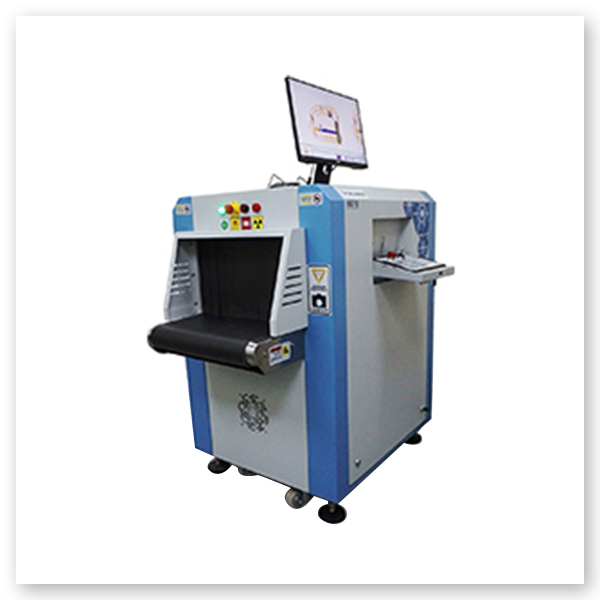
Security screening has quietly become part of everyday life at airports, in shopping malls, inside hospitals, and even at the entrance of corporate offices. As footfall grows and threats keep evolving, organisations are leaning more heavily on automated inspection tools. This is where the X-ray baggage scanner comes in. Most people walk past one without ever wondering what actually happens inside that steel tunnel, or what the operator on the other side of the monitor is really looking at.
So what exactly can this equipment see, and just as importantly, what can it miss? This guide answers
both questions in plain language, based on how these systems are actually built and used across
airports, campuses and commercial buildings in India and abroad.
What Is an X-Ray Baggage Scanner?
This security screening device creates a visual representation of a bag, box, or package’s contents without requiring anyone to open it by using regulated X-ray radiation. A detector array on the opposite side transforms the absorbed and transmitted radiation into a color-coded image on a monitor as the bag moves through the apparatus on a conveyor belt as X-ray beams pass through it.
The goal is straightforward: give a trained operator a fast, non-invasive technique to inspect what is inside a bag before it enters a protected environment. Airport check-in and boarding areas, metro and train stations, hotel lobbies, hospital entrances, courts, government buildings, data centers, factories, and, more and more, sizable corporate campuses and educational institutions all employ these units.
What Can an X-Ray Baggage Scanner Detect?
This is the question most people truly want answered. In general terms, these systems are built to signal anything unexpected in shape, density, or material composition. This comprises:
- Firearms and firearm parts
- Knives, blades and other sharp metal objects
- Explosive materials and explosive-like density patterns
- Ammunition and metallic rounds
- Electronic devices such as laptops, tablets and power banks
- Batteries, including lithium cells
- Liquids, gels and aerosols above certain volumes
- Organic material (food, textiles, paper)
- Inorganic material (metal, ceramics, glass)
- Mixed-material or layered items
- Unusually dense objects that block the X-ray beam
- Suspicious shapes that resemble known threat outlines
- Items that appear deliberately concealed inside other objects
Through color difference, operators are trained to read all of this. Inorganic (metallic) objects appear blue or green on most systems, organic stuff appears orange or amber, and thick or mixed material that the machine is unable to accurately classify is shown in a darker shade, frequently black or dark green, requiring closer examination.
How Does the Scanner Tell Materials Apart?
The colour distinction indicated above is feasible due of dual-energy X-ray technology. Instead of firing a single X-ray beam, the system delivers two beams of different energy levels through the bag. Organic and inorganic materials absorb these two energy levels differently, and the system uses that difference to work out what a given object is likely comprised of, even when numerous items are stacked on top of each other.
Here is a simplified view of how that colour mapping typically works:
| Material Type | Typical Colour | Examples |
| Organic | Orange / Amber | Food, paper, clothing, plastics |
| Inorganic | Blue / Green | Metal tools, coins, jewellery |
| Mixed / Dense | Black / Dark Green | Layered electronics, dense blocks, concealed items |
This is also the reason it’s more difficult to read a bag full of overlapping things. The operator loses part of the clarity that allows for quick decisions when items stack, causing their colors to blur. Before thinking that any scanner will catch everything on the first pass, it is important to recognize that this is a real constraint rather than a marketing afterthought.
Can It Detect Drugs?
In part. By detecting an organic material density that differs from the claimed contents of a bag or a suspicious shape concealed inside packaging, a baggage screening system can frequently identify narcotics indirectly. It is unable to verify a substance’s narcotic status chemically. Chemical composition is not depicted in the image; only shape, density, and material category are.
That is why narcotics detection worldwide is a layered procedure. The X-ray image raises a flag, and a trained officer, often accompanied by a physical search or a chemical trace detector, confirms what the drug actually is. It would not be feasible to rely just on the X-ray image because it would produce too many false positives and false negatives.
Does It Detect Cash or Gold?
Due to its density and metallic nature, gold is typically visible on screens. Depending on its quantity and packing method, it frequently appears as a bright, solid blue-green shape. Conversely, it is significantly more difficult to consistently identify loose cash. Because paper money is organic and thin, a stack of notes can mix in with other paper-based goods in a bag, such books or paperwork.
In summary, density and packing have a significant impact on visibility. A dense cluster of gold jewelery is easier to flag than a bundle of notes wrapped inside garments. Airports and customs offices still use manual checks and declaration forms instead of just the scanner image for financial or customs-related declarations.
Can It Detect Explosives?
This is one of the primary reasons the technology exists. Explosive materials tend to have a characteristic density signature that a trained operator, or an AI-assisted system, can distinguish even when the explosive is moulded into an unusual shape to evade detection.
Here, modern systems combine three layers of detection: shape recognition (matching outlines against known threat profiles), density analysis (determining how much the material blocks the X-ray beam), and increasingly, AI-assisted detection, which automatically highlights a suspicious area on screen in a bright color or outline box, drawing the operator’s attention to it right away rather than depending solely on human scanning speed.
Can Food and Liquids Be Detected?
Indeed. A packed lunch, fruit, or snacks are rarely difficult to recognize because food is organic and appears plainly in the orange-amber region on most systems. Although the system typically cannot distinguish between water, juice, or a chemical liquid based solely on the image, liquids are also visible. For this reason, rather than relying solely on the scan to determine what a liquid is, airport security continues to impose distinct volume restrictions and container regulations for liquids, gels, and aerosols.
What Cannot Be Reliably Detected?
Since exaggerating the capabilities of any screening device leads to a false sense of security, a responsible guide must be truthful about its limitations. There are actual gaps:
- An image by itself cannot verify the precise chemical identity of a substance (drugs, chemicals, or liquids).
- Items that are extremely thin or flat, such some plastic weapons or blades, may be more difficult to tell apart from regular goods.
- Sometimes recognition is delayed by objects that are purposefully packed or formed to resemble commonplace items.
- Smaller objects beneath larger ones may be hidden by extremely dense, overlapping bags.
- The scanner cannot prove intent — it flags items, not motives
For this reason, screening technology is not meant to be used as a stand-alone decision maker but rather in conjunction with qualified staff, supplementary manual checks, and, when necessary, explosive trace detection swabs.
Which Industries Benefit Most?
Although airports are the most obvious use case, baggage and parcel screening is already commonplace in a far wider range of settings:
- Airports and cargo terminals
- Metro and railway stations
- Hotels and hospitality venues
- Hospitals and healthcare campuses
- Shopping malls and retail complexes
- Government buildings and courts
- Corporate offices and IT campuses
- Manufacturing plants and industrial sites
- Educational institutions and examination centres
Procurement teams usually choose scanner parameters (tunnel size, penetration capabilities, throughput speed) based on the particular location rather than a one-size-fits-all strategy because each of these venues has a unique risk profile and foot traffic pattern.
Why Modern AI-Based Scanners Are More Accurate
Traditional X-ray screening still rely primarily on how alert and well-trained the operator is at any given moment, which is a serious constraint during long shifts or high-traffic periods. By handling some of the tedious pattern-recognition tasks, AI-assisted baggage screening technologies are altering that equation.
In practical terms, this manifests as real-time automatic threat recognition that highlights suspicious shapes, image enhancement that sharpens contrast on overlapping or dense objects, automatic alerts that flag a bag before the operator has consciously processed it, and a quantifiable decrease in false alarms when compared to manual-only screening. This type of AI-assisted screening equipment is developed by companies like Krystalvision with the specific goal of lowering operator fatigue and enhancing uniformity for each bag that travels through the tunnel.
Common Questions About X-Ray Baggage Screening
-
Can It Detect Mobile Phones?
Yes, easy. Travelers are frequently asked to remove gadgets and place them separately for screening at busier gates because mobile phones feature a dense combination of metal and circuitry that sticks out sharply against most bag contents.
-
Does It Detect Gold?
Since gold is metallic and dense, the answer is usually yes. Depending on how they are placed inside the bag, smaller items like thin gold chains may be less noticeable than a solid block or a collection of jewelry.
-
Can It Detect Plastic Weapons?
This is more difficult. Many plastic weapons and blades have a lesser density than metal, hence they might occasionally resemble ordinary plastic items on screen. This is one of the known shortcomings with X-ray-only screening, which contributes to the continued use of metal detectors and supplementary inspections at high-security locations.
-
What About Lithium Batteries?
Airlines prohibit loose lithium batteries in checked baggage because batteries are typically visible due to their dense, layered internal structure. The scanner can flag the shape, but battery-specific constraints exist mostly because of fire risk, not detection difficulty.
-
Can Airport X-Ray Machines Detect Hidden Compartments?
Often, yes. A false bottom, a lined pocket, or a hollowed-out item frequently causes an abnormal density pattern or an unexplained gap in the image, which expert operators are trained to notice. It is not assured on every attempt, which is why customs and security officers still combine scanning with physical inspection for high-risk bags.
-
How Accurate Is an X-Ray Baggage Scanner?
Three interrelated elements determine accuracy: the hardware’s quality, the operator’s proficiency, and if the system incorporates AI-assisted detection. Although no screening device anywhere claims 100% detection for every potential scenario, a well-maintained, AI-supported unit run by a qualified operator can achieve very high detection rates for typical danger categories.
-
Can It Detect All Electronic Devices?
Baggage and package scanners are constructed and tested in accordance with accepted radiation safety standards. They are shielded devices where the X-ray beam remains contained within the tunnel. Operators and onlookers near a baggage unit are not exposed to the beam during regular operation, in contrast to full-body scanners.
-
Does It Catch Every Threat?
No single machine does, and any vendor stating otherwise should be handled with caution. That is precisely why layered security, screening plus trained personnel plus, when appropriate, manual search or trace detection, remains the industry norm rather than relying on any one piece of equipment in isolation.
Conclusion
An X-ray baggage scanner is actually good at what it is supposed to do: flagging weapons, explosives thick or strange shapes, and a wide range of organic and inorganic materials, rapidly and without opening a single suitcase. It is not and was never intended to be a stand-alone system that can independently verify chemical identity, intent, or ensure a zero-miss outcome. What distinguishes a truly secure checkpoint from one that merely appears secure on paper is an understanding of both sides of that equation, what it detects, and where it requires human support.