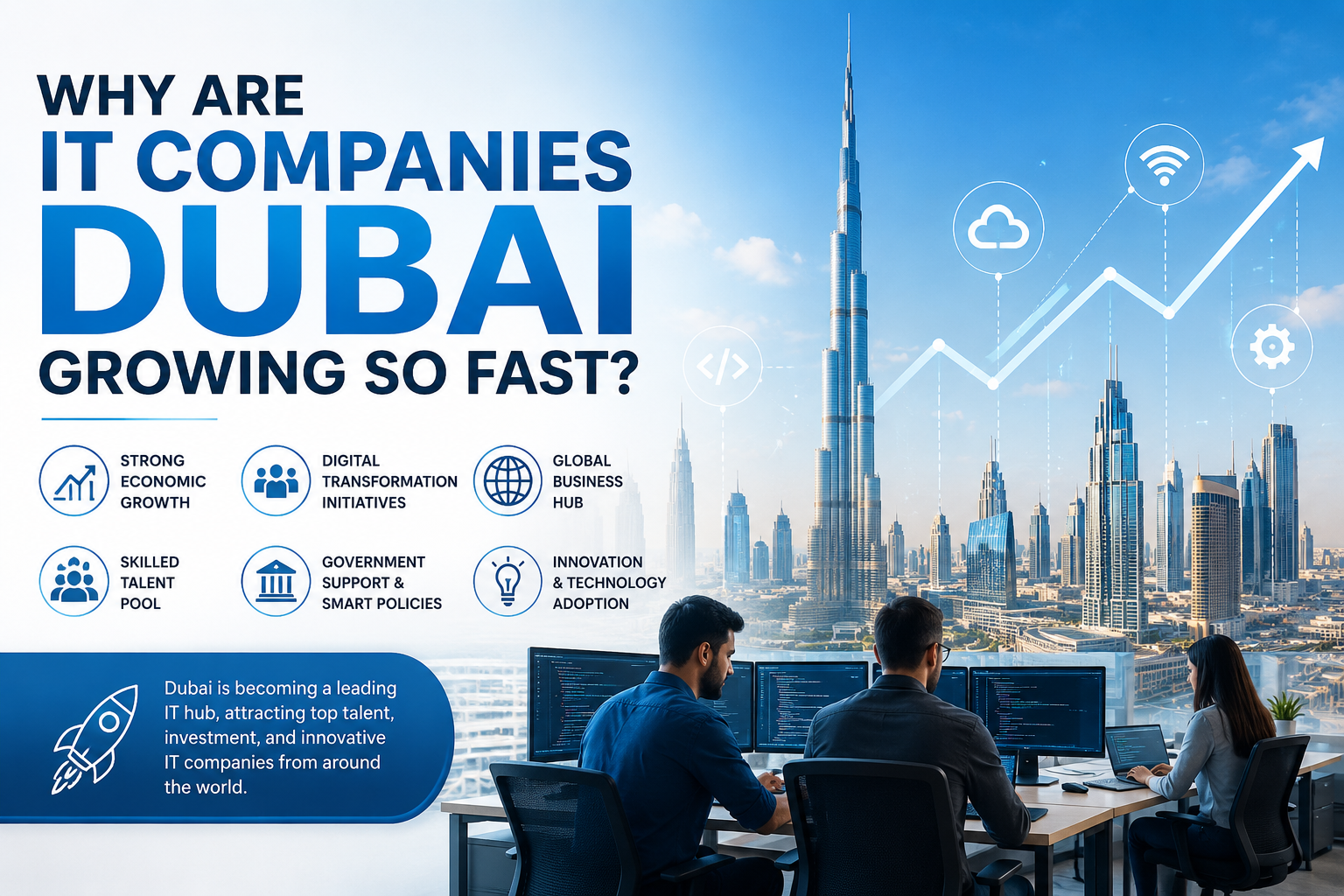
IT Companies Dubai has quietly transformed itself from a trading and tourism hub into one of the most dynamic technology ecosystems in the world. Walk through Dubai Internet City, Dubai Silicon Oasis, or the newer free zones springing up across the emirate, and you’ll find everything from scrappy startups to the regional headquarters of Microsoft, Oracle, SAP, and Amazon Web Services. The UAE’s broader ICT market is now valued well above $50 billion and continues to grow at a double-digit pace year over year, making it one of the fastest-expanding tech markets in the Middle East.
So what exactly is driving this boom? The answer isn’t one single factor — it’s a combination of government vision, favorable business policy, geographic advantage, and a talent strategy that few cities in the world can match.
1. A Government That Treats Technology as a National Priority
Unlike many economies where tech growth happens organically and government policy plays catch-up, Dubai’s government has been the primary architect of its own digital transformation. Initiatives like Smart Dubai, Dubai 10X, and the UAE AI Strategy 2031 were designed years in advance to position the emirate as a global leader in artificial intelligence, blockchain, and smart city infrastructure.
The Dubai Future Foundation actively funds and incubates emerging technologies, while government-backed programs continuously push public services onto digital platforms — the “Dubai Now” app, for instance, lets residents pay bills, renew licenses, and access dozens of government services from a single interface. This isn’t just convenient for citizens; it creates a constant stream of large-scale digital transformation contracts that local and international IT firms compete for, fueling steady revenue growth across the sector.
2. Free Zones and Tax Advantages That Attract Global Players
Dubai’s free zones — particularly Dubai Internet City, Dubai Silicon Oasis, and in5 — offer IT companies benefits that are hard to find elsewhere: 100% foreign ownership, zero or minimal corporate tax in qualifying zones, no currency restrictions, and streamlined licensing processes that can take days rather than months.
These zones function almost like technology ecosystems in miniature, clustering companies, investors, and talent in close proximity. A startup can set up shop within walking distance of a multinational cloud provider, a venture capital office, and a coding academy — all within the same free zone. This density accelerates partnerships, hiring, and deal-making in ways that dispersed cities can’t replicate.
3. Strategic Geography and Global Connectivity
Dubai sits at the crossroads of Europe, Asia, and Africa, within an eight-hour flight of roughly two-thirds of the world’s population. For IT companies serving multinational clients, this location is a genuine operational advantage — it allows a single regional office to support clients across three continents without the time-zone friction that plagues remote-first arrangements elsewhere.
This connectivity extends to digital infrastructure as well. The UAE has continued to attract major investment into data centers, with global players such as AWS, Google, and Microsoft expanding their regional cloud capacity in the country. More data centers mean lower latency, better cloud service reliability, and a stronger case for enterprises to base their regional IT operations in Dubai rather than routing everything through Europe or Asia.
4. A Deliberate Strategy to Import Global Talent
Perhaps the most underrated driver of Dubai’s IT growth is its aggressive talent strategy. The technology sector runs on skilled engineers, data scientists, and product managers — and Dubai has made it remarkably easy for that talent to relocate.
The Golden Visa program offers long-term residency to skilled professionals and investors, removing one of the biggest barriers that typically slows down tech hiring in other markets: visa uncertainty. Combined with a tax-free personal income structure, competitive salaries, and a high standard of living, Dubai has become genuinely attractive to engineers and executives who might otherwise gravitate toward Singapore, London, or Silicon Valley.
This has created a virtuous cycle: as more skilled professionals move to Dubai, more companies open offices there to access that talent pool, which in turn attracts even more professionals looking for opportunities.
5. A Booming Startup and Investment Culture
Dubai’s IT growth isn’t just about multinational branch offices — it’s increasingly homegrown. Companies like Careem (ride-hailing and super-app services) and a growing wave of fintech startups have shown that Dubai can produce globally competitive technology companies, not just host foreign ones.
Venture capital activity in the region has picked up substantially, with local startups securing record funding rounds in sectors like fintech, healthtech, and payments. Government-backed accelerators and incubators, along with a growing base of angel investors and regional VC funds, have made it easier for founders to raise capital without leaving the region. This matters because a strong startup ecosystem doesn’t just create new companies — it also produces experienced talent who later join or found other tech ventures, deepening the overall talent pool.
6. Diversification Away From Oil-Dependent Growth
The UAE’s long-term economic strategy has explicitly prioritized diversification away from oil revenue, and technology is one of the primary beneficiaries of that shift. Government investment that might once have gone into traditional infrastructure or energy projects is increasingly directed toward digital infrastructure, smart city initiatives, and technology education.
This isn’t a short-term trend — it’s a structural shift in how the UAE plans to generate economic value over the coming decades. That kind of long-term government commitment gives IT companies confidence that today’s growth isn’t a temporary bubble, but part of a sustained national strategy.
7. Sector-Specific Momentum: AI, Fintech, and Cybersecurity
Within the broader IT boom, a few sectors stand out as particular growth engines:
- Artificial Intelligence — Backed by national AI strategy targets, companies specializing in AI-driven solutions for healthcare, logistics, and government services are seeing outsized demand.
- Fintech — Dubai’s ambition to become a global financial hub has created strong demand for digital payment platforms, blockchain-based financial products, and regtech solutions.
- Cybersecurity — As government and enterprise digital transformation accelerates, so does the need to secure that infrastructure, making cybersecurity one of the fastest-growing IT services categories in the emirate.
What This Means for Businesses and Job Seekers
For businesses, Dubai’s growth signals an increasingly competitive but opportunity-rich market — one where global enterprises, agile local players, and government contracts all coexist. For job seekers and entrepreneurs, it represents a rare combination of favorable tax policy, quality of life, and genuine career opportunity in emerging fields like AI and fintech.
Final Thoughts
Dubai’s IT sector isn’t growing by accident. It’s the product of a deliberate, decades-long strategy that combines smart government policy, business-friendly regulation, world-class connectivity, and an aggressive approach to attracting global talent and capital. As the UAE continues investing in AI, cloud infrastructure, and digital government services, there’s little reason to expect this momentum to slow down anytime soon. For companies and professionals looking at where the next major technology hub will emerge, Dubai has already made its case.