So you’ve finished 12th and now everyone around you is asking the same question — “What’s next?” Engineering? Commerce? Medicine? But you’ve always been the one doodling in notebooks, obsessing over fonts, or wondering why some logos just feel right.
Here’s the thing — that instinct is worth something. And graphic design courses after 12th might be exactly where it leads.
Why Graphic Design is Actually a Solid Career Choice
Let’s be honest. Five years ago, parents weren’t exactly thrilled when their kid said “I want to do design.” But things have changed — fast. Every brand today needs content. Every startup needs a visual identity. Every product needs packaging, ads, and a website that doesn’t look like it was built in 2005.
Graphic designers are no longer just people who “make things pretty.” They solve problems visually. And companies are paying well for that skill.
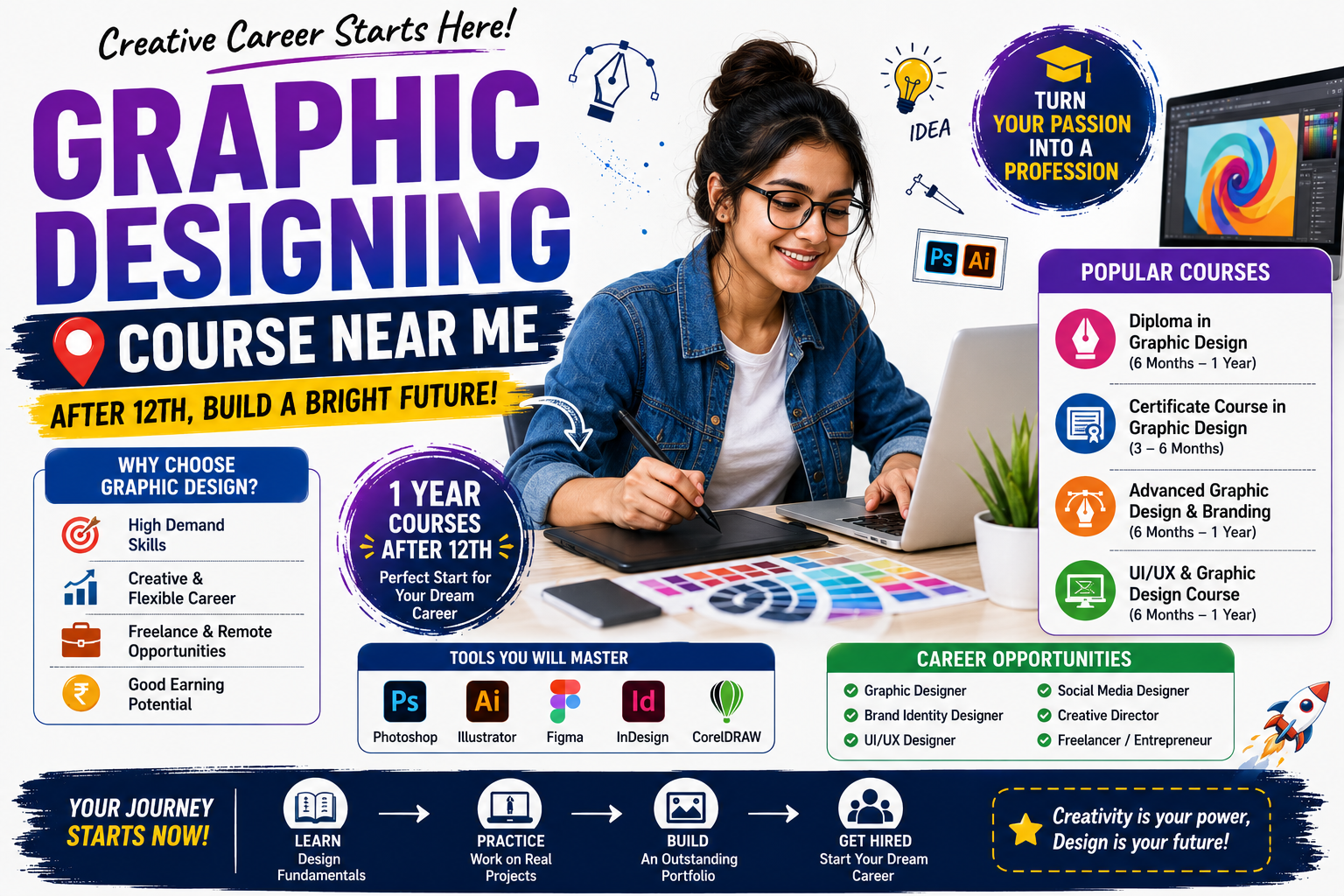
Types of Graphic Design Courses You Can Pursue After 12th
There’s no single path here. Depending on how much time and money you want to invest, you’ve got a few solid options.
Bachelor’s Degree Programs (3–4 Years)
If you want the full, structured route, a B.Des (Bachelor of Design) or BFA in Graphic Design is the gold standard. Institutions like NID (National Institute of Design), MIT Institute of Design, and several private colleges offer these programs.
You’ll cover everything — typography, color theory, branding, UI/UX, illustration, and more. Plus, the network you build during these years? Genuinely valuable.
Entry usually requires clearing entrance exams like NID DAT, CEED, or college-specific tests.
Diploma & Certificate Courses (6 Months – 1 Year)
Not everyone wants to spend four years on one subject — totally fair. Short-term diploma courses in graphic design from institutes like Arena Animation, MAAC, or Frameboxx are popular for a reason. They’re focused, practical, and get you job-ready faster.
These work especially well if you’re already doing something else alongside — like a BCom or BA — and want to build a skill on the side.
Online Courses
Honestly, some of the best graphic design education today is online. Platforms like Coursera, Skillshare, and Canva’s own design school offer beginner-to-advanced programs. If you’re self-disciplined, you can learn industry-standard tools like Adobe Photoshop, Illustrator, and InDesign at your own pace — often at a fraction of the cost.
The catch? You’ll need to hustle harder to build your portfolio and get noticed.
What You Actually Learn in These Courses
Theory is one part, but the real stuff is in the doing. Most graphic design programs after 12th will teach you:
- Typography — how to use fonts to communicate mood, tone, and hierarchy
- Color theory — why certain colors work together and why others fight
- Branding & identity design — creating logos, visual systems, and brand guidelines
- Print design — posters, flyers, brochures, packaging
- Digital design — social media graphics, web assets, ad creatives
- Software skills — Adobe Creative Suite is the industry standard, but Figma is increasingly important too
What Stream Do You Need to Have in 12th?
Here’s the good news — you don’t need to be from a science or commerce background. Most graphic design courses after 12th are open to students from any stream, as long as you have a basic interest in art and design.
Some top institutes do have portfolio-based selection or entrance exams, but they’re testing your creative thinking, not your math scores.
Skills That’ll Actually Make You Stand Out
Courses will teach you tools. But what separates an average designer from a great one is harder to teach:
- Curiosity about visual culture (look at design around you — really look)
- The ability to take feedback without taking it personally
- A habit of building and sharing your work publicly
- Understanding what the client actually needs (not just what they say they want)
Is It Worth It?
If you’re genuinely interested in visual communication, storytelling through design, and building things people actually see and react to — yes, absolutely. Graphic design courses after 12th give you a real, transferable skill in a world that runs on content.
Just don’t pick it because it “seems easy.” It’s creative work, and creative work is demanding in ways that a timetable won’t always show you.
But if it’s your thing? Go all in.
Graphic Design Courses After 12th — What Nobody Tells You Before You Enroll
So you’ve finished 12th and now everyone around you is asking the same question — “What’s next?” Engineering? Commerce? Medicine? But you’ve always been the one doodling in notebooks, obsessing over fonts, or wondering why some logos just feel right.
Here’s the thing — that instinct is worth something. And graphic design courses after 12th might be exactly where it leads.
Why Graphic Design is Actually a Solid Career Choice
Let’s be honest. Five years ago, parents weren’t exactly thrilled when their kid said “I want to do design.” But things have changed — fast. Every brand today needs content. Every startup needs a visual identity. Every product needs packaging, ads, and a website that doesn’t look like it was built in 2005.
Graphic designers are no longer just people who “make things pretty.” They solve problems visually. And companies are paying well for that skill.
Types of Graphic Design Courses You Can Pursue After 12th
There’s no single path here. Depending on how much time and money you want to invest, you’ve got a few solid options.
Bachelor’s Degree Programs (3–4 Years)
If you want the full, structured route, a B.Des (Bachelor of Design) or BFA in Graphic Design is the gold standard. Institutions like NID (National Institute of Design), MIT Institute of Design, and several private colleges offer these programs.
You’ll cover everything — typography, color theory, branding, UI/UX, illustration, and more. Plus, the network you build during these years? Genuinely valuable.
Entry usually requires clearing entrance exams like NID DAT, CEED, or college-specific tests.
Diploma & Certificate Courses (6 Months – 1 Year)
Not everyone wants to spend four years on one subject — totally fair. Short-term diploma courses in graphic design from institutes like Arena Animation, MAAC, or Frameboxx are popular for a reason. They’re focused, practical, and get you job-ready faster.
These work especially well if you’re already doing something else alongside — like a BCom or BA — and want to build a skill on the side.
Online Courses
Honestly, some of the best graphic design education today is online. Platforms like Coursera, Skillshare, and Canva’s own design school offer beginner-to-advanced programs. If you’re self-disciplined, you can learn industry-standard tools like Adobe Photoshop, Illustrator, and InDesign at your own pace — often at a fraction of the cost.
The catch? You’ll need to hustle harder to build your portfolio and get noticed.
What You Actually Learn in These Courses
Theory is one part, but the real stuff is in the doing. Most graphic design programs after 12th will teach you:
- Typography — how to use fonts to communicate mood, tone, and hierarchy
- Color theory — why certain colors work together and why others fight
- Branding & identity design — creating logos, visual systems, and brand guidelines
- Print design — posters, flyers, brochures, packaging
- Digital design — social media graphics, web assets, ad creatives
- Software skills — Adobe Creative Suite is the industry standard, but Figma is increasingly important too
What Stream Do You Need to Have in 12th?
Here’s the good news — you don’t need to be from a science or commerce background. Most graphic design courses after 12th are open to students from any stream, as long as you have a basic interest in art and design.
Some top institutes do have portfolio-based selection or entrance exams, but they’re testing your creative thinking, not your math scores.
Skills That’ll Actually Make You Stand Out
Courses will teach you tools. But what separates an average designer from a great one is harder to teach:
- Curiosity about visual culture (look at design around you — really look)
- The ability to take feedback without taking it personally
- A habit of building and sharing your work publicly
- Understanding what the client actually needs (not just what they say they want)
Is It Worth It?
If you’re genuinely interested in visual communication, storytelling through design, and building things people actually see and react to — yes, absolutely. Graphic design courses after 12th give you a real, transferable skill in a world that runs on content.
Just don’t pick it because it “seems easy.” It’s creative work, and creative work is demanding in ways that a timetable won’t always show you.
But if it’s your thing? Go all in.
So you’ve finished 12th and now everyone around you is asking the same question — “What’s next?” Engineering? Commerce? Medicine? But you’ve always been the one doodling in notebooks, obsessing over fonts, or wondering why some logos just feel right.
Here’s the thing — that instinct is worth something. And graphic design courses after 12th might be exactly where it leads.
Why Graphic Design is Actually a Solid Career Choice
Let’s be honest. Five years ago, parents weren’t exactly thrilled when their kid said “I want to do design.” But things have changed — fast. Every brand today needs content. Every startup needs a visual identity. Every product needs packaging, ads, and a website that doesn’t look like it was built in 2005.
Graphic designers are no longer just people who “make things pretty.” They solve problems visually. And companies are paying well for that skill.
Types of Graphic Design Courses You Can Pursue After 12th
There’s no single path here. Depending on how much time and money you want to invest, you’ve got a few solid options.
Bachelor’s Degree Programs (3–4 Years)
If you want the full, structured route, a B.Des (Bachelor of Design) or BFA in Graphic Design is the gold standard. Institutions like NID (National Institute of Design), MIT Institute of Design, and several private colleges offer these programs.
You’ll cover everything — typography, color theory, branding, UI/UX, illustration, and more. Plus, the network you build during these years? Genuinely valuable.
Entry usually requires clearing entrance exams like NID DAT, CEED, or college-specific tests.
Diploma & Certificate Courses (6 Months – 1 Year)
Not everyone wants to spend four years on one subject — totally fair. Short-term diploma courses in graphic design from institutes like Arena Animation, MAAC, or Frameboxx are popular for a reason. They’re focused, practical, and get you job-ready faster.
These work especially well if you’re already doing something else alongside — like a BCom or BA — and want to build a skill on the side.
Online Courses
Honestly, some of the best graphic design education today is online. Platforms like Coursera, Skillshare, and Canva’s own design school offer beginner-to-advanced programs. If you’re self-disciplined, you can learn industry-standard tools like Adobe Photoshop, Illustrator, and InDesign at your own pace — often at a fraction of the cost.
The catch? You’ll need to hustle harder to build your portfolio and get noticed.
What You Actually Learn in These Courses
Theory is one part, but the real stuff is in the doing. Most graphic design programs after 12th will teach you:
- Typography—how to use fonts to communicate mood, tone, and hierarchy
- Color theory — why certain colors work together and why others fight
- Branding & identity design — creating logos, visual systems, and brand guidelines
- Print design—posters, flyers, brochures, packaging
- Digital design—social media graphics, web assets, ad creatives
- Software skills—Adobe Creative Suite is the industry standard, but Figma is increasingly important too
What Stream Do You Need to Have in 12th?
Here’s the good news — you don’t need to be from a science or commerce background. Most graphic design courses after 12th are open to students from any stream, as long as you have a basic interest in art and design.
Some top institutes do have portfolio-based selection or entrance exams, but they’re testing your creative thinking, not your math scores.
Skills That’ll Actually Make You Stand Out
Courses will teach you tools. But what separates an average designer from a great one is harder to teach:
- Curiosity about visual culture (look at design around you — really look)
- The ability to take feedback without taking it personally
- A habit of building and sharing your work publicly
- Understanding what the client actually needs (not just what they say they want)
Is It Worth It?
If you’re genuinely interested in visual communication, storytelling through design, and building things people actually see and react to — yes, absolutely. Graphic design courses after 12th give you a real, transferable skill in a world that runs on content.
Just don’t pick it because it “seems easy.” It’s creative work, and creative work is demanding in ways that a timetable won’t always show you.
But if it’s your thing? Go all in.