Every business faces problems such as falling sales, delayed projects, customer complaints, or rising costs. Solving these issues quickly is important, but finding the real reason behind them is even more valuable. This is where root cause analysis helps. Instead of fixing only the visible problem, it focuses on identifying the actual reason the problem happened. Data plays a major role in making this process more accurate and reliable. If you want to build practical skills in this area, you can explore Data Analytics Courses in Bangalore at FITA Academy to strengthen your knowledge and apply these techniques with confidence.
Root cause analysis using data helps organizations make informed decisions instead of relying on assumptions. By studying facts, trends, and patterns, teams can discover hidden issues and create solutions that prevent the same problem from happening again. This approach saves time, reduces costs, and improves overall business performance.
What is Root Cause Analysis?
Root cause analysis is a technique employed to determine the primary cause of an issue. Instead of addressing only the symptoms, it looks deeper to understand why the issue occurred. After pinpointing the root cause, companies can execute sustainable solutions instead of quick fixes.
For example, if a company experiences frequent product returns, the problem may not simply be poor product quality. The actual cause could be incorrect packaging, manufacturing defects, or unclear product instructions. Data helps identify which factor contributes the most to the issue.
Why Data is Important in Root Cause Analysis
Data provides evidence that supports decision-making. Without data, people may rely on personal opinions or guesswork, which can lead to incorrect conclusions. Reliable data allows analysts to understand what happened, when it happened, and how often it occurred.
Different types of data can be used depending on the situation. Sales records, customer feedback, production reports, website analytics, and employee performance data all provide useful insights. Combining these data sources often gives a more complete picture of the problem.
Steps to Perform Root Cause Analysis Using Data
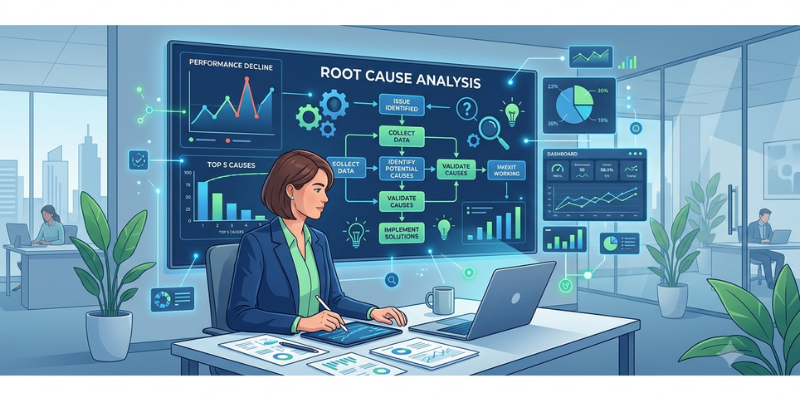
The first step is to clearly define the problem. A well-defined problem helps teams focus on the right information instead of collecting unnecessary data.
The next step is gathering relevant data from reliable sources. The quality of the analysis depends on the accuracy of the data collected. Missing or incorrect information can lead to poor decisions.
After collecting the data, analysts organize and examine it for patterns, trends, and unusual changes. Charts, tables, and summary statistics make it easier to identify possible causes.
Once the possible causes are identified, each one should be tested using available evidence. This process helps eliminate incorrect assumptions and confirms the actual root cause. If you would like to improve your practical analysis skills, join a Data Analytics Course in Hyderabad to gain experience with real business scenarios and analytical methods.
Common Techniques Used
Several techniques support root cause analysis. One popular method is the Five Whys technique, where repeated “why” questions help uncover the underlying cause of a problem.
Another useful method is the Fishbone Diagram, which organizes possible causes into categories such as people, processes, equipment, materials, and environment. This makes it easier to examine every possible factor.
Trend analysis is also valuable because it shows how performance changes over time. Comparing historical data often reveals recurring issues that may otherwise go unnoticed.
Benefits of Root Cause Analysis Using Data
Using data for root cause analysis offers many advantages. It improves decision-making because solutions are based on facts rather than opinions. It also reduces repeated problems by addressing the actual cause instead of only the symptoms.
Businesses can improve customer satisfaction, increase operational efficiency, reduce unnecessary costs, and enhance product quality. Teams also gain confidence in their decisions because they have clear evidence to support their actions.
Another important benefit is continuous improvement. As organizations collect and analyze more data, they become better at identifying risks early and preventing future problems before they grow larger.
Root cause analysis using data is an essential skill for modern businesses. It helps organizations move beyond surface-level solutions and identify the real reasons behind challenges. By collecting accurate data, analyzing patterns, and testing possible causes, businesses can make smarter decisions and achieve lasting improvements. Mastering these concepts enhances your analytical thinking skills and equips you to tackle real-world business challenges with assurance. If you are ready to develop these valuable skills, enroll in a Data Analytics Course in Ahmedabad to expand your expertise and advance your career.