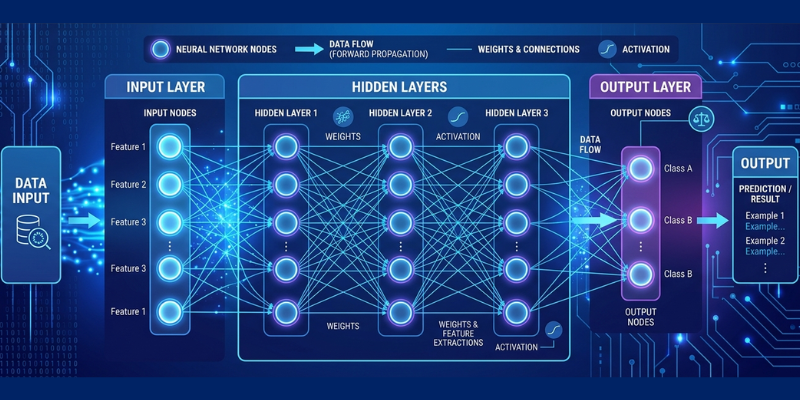
Deep learning has become one of the most important areas of artificial intelligence. It powers applications such as image recognition, speech assistants, language translation, and recommendation systems. While many people use technologies built on deep learning every day, understanding how these models work can seem difficult at first. Learning the core architecture of deep learning models helps beginners understand how machines process information and make intelligent decisions. If you want to build a strong foundation in this field, you can take an Artificial Intelligence Course in Trivandrum at FITA Academy to develop practical knowledge and skills.
What is a Deep Learning Model
A deep learning model is a category of machine learning system that identifies patterns from extensive datasets. It is designed to imitate certain aspects of how the human brain processes information. Instead of relying on manually created rules, the model learns by analyzing examples and improving its performance over time.
The word “deep” denotes the various layers incorporated in the model. These layers work together to transform raw data into meaningful insights. As information moves through the layers, the model gradually identifies important features and patterns.
Understanding Neural Networks
The foundation of every deep learning model is a neural network. A neural network is made up of nodes that are connected to one another, commonly referred to as neurons. These neurons receive information, process it, and pass it to other neurons.
Neural networks are generally structured into three primary components. The first section is the input layer, which receives the raw data. The second section contains one or more hidden layers that process the information. The final section is the output layer, which generates the prediction or result.
Each connection between neurons has a value called a weight. These weights help determine the importance of different pieces of information. Throughout the training process, the model modifies these weights to enhance its precision.
The Role of Hidden Layers
Hidden layers are the most important part of a deep learning architecture. They allow the model to learn complex relationships within data. A simple model may identify basic patterns, while deeper models can recognize highly detailed features.
For example, when analyzing an image, the first hidden layer may detect edges and shapes. The next layer may identify parts of objects. Deeper layers can eventually recognize complete objects such as cars, animals, or faces.
The presence of multiple hidden layers enables deep learning models to solve tasks that would be difficult for traditional machine learning methods. To achieve a more profound comprehension of these ideas via structured learning, join the Artificial Intelligence Course in Kochi and strengthen your expertise with practical experience.
How Deep Learning Models Learn
Deep learning models acquire knowledge via a procedure known as training. During training, the model receives input data along with the correct answers. It makes predictions and compares them with the expected results.
When the prediction is incorrect, the model calculates the error and adjusts its weights. This process is repeated many times until the model becomes more accurate. The objective is to minimize mistakes and enhance performance on fresh data.
A large amount of quality data is often required for successful training. More examples help the model recognize patterns more effectively and make better predictions.
Activation Functions and Output Generation
Activation functions are crucial in the functioning of neural networks. They help determine whether a neuron should pass information to the next layer. Without activation functions, deep learning models would struggle to learn complex relationships.
After information passes through all layers, the output layer produces the final result. Depending on the application, the output may be a category, a prediction, or a numerical value. This flexibility allows deep learning models to support a wide range of real-world applications.
The core architecture of deep learning models is built on neural networks, layers, weights, activation functions, and continuous learning. Each component works together to transform data into useful predictions and insights. Understanding these building blocks provides a solid starting point for anyone interested in artificial intelligence and machine learning. As deep learning continues to shape modern technology, learning its architecture can open the door to exciting opportunities in the field. If you are ready to advance your knowledge and practical skills, consider enrolling in an Artificial Intelligence Course in Pune to accelerate your learning journey.